
When Should You Send Wedding Invitations?
For a standard local wedding, send invitations 6 to 8 weeks before the wedding date. If you skipped save the dates, bump that to 10 to 12 weeks. Destination weddings need 12 to 16 weeks minimum, and international guests need at least 6 months if they require a visa. Set your RSVP deadline 3 to 4 weeks before the wedding so you have time to give final numbers to your caterer and venue.
Most couples spend months planning every detail of their wedding and then scramble at the last minute with invitations. It happens more than you think. The invitation timing window is tighter than it feels, and getting it wrong either leaves guests with no time to plan or risks the envelope sitting in a drawer until it is too late to matter.
This guide covers every scenario: local weddings, destination weddings, holiday weekends, weekday ceremonies, short engagements, and everything in between. You will also find a full month-by-month timeline, envelope addressing etiquette, wording templates, and the most common mistakes that tank attendance.
The Standard Rule: 6 to 8 Weeks Before the Wedding

For most couples planning a local wedding where the majority of guests live within driving distance, 6 to 8 weeks is the standard window. It gives guests enough time to sort childcare, request time off work, and make any short travel arrangements without so much lead time that the invitation gets buried or forgotten.
Eight weeks is the safer end of that range. Six weeks works only when your entire guest list is local and you already sent save the dates. If even a handful of people are traveling, give yourself the full 8 weeks.
Here is the quick reference breakdown before we get into the details:
| Wedding Scenario | When to Send |
|---|---|
| Standard local wedding (save the dates sent) | 6 to 8 weeks out |
| No save the dates sent | 10 to 12 weeks out |
| Destination wedding | 12 to 16 weeks out |
| International guests needing visas | 6 months out |
| Holiday weekend wedding | 10 to 12 weeks out |
| Weekday wedding | 8 to 10 weeks out |
| Short engagement (under 6 months) | Send immediately, 10 to 12 weeks if possible |
| RSVP deadline | 3 to 4 weeks before the wedding |
Wedding Invitation Timing by Wedding Type

The 6 to 8 week rule shifts depending on your specific situation. Guest travel distance, whether you sent save the dates, holiday conflicts, and your venue location all affect what the right window looks like for your wedding specifically.
Local Wedding
A local wedding is any event where most guests live within two to three hours by car. The 6 to 8 week window covers this comfortably. Eight weeks is the smarter default because even in a mostly local guest list, a few people are usually traveling, and they appreciate the extra breathing room.
If you already sent save the dates and your guest list is entirely local, 6 weeks is fine. If you skipped save the dates, push out to 10 to 12 weeks so the invitation carries the full weight of both pieces.
Destination Wedding
Destination weddings need a minimum of 12 to 16 weeks notice. Flights, hotels, and rental cars book up fast, and your guests are being asked to plan a trip around your event. The earlier you give them that window, the better the flight prices they can find, and the more likely they are to actually attend.
International guests who need visas are a separate category. Those guests need their invitations at least 6 months before the wedding. Visa processing timelines vary a lot by country, and some embassy appointments take weeks to schedule. US passport renewal runs 6 to 8 weeks under standard processing, so guests who need to renew a passport need that buffer stacked on top of your send date.
One thing couples miss: if your destination wedding overlaps with your honeymoon departure, guests will often want to book their return flight and accommodation in one go. Giving them 4 months minimum means they can catch early booking rates rather than paying peak prices because notice came too late.
Guests traveling to EU countries, Mexico, and most Caribbean destinations with a US, UK, Canadian, or Australian passport generally do not need advance visas. Guests traveling to India, China, Russia, Brazil, or parts of Africa will need visas that can take 4 to 8 weeks to process. If any guests on your list fall into that category, flag it clearly on your invitation details insert or wedding website.
Holiday Weekend Wedding
Holiday weekends, Labor Day, Thanksgiving, New Year’s, Fourth of July, require 10 to 12 weeks notice. No exceptions. Holiday flights get booked months out, hotels near popular venues sell out fast, and guests with families usually have competing plans already locked in well in advance. The extra lead time has a direct impact on your attendance rate.
If you are planning a holiday weekend wedding and have not sent invitations yet, this is the one scenario where you should go out the door immediately regardless of where you land in that window.
Weekday Wedding
Weekday weddings need 8 to 10 weeks notice, not because of travel logistics but because of scheduling complexity. Guests need time to formally request time off work, and that process alone takes longer than most people think. In most corporate environments a time-off request goes through a manager, sometimes a second approval layer, and then into a scheduling system. That process takes 1 to 2 weeks at many companies before the employee can even confirm they are free.
If a significant portion of your guest list works in industries with busy seasons, accounting in Q1, retail in Q4, teachers in June and September, factor that in. A weekday wedding during tax season or the holiday retail rush is going to see lower attendance no matter how much notice you give, so 10 weeks out is the safer target for those guest profiles.
Short Engagement
With a short engagement under 4 to 6 months, skip save the dates entirely and go straight to formal invitations at 10 to 12 weeks out. The invitation does the work of both pieces. For very short engagements under 8 weeks out from the wedding, send immediately.
Consider calling or texting your closest guests before the formal invitation arrives. They appreciate the personal heads-up and it gives you an early read on who can make it before you finalize numbers. All-in-one invitation suites work well here because they combine the invitation, RSVP, and details on a single card, which saves production and assembly time.
For more ideas on keeping costs and timelines manageable, see our guide on budget wedding ideas that do not look cheap.
Save the Dates vs. Wedding Invitations: What Is the Difference?

Save the dates are an early heads-up. They do not need full details, just the date, a location hint, and your wedding website URL. Wedding invitations are the official piece containing everything guests need: venue, time, dress code, and RSVP instructions.
Many couples treat save the dates as optional. For destination weddings, holiday weekends, and large guest lists with many out-of-town guests, they are not optional. For small local weddings under 30 people or very short engagements, they can be skipped entirely without hurting attendance.
| Save the Date | Wedding Invitation | |
|---|---|---|
| When to send | 6 to 12 months out | 6 to 8 weeks out |
| What it includes | Date, location hint, wedding website | Full venue details, time, dress code, RSVP |
| Required? | Recommended, not required | Always required |
| Format options | Card, magnet, postcard, digital | Paper suite, digital, all-in-one |
| Skippable? | Yes, for small local weddings | No |
The Full Wedding Invitation Timeline Month by Month

This is your master checklist from the moment you set the date through the week of the wedding. Use it to stay ahead rather than catching up.
12 Months Out
Lock in your venue and wedding date. For destination weddings and holiday weekend weddings, send save the dates immediately. Start browsing invitation styles and shortlisting designers or print vendors. This is also the time to start a dedicated planning system, whether that is a notebook, binder, or app, so every vendor quote, guest address, and deadline lives in one place.
9 to 10 Months Out
Send save the dates for standard local weddings. Finalize your guest list now, because the invitation count determines your print order size. Start collecting guest mailing addresses. This part takes longer than expected. People move, names change after marriages, and some contacts go through multiple family members before you land on the right address.
4 to 6 Months Out
Finalize invitation wording, design, and suite components. Place your print order. Design approval plus production plus shipping equals a minimum of 4 to 6 weeks for most vendors, so couples who wait until 8 weeks out and start ordering then often end up mailing at 4 weeks, which is too late. Order 10 to 15 percent more than your guest count for addressing mistakes, damaged envelopes, and last-minute additions. If you are using a calligrapher for addressing, book them now because good calligraphers fill up months ahead.
8 to 12 Weeks Out
Invitations arrive from the printer. Assemble full suites: invitation, RSVP card, details insert, and envelopes. Before you buy stamps for 150 envelopes, take one fully assembled suite to the post office and weigh it. A standard invitation suite almost always weighs more than a standard letter. Buying regular stamps without checking results in returned envelopes, and there is nothing more frustrating than realizing it two weeks later.
6 to 8 Weeks Out
Mail your invitations. Track delivery through USPS Informed Delivery so you know when they start landing in mailboxes. Begin logging RSVPs as they come back. Mail on a Monday or Tuesday. Weekend postal backlogs add 1 to 2 days to delivery times and pieces dropped on Friday or Saturday often sit until Monday anyway.
2 to 4 Weeks Before the RSVP Deadline
Send a reminder to anyone who has not responded. A short text or direct message works better than email for close family and friends. Keep the tone light and practical. You are not following up to make them feel guilty; you are following up because you genuinely need the number for your caterer.
3 to 4 Weeks Out
RSVP deadline passes. Submit your final headcount to the venue and caterer. Follow up on any remaining non-responders. Expect 10 to 15 percent of guests to miss your deadline regardless of how clearly you communicated it. Plan your numbers with that buffer in mind.
1 to 2 Weeks Out
Finalize the seating chart and confirm final numbers with all vendors. This is also when you want your thank-you cards ready to go so you can start sending them immediately after the wedding while everything is still fresh.
How to Address Wedding Invitation Envelopes
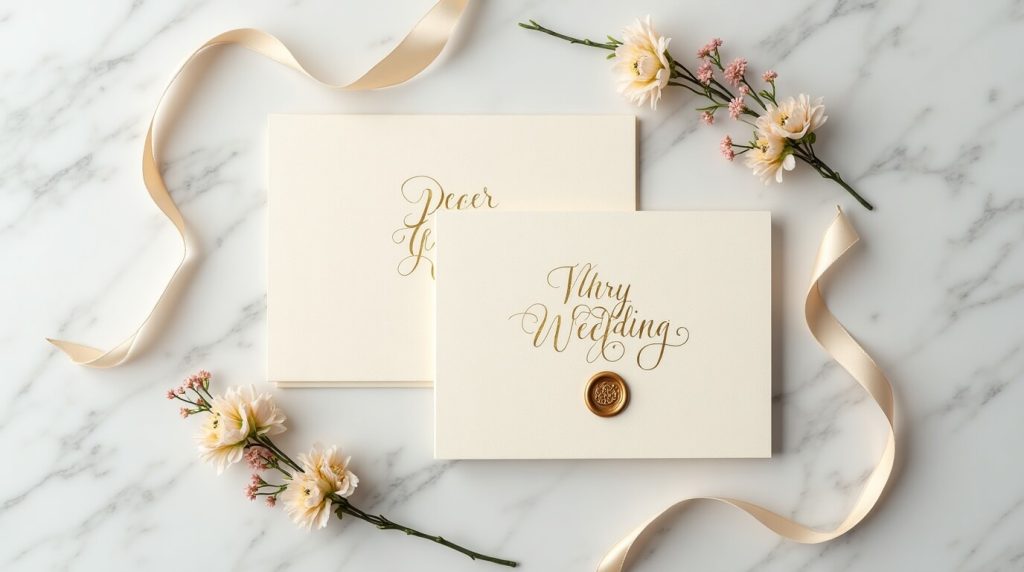
Envelope addressing trips up more couples than almost anything else in the stationery process. Getting addresses wrong means returned mail and reprinting. Getting the etiquette wrong on a formal wedding can create real friction before anyone has even opened the suite.
For more on the visual side of your stationery choices, check our guide on wedding flower costs and where to allocate your decor budget for ideas on keeping the overall aesthetic cohesive.
Inner vs. Outer Envelope
Traditional formal suites include two envelopes. The outer envelope is addressed to the household and uses full names and titles. The inner envelope lists exactly who is invited and can be more informal, just first names or first names plus “and guest” for plus-ones.
The inner envelope is the clearest tool for communicating who is specifically invited. If you write “The Johnson Family” on the outer envelope without an inner envelope, guests reasonably assume children are included. If you want to limit that, the inner envelope is the right place to draw that line, not a note on the RSVP card.
Many modern couples skip the inner envelope entirely. That works fine for casual and semi-formal weddings. For black-tie and formal events, keeping the inner envelope removes ambiguity about who is on the guest list.
Addressing Plus-Ones
If a guest has a plus-one and you know the partner, address the outer envelope to both people by name. “Mr. James Carter and Ms. Sofia Reyes” is the correct format. If you do not know the partner’s name, address it to “Mr. James Carter and Guest.”
Never write “and family” on a wedding invitation unless you genuinely mean everyone in that household. If you are inviting children, list them by name on the inner envelope. If children are not invited, address the outer envelope only to the parents and make sure your wedding website clearly states the adults-only policy so expectations are set before the RSVP arrives.
Titles and Formal Addressing
| Household Type | Outer Envelope Format |
|---|---|
| Married couple, same last name | Mr. and Mrs. James Carter |
| Married couple, different last names | Ms. Sofia Reyes and Mr. James Carter |
| Unmarried couple living together | Ms. Sofia Reyes and Mr. James Carter |
| Single guest with plus-one | Mr. James Carter and Guest |
| Doctor | Dr. Sofia Reyes |
| Military | Captain James Carter, USA |
| Judge | The Honorable James Carter |
Return address goes on the back flap of the outer envelope, not the front. A custom stamp or pre-printed return address labels keeps this consistent across a large batch and saves significant time compared to handwriting each one.
Paper vs. Digital Wedding Invitations
Paper invitations need a 1 to 2 week postal delivery buffer added on top of your send date target. Digital invitations follow the same 6 to 8 week schedule but can be scheduled in advance. Platforms like Paperless Post and Zola handle formatted digital invitations with built-in RSVP tracking, which a standard email cannot match.
The hybrid approach is now the most common format in 2026: a digital save the date followed by a printed formal invitation. For international guests, emailing a PDF preview the same day you mail the paper suite means they have all the details immediately without waiting on international postal delivery. QR code RSVP inserts are becoming standard for the same reason, they cut manual data entry and speed up response tracking.
| Paper Invitations | Digital Invitations | |
|---|---|---|
| Timing | 6 to 8 weeks, plus 1 to 2 week postal buffer | 6 to 8 weeks, or scheduled in advance |
| Cost | Higher (printing plus postage) | Lower to free |
| Formality | Higher | Lower to moderate |
| RSVP tracking | Manual unless QR code added | Automatic |
| Best for | Formal and semi-formal weddings | Casual weddings, elopements, short engagements |
Wedding Invitation Wording: What Goes Where
Invitation wording trips up more couples than almost any other part of the stationery process. The structure has a specific order and each line serves a purpose.
The standard formal invitation follows this order: host line, request line, names of the couple, date and time written out in full, venue name, venue address, and a reception line if the reception is at a different location.
Host Line Examples
| Hosting Situation | Host Line Wording |
|---|---|
| Bride’s parents hosting | Mr. and Mrs. Robert Allen request the honor of your presence |
| Both families hosting | Together with their families, Sophia Allen and James Carter request the honor of your presence |
| Couple hosting themselves | Sophia Allen and James Carter request the honor of your presence |
| Divorced parents hosting | Mrs. Linda Allen and Mr. Robert Allen request the honor of your presence |
Date and Time Formatting
Formal invitations write out the date and time in full. “Saturday, the fourteenth of September, two thousand and twenty-six, at half past four in the afternoon.” Casual invitations can use standard date formats. The rule of thumb: script fonts and heavy cardstock call for written-out formatting. Modern sans-serif designs are fine with numerals.
What Not to Include on the Invitation Itself
Registry information never goes on the formal invitation. It belongs on the wedding website. Dress code goes in the lower right corner of the invitation or on the details insert, not in the body of the text. Parking and accommodation instructions belong on the details insert or wedding website, not on the main card. Keeping the main card clean makes it easier to read and gives it a more polished look.
RSVP Deadline: How to Set It and Follow Up
Set your RSVP deadline 3 to 4 weeks before the wedding date. That window gives you time to submit final headcount to the venue and caterer, build the seating chart, and confirm vendor minimums.
Never set the deadline less than 2 weeks out. There is no buffer left for vendor communication. Never set it more than 6 weeks out because guests forget and circumstances change.
Expect 10 to 15 percent of guests to miss your deadline no matter how clearly you communicate it. Plan for it.
A follow-up message that actually works: “Hey, just checking in on the wedding RSVP. We need final numbers by [date] for the caterer. Let us know if you can make it.” Keep it light and practical, not guilt-laden.
You can also manage RSVPs digitally through your wedding website. The Knot and Zola both offer free wedding websites with built-in RSVP tracking that syncs responses automatically, which saves a lot of manual logging when responses start coming in fast.
Common Mistakes That Cost You Attendance
Sending too early. Invitations mailed more than 3 months before a local wedding tend to get misplaced. Details can still change at that stage, including venue layout, start time, and parking arrangements.
Sending too late. Less than 4 weeks notice for a local wedding and less than 8 weeks for a destination or holiday event means guests either cannot attend or scramble to make it work. By that point, flights are expensive and hotels near the venue are often sold out.
Skipping the postage weight check. A fully assembled suite almost always weighs more than a standard letter. Buying regular stamps without checking results in returned envelopes, and discovering it two weeks later is a genuinely bad afternoon.
Not ordering extras. Order 10 to 15 percent more than your guest count. Addressing mistakes, damaged envelopes, and last-minute additions are essentially guaranteed on any list over 50 people.
Mailing on Friday or Saturday. Weekend postal backlogs add 1 to 2 days to delivery times. Mail on Monday or Tuesday.
Ignoring production time. Design approval plus printing plus shipping equals 4 to 6 weeks minimum. Couples who start ordering at the 8-week mark often end up mailing at 4 weeks, which is too late.
Pro Tips for Mailing Wedding Invitations

Weigh before you stamp. Take one fully assembled suite to the post office and weigh it. Confirm the weight using the USPS postage calculator, then buy stamps in bulk to avoid multiple trips.
Request hand-canceling. Ask the postal clerk to hand-cancel your envelopes instead of running them through the machine. This protects wax seals, ribbon wrapping, and heavier paper stock from damage.
Mail Monday or Tuesday. Pieces mailed mid-week arrive faster and more reliably than weekend drops.
Add a QR code RSVP. A small insert card with a QR code linking to your wedding website response form dramatically speeds up response rates compared to paper cards alone.
Verify international postage separately. International rates vary by country, weight, and envelope dimensions. Confirm at the counter before mailing any overseas suites.
Send a PDF preview to international guests. Email a digital version the same day you mail the paper suite so international guests have all the details immediately without waiting on delivery.
For everything related to your overall wedding vision and vendor planning, our wedding catering questions guide walks through the key conversations to have with your caterer once RSVPs are finalized.
How to Assemble a Wedding Invitation Suite
Assembling invitation suites sounds straightforward until you are 80 envelopes deep and realize you have been stacking the inserts in the wrong order. Getting this right the first time saves a full evening of redoing it.
The Correct Stacking Order
Place the invitation face up at the bottom of the stack. The RSVP card goes on top of the invitation, face up, tucked into its own small envelope (unsealed). The details insert goes on top of that. If you have additional inserts like accommodation cards, directions, or a map card, those go last. Everything stacks face up so when the guest pulls the suite from the envelope, they see the invitation first.
If your suite includes a vellum overlay or ribbon wrap, the ribbon ties around the whole stack before the stack goes into the envelope. The bow sits on the front.
Inner vs. Outer Envelope Assembly
For suites with two envelopes, the full stack goes into the inner envelope unsealed, with the invitation facing the back flap. The inner envelope then slides into the outer envelope with the guest’s name facing the back flap of the outer envelope, so when they open it and pull out the inner envelope, they see the name right away.
For single-envelope suites (the more common modern format), the stack goes in facing the back flap. The guest pulls everything out in the correct reading order.
Stamp Placement and Postage
Standard stamp goes upper right on the outer envelope. Return address stamp or label goes on the back flap, not the front. If you are using a wax seal on the back flap, apply the wax seal after the return address label, or use a stamp design that fits around it.
Weigh one fully assembled suite before buying stamps for the entire batch. Wedding suites with multiple inserts, thick cardstock, and ribbon often push past the standard letter rate. Going to the post office and discovering your stamps are 20 cents short per envelope after the whole batch is stamped is the kind of problem that ruins a Tuesday.
Assembly Tips That Save Time
Set up an assembly line across a large table. Do one task at a time across all envelopes rather than assembling each one individually: stack all suites first, then stuff all envelopes, then label all return addresses, then stamp. Assembly-line format cuts the total time roughly in half.
If you are addressing by hand, do that before stuffing. It is much easier to write on an empty envelope than on a stuffed, sealed one.
For large guest lists, an evening with a few trusted friends and a good playlist gets it done faster than spreading it across multiple solo sessions. Have one person stuff, one person label, one person stamp.
If your venue is still finalizing details when you are ready to mail, get everything assembled and addressed except the final seal. Hold for a few days if needed, then seal and mail in one batch. Do not mail in stages if you can avoid it. Guests who get invitations noticeably later than others sometimes assume they were added as an afterthought, which is an awkward impression before the wedding even happens.
Once your final headcount comes in from RSVPs, your next big deadline is locking in your catering logistics. That means final headcount to the venue, menu confirmation, and dietary restriction notes to the kitchen before they finalize their prep plan.
Frequently Asked Questions
Is 3 months too early to send wedding invitations?
Three months is not too early for most wedding types. For a standard local wedding where save the dates already went out, 12 weeks is on the early side but perfectly acceptable. For destination weddings, holiday weekends, or any event requiring significant travel, 12 weeks is the right minimum. The main risk with sending too early for a local wedding is that the invitation gets misplaced before the date arrives.
What happens if I send invitations too late?
Guests who receive invitations less than 4 weeks before a local wedding often cannot attend, not because they do not want to but because travel, childcare, and work schedules are already locked in. Late invitations also compress your RSVP window, which means you go into vendor final count conversations with incomplete numbers. For destination weddings, invitations arriving less than 8 weeks out almost always result in noticeably lower attendance.
Do I need save the dates if I send invitations early?
Not always. If you send formal invitations 10 to 12 weeks before the wedding, they do the same work a save the date would have done. Save the dates become genuinely necessary for destination weddings, holiday weekend events, and any situation where guests need to book flights or accommodation. For small local weddings under 30 people, save the dates are often skipped entirely with no effect on attendance.
When should out-of-town guests receive their invitations?
Out-of-town guests should receive invitations at least 8 weeks before the wedding, with 10 to 12 weeks preferred if they need to book flights or accommodation. For international guests, 12 to 16 weeks is the minimum. You can mail out-of-town invitations a week earlier than local ones if your guest list has a clear split between local and traveling guests.
How long does printing take for wedding invitations?
Digital printing typically takes 3 to 5 business days. Flat foil, letterpress, and specialty finishes take 7 to 14 business days. Shipping adds another 3 to 7 business days. Budget 4 to 6 weeks total from order placement to invitations in hand, then add another week for assembly before mailing.
Should I send digital or paper wedding invitations?
Paper invitations remain the standard for formal and semi-formal weddings. Digital works well for casual weddings, elopements, and micro-weddings. The hybrid approach (digital save the date plus printed formal invitation) is the most common format in 2026 because it combines the speed of digital with the formality of print. You can build your wedding website on The Knot or Zola to handle digital RSVPs alongside your paper suite.
When should I follow up on missing RSVPs?
Follow up 3 to 5 days after your RSVP deadline passes. A short text or direct message works better than email for close family and friends. Keep the tone light: you need the number for the caterer, not an explanation of their plans. Expect 10 to 15 percent of guests to miss your deadline regardless.
Can I send wedding invitations by email?
Yes, and it works well for the right wedding type. Email invitations fit casual weddings, micro-weddings, and elopement celebrations where the guest list is comfortable with digital communication. They are not the standard for formal or black-tie weddings. If you go digital, use a platform like Paperless Post or Zola rather than a plain email. Both offer proper formatting and built-in RSVP tracking.
What do I do if my invitations arrive damaged from the printer?
Contact the printer immediately with photos. Most reputable printers will reprint damaged orders at no cost if damage occurred during production or shipping. This is why ordering 10 to 15 percent more than your guest count matters: minor damage on a few envelopes can be absorbed by your extras without needing a full reprint. If the damage is widespread and the printer refuses, dispute the charge with your credit card company and source a local or rush printer for a replacement order.
What is the difference between a formal and casual invitation suite?
A formal suite typically includes an outer envelope, inner envelope, invitation card, RSVP card with return envelope, and a details insert. Casual suites often combine everything onto fewer pieces and skip the inner envelope. The level of formality should match the wedding itself: black-tie events call for the full formal suite, while backyard and outdoor weddings can use a simpler all-in-one format without losing anything.
For more wedding planning guidance, browse our full collection at StyleSora.
About The Author


Leave a Reply