
Quick Answer
A wedding emergency kit is a stocked bag of small fixes for the things that actually go wrong on a wedding day: a popped button, a headache, a blister, a stain on a white dress, a dead phone battery. Wedding insurance covers the big losses, but only about 30 percent of couples even buy a policy, and most of what happens on a wedding day is too small for a claim anyway. A good kit covers safety pins, fashion tape, stain remover, pain relievers, blister pads, and a phone charger at minimum, then gets customized with personal items like specific medications or a backup lipstick. The maid of honor, a day-of coordinator, or another trusted, level-headed adult should carry it. It should be packed and handed off no later than the wedding rehearsal, never assembled the morning of.
What Is a Wedding Emergency Kit and Why You Need One

A wedding emergency kit is exactly what it sounds like: a portable stash of supplies built to solve the small, predictable problems that show up at almost every wedding. Not the catastrophic ones. Not the vendor cancellations or the rainstorms that move an entire ceremony indoors. Those get handled by your planner, your venue, or your insurance policy if you bought one. A kit is for the stuff that happens in the thirty seconds before you walk down the aisle, or two songs into the reception, when there is no time to drive to a pharmacy and no one wants to bother you with it.
Ask any coordinator who has worked more than a handful of weddings and you will hear the same short list over and over. A strap comes loose. A heel catches on a rug and snaps. Someone gets a headache from the champagne, the heat, or the stress. A bridesmaid steps on the hem of her dress and rips a seam. A flower girl spills juice on her dress thirty minutes before photos. None of these are emergencies in the dramatic sense. They are small, fixable, and completely normal, but only if someone packed the right supplies ahead of time.
How Common Wedding Day Mishaps Actually Are
Wardrobe issues top the list by a wide margin. Stains, loose buttons, broken zippers, fallen hems, and snapped straps account for the majority of what a kit gets used for, which is exactly why this guide spends an entire section on dress and suit fixes alone. After wardrobe, the next most common category is physical comfort: blisters from new shoes, headaches from skipped meals or nerves, dehydration from standing in the sun during photos, and the occasional stomach upset from a buffet line.
None of this requires a miracle. It requires a stocked bag and someone calm enough to use it. Most of these problems take less than two minutes to fix once you have the right item in hand, which is the entire argument for building a kit before the big day instead of hoping nothing happens.
Think about the actual sequence of a wedding day for a moment. Hair and makeup usually start early, often before sunrise for a large wedding party. Dresses go on hours before the ceremony, which means fabric has time to wrinkle, straps have time to slip, and shoes have time to start rubbing before a single photo is taken. By the time the ceremony begins, the wedding party has already been on their feet, in formalwear, for several hours. The reception then adds several more hours of dancing, eating, hugging, and crying on top of that. Stretched across a twelve to fourteen hour day, the odds that nothing needs fixing are quite low. The odds that something needs a quick fix are close to certain.
This is also why a kit pays for itself even at weddings that go smoothly in every major sense. A flawless venue, perfect weather, and an on-time photographer do not prevent a bobby pin from working loose or a heel from catching on a rug. The kit is not protection against disaster. It is maintenance for a day that involves more physical activity, more emotion, and more hours in formalwear than almost anything else a person experiences in a single stretch of time.
The Difference Between a Bride Kit and a Full Wedding Party Kit
A bride-only kit is small and personal. It covers her dress, her shoes, her makeup, and her specific needs, like a prescription medication or a preferred shade of lipstick for touch-ups. It is the kind of kit that fits in a clutch or a small zip pouch and stays within arm’s reach of the maid of honor all day.
A full wedding party kit is bigger and more general. It needs to cover bridesmaids, groomsmen, parents, and sometimes a flower girl or ring bearer too, which means more sizes of safety pins, more shades of stain remover, multiple pairs of blister pads, and backup ties or bow ties in case a groomsman forgets his. Most couples end up building something in between: a core kit with the basics everyone might need, plus a smaller personal pouch for the bride and a separate, even smaller one for the groom.
The size of the wedding party matters more here than most couples expect going in. A wedding with two bridesmaids and two groomsmen has very different needs than one with eight people standing up on each side. For larger wedding parties, it is worth asking one or two bridesmaids directly whether they have any specific needs, an allergy, a medication, a particular shoe size for blister pads, rather than assuming a single generic kit will cover everyone equally well.
Why This Should Not Be an Afterthought
The emergency kit is one of the few wedding day details that costs almost nothing and prevents almost everything. A $30 to $75 kit is a rounding error against a wedding budget that, according to The Knot’s 2026 Real Weddings Study, averaged $34,200 in 2025. Yet it is consistently one of the last things couples think about, usually remembered the week before the wedding, if at all.
The cost of skipping it is not financial. It is the photo where a bridesmaid is visibly tugging at a strap, or the fifteen minutes spent searching three different cars for a phone charger while the DJ stalls the reception entrance. A kit assembled in advance means none of that becomes the story people tell about your wedding. It just gets handled, quietly, by whoever is holding the bag.
There is also a budgeting argument worth making here. Most couples spend real money on wedding insurance, day-of coordinators, and contingency plans for weather or vendor cancellations, and those protections matter for the truly major risks. But the National Association of Insurance Commissioners reports that only about 30 percent of couples actually purchase a wedding insurance policy, which means the majority of weddings are proceeding with no formal safety net at all. Even for the couples who do buy a policy, insurance is built for major losses: a venue that burns down, a vendor that never shows up, a hurricane that forces a postponement. It is not designed for, and will not reimburse, a popped button or a headache.
An emergency kit fills exactly that gap. It is the only form of wedding day protection built specifically for the small, frequent, low-stakes problems rather than the rare, expensive, high-stakes ones. Skipping it because “nothing will go wrong” misunderstands what it is actually for. It was never about preventing disaster. It was always about preventing a dozen tiny interruptions from adding up into a day that feels more stressful than it needed to be.
The Easiest Way to Start: Pre-Made vs DIY

There are two ways to build a wedding emergency kit, and most couples end up using a blend of both. The first is buying a pre-assembled kit and customizing it. The second is building one entirely from scratch, item by item, using a checklist like the one further down in this guide.
What a Pre-Made Kit Typically Covers
A pre-made kit gets you the boring-but-essential basics in one purchase: safety pins in multiple sizes, a small sewing kit, fashion tape, a stain remover wipe or pen, bobby pins, and usually a few personal care items like blister pads and pain relievers. The Bridal Emergency Kit with 40+ essentials is built specifically for this purpose, packed into a single compact pouch so you are not hunting through a junk drawer two days before the wedding trying to remember if you own a seam ripper. For couples who are short on planning time, starting with a kit like this and adding a handful of personal items is the fastest way to be fully covered.
The advantage of a pre-made kit is speed. You are not researching forty individual products, comparing prices, and waiting on forty separate shipments. You order one item, it shows up in one box, and you are most of the way to a finished kit before you have spent an hour on it.
There is also a quieter advantage that does not get talked about as often: a pre-made kit is harder to forget items from. When you build a kit yourself, it is easy to remember the items that feel important, like a sewing kit or stain remover, and overlook the smaller things, like clear nail polish for a hosiery run or static guard for cold weather. A pre-made kit, assembled by someone whose job is specifically thinking through wedding day mishaps, tends to include the items that only become obvious in hindsight, after they were needed and not on hand.
What You Should Always Add Yourself
No pre-made kit, no matter how thorough, knows what your dress fabric is, what medications you take, or what shade of lipstick you are wearing. These are the things every bride and groom need to add personally, regardless of which base kit they start with:
- Prescription medications, clearly labeled, in their original bottles
- A backup lipstick or lip color that matches what the makeup artist used
- A small fabric swatch from your dress alteration, useful for testing stain removers
- Specific allergy medication if anyone in the wedding party has a known allergy
- A spare pair of earrings or jewelry backup if something breaks
- Cash in small bills, since pre-made kits never include this
This is also where you personalize for your specific venue and season, which gets its own full section later in this guide.
Building a Fully Custom Kit From Scratch
If you would rather build everything yourself, a fully DIY kit gives you total control over what goes in, but it takes real time. Plan on one to two hours of shopping and assembling if you are starting from zero, longer if you are trying to track down specific shades or sizes. The advantage is that nothing in the kit is wasted. Every item is something you specifically decided you needed, rather than a generic inclusion that may never get used.
The risk with a fully custom kit is forgetting something. This is where a detailed checklist matters more than enthusiasm. Work through the categories systematically, wardrobe, beauty, health, practical, rather than trying to remember everything off the top of your head while standing in a drugstore aisle.
A practical approach that works well for a lot of couples is splitting the shopping list across two or three people instead of tackling it alone. One person handles wardrobe and beauty items, another covers health and practical essentials, and a third focuses on anything seasonal or venue-specific. This spreads the cost, the time, and the mental load of remembering forty small items across a few people rather than leaving it all on one person’s to-do list during an already busy final month of planning.
| Factor | Pre-Made Kit | Fully DIY Kit |
|---|---|---|
| Cost | $25 to $60 | Variable, often similar once complete |
| Time required | Minimal, ready to use | 1 to 2 hours to assemble |
| Personalization | Covers basics only | Fully customized to your needs |
| Best for | Couples short on planning time | Couples with specific needs or allergies |
| Biggest gap | Missing personal medications, exact shade matches | None, if planned thoroughly |
| Recommended approach | Use as a base, then customize | Use a checklist to avoid missing items |
The honest answer for most couples is to do both. Buy a base kit for the boring essentials, then spend twenty minutes adding the personal items only you would think to include.
Wardrobe and Dress Fixes
This is the category that gets used most. Whatever else ends up in your kit, do not skip this section.
Safety Pins and Sewing Kit Essentials
Pack safety pins in at least three sizes, small for delicate fabric, medium for general use, and large for heavier suiting or a bustle that needs reinforcing. A small sewing kit with white thread, ivory thread, and black thread covers the vast majority of wedding attire, since most dresses fall somewhere on the white-to-ivory spectrum and most suits are black or navy. Include a few pre-threaded needles if you can find them, since threading a needle with shaking hands thirty minutes before a ceremony is its own small disaster.
A pair of small, sharp scissors belongs here too, along with a seam ripper in case a hem needs adjusting on the fly. These are the tools that turn a ripped seam from a crisis into a two-minute fix in a bathroom stall.
When a strap or seam actually fails, speed matters more than perfection. A safety pin closed from the inside of the fabric, angled slightly so the point cannot work its way through to the outside, holds far longer than a pin placed in a hurry without thinking about the angle. For a split seam under the arm or along a side zipper, a few safety pins spaced an inch apart hold the fabric closed well enough to finish the night, even without a proper repair. Save the actual sewing for after the reception, once there is time to do it without an audience.
It is also worth packing a couple of large diaper pins or kilt pins alongside the standard safety pins. They hold significantly more weight than a small pin and are the better choice for anything structural, like reinforcing a strap on a heavier beaded gown or holding a bustle loop that keeps slipping.
Fashion Tape and Double-Sided Tape
Fashion tape is one of those items nobody thinks about until they desperately need it. It holds a neckline in place, secures a fallen strap, keeps a slit from gaping open, and tacks down a hem that is dragging on the ground. Pack at least two strips, since one almost always gets used on the dress and a second tends to get borrowed by a bridesmaid for the exact same reason.
Double-sided fabric tape works for the same purposes and is a reasonable substitute if fashion tape specifically is not available, though true fashion tape is gentler on delicate fabrics like silk and chiffon and less likely to leave residue. For a strapless or backless dress in particular, applying fashion tape early, before the first photo session rather than waiting for a slip to actually happen, prevents the small, distracted adjustments that otherwise show up in candid shots.
Stain Remover for Spills and Makeup Smudges
If there is one single item that wedding coordinators name most often as the most-used item in any kit, it is a stain remover pen. Red wine, foundation, lipstick, grass stains from outdoor photos, even chocolate from the dessert table, all of it shows up eventually, usually on white fabric, usually at the worst possible moment. Pack two stain remover pens or wipes, since one tends to disappear into someone’s pocket during the chaos of a reception.
For a white or ivory dress specifically, a small container of cornstarch or baby powder is worth adding too. Pressed gently onto an oil-based stain, it absorbs the oil before it sets, buying time until a proper stain remover or dry cleaner can finish the job.
The biggest mistake people make with a fresh stain is rubbing it. Rubbing pushes the stain deeper into the fibers and spreads it wider instead of lifting it out. Blot, do not rub, using a clean section of cloth or a tissue, working from the outside edge of the stain inward so it does not spread further than it already has. For red wine specifically, a small amount of club soda blotted onto the stain before applying the stain remover pen helps dilute the color before it has a chance to set. None of this needs to be a perfect, permanent fix. The goal on the day itself is simply getting through the remaining photos and the reception without the stain being the first thing anyone notices, with full cleaning left to a professional afterward.
Steaming Out Last-Minute Wrinkles
Garment bags do not always prevent wrinkles, especially after a long car ride or a few hours folded in a suitcase for a destination wedding. A full ironing board is rarely available in a hotel suite or getting-ready space, and even when it is, nobody wants to risk an iron directly on delicate lace or beading.
A handheld steamer solves this without the risk. The Conair Turbo ExtremeSteam Handheld Garment Steamer heats up in about 40 seconds and runs for roughly 20 minutes of continuous steam, which is more than enough to smooth out a dress, a suit jacket, or a row of bridesmaid dresses before anyone notices a wrinkle in the photos. It is small enough to pack directly into the emergency kit bag, which matters more than it sounds like it should when getting-ready spaces are already cluttered with garment bags, makeup stations, and a dozen people trying to move around each other.
A steamer earns its place in the kit well beyond the getting-ready room too. Linen suits and chiffon dresses, both popular for warm-weather weddings, wrinkle easily just from sitting during the car ride to the venue, and a quick pass with a handheld steamer right before formal photos noticeably sharpens how everyone looks in the final gallery. Hang the garment on a door frame or a tall hook, work the steamer in slow, even passes from top to bottom, and keep a hand stretched gently behind the fabric to help release stubborn creases without scorching anything.
Once the dress is steamed and ready, the next step for a lot of couples is figuring out the bustle for the reception. If you have not worked through how to bustle a wedding dress with whoever is helping you get dressed, do that walkthrough before the ceremony, not after, since a rushed bustle attempt is one of the more common sources of a torn seam later in the night.
Heel Stoppers and Blister Prevention
Grass, cobblestones, and gravel paths are beautiful in photos and brutal on heels. Heel stoppers, small clear caps that slide over the tip of a heel, prevent sinking into soft ground and the embarrassing wobble that comes with it. They are inexpensive, take seconds to apply, and are worth packing even for an indoor venue, since outdoor photo locations are common even when the ceremony itself is inside.
Blister prevention belongs in this section as much as the health section, since most blisters on a wedding day come directly from new shoes that have never been broken in. A roll of moleskin or a few blister pads applied preemptively, before the pain starts, prevents the limping-by-hour-six problem that shows up in so many wedding day stories.
A few extra minutes of preparation the week before the wedding prevents most of this entirely. Wearing the actual wedding shoes around the house for short stretches softens the material in the spots most likely to rub, and a thin layer of petroleum jelly or anti-blister balm applied to heels and toes on the day itself reduces friction before it ever becomes a problem. For anyone who knows from experience that their feet do not tolerate heels well over a long day, packing a pair of foldable flats as a reception backup is one of the more popular last-minute additions to a kit, swapped in the moment the formal photos wrap up.
Beauty and Hair Touch-Up Essentials

Bobby Pins, Hair Ties, and Hairspray
Hairstyles move throughout a long day, especially through a first look, a ceremony, photos, and several hours of dancing. Pack a generous handful of bobby pins in a shade that matches the wearer’s hair color, since mismatched pins are surprisingly visible in close-up photos. A few hair ties are worth including too, for anyone who decides midway through the reception that an updo needs to come down.
Travel-size hairspray rounds this out. Humidity, wind, and a few hours on a dance floor will undo even the most carefully set style, and a quick spray during a bathroom break can buy another hour or two of holding power. For a particularly intricate updo, a few extra hairpins or a small hair net packed alongside the bobby pins gives a hairstylist or a handy bridesmaid the materials needed to rebuild a section that has come loose, rather than just patching it temporarily.
Lipstick, Lip Balm, and Oil Blotting Sheets
Lipstick wears off after eating, drinking, and the inevitable round of kisses on the cheek from relatives. Pack the exact shade the makeup artist used if at all possible, since a close-but-not-quite match is noticeable in photos taken later in the day compared to the first-look shots. A basic lip balm is worth including too, particularly for outdoor weddings where wind and sun dry out lips quickly.
Oil blotting sheets handle shine without disturbing makeup the way powder reapplication can. A few quick blots before formal photos or right before the first dance keep everyone looking fresh without the chalky buildup that comes from layering too much powder over hours of wear. Keep a small travel-size setting spray in this same pocket of the kit as well. A light mist over the whole face, after lipstick and blotting, helps everything sit a little longer through the heat of a dance floor and the humidity of an outdoor cocktail hour.
Compact Mirror and Small Hairbrush
It sounds almost too simple to mention, but a compact mirror gets used constantly throughout the day, for lipstick touch-ups, checking hair after the ceremony, and a dozen small adjustments nobody wants to do without being able to see what they are doing. A small folding hairbrush or comb takes up almost no space and saves a trip back to the getting-ready room every time a strand falls out of place. A travel-size pack of makeup wipes is a natural companion to keep in this same section of the kit, useful for cleaning up smudged eyeliner from happy tears during the ceremony without disturbing the rest of the makeup look.
Clear Nail Polish for Hosiery Runs
A run in hosiery or tights is one of those small disasters that feels much bigger than it is, mostly because there is rarely an easy fix on hand. A dab of clear nail polish stops a run from spreading any further, buying enough time to either change into a backup pair or simply make it through the remaining photos and ceremony without the run becoming visible. Pack a small bottle specifically for this, separate from any nail care items, since clear polish dries out faster than people expect and you do not want to discover an empty bottle mid-emergency. A spare pair of nude or sheer hosiery in the correct size, folded flat in the kit, is the more reliable backup if a run happens early enough in the day that a full change is still practical.
Health and Comfort Essentials

Pain Relievers and Allergy Medication
Pain relievers are, alongside safety pins, one of the two most frequently used items in any wedding emergency kit, according to wedding coordinators who pack these bags week after week. Stress, dehydration, tight hairstyles, and standing for hours all contribute to headaches that show up at the worst possible time. Pack both ibuprofen and acetaminophen, since different people respond better to one or the other, and a few individually wrapped packets travel easier than a full bottle.
Allergy medication deserves its own line item, especially for outdoor or garden weddings where pollen, grass, and flowers are unavoidable. If anyone in the wedding party has a known severe allergy, make sure they are carrying their own epinephrine auto-injector personally rather than relying on the shared kit, since minutes matter in a true allergic reaction and the kit may not be close enough, fast enough.
Tight hairstyles deserve a specific mention here too, since an updo pinned tightly enough to last through a reception is also tight enough to cause real tension headaches by hour four or five. Packing an extra-strength pain reliever option, alongside the standard dose, gives whoever is carrying the kit a stronger tool for a headache that the standard dose is not touching. A few electrolyte powder packets are a smart addition as well, mixed into a water bottle for anyone who is starting to feel lightheaded between the ceremony and the reception.
Band-Aids and Blister Care
New shoes, tight straps, and a full day on your feet are a near-guaranteed recipe for blisters. Pack a range of bandage sizes along with dedicated blister pads, which cushion and protect a blister far more effectively than a standard bandage. Apply them at the first sign of rubbing rather than waiting for an actual blister to form, since prevention takes thirty seconds and treatment after the fact takes much longer to feel comfortable again.
A small tube of antibiotic ointment rounds this category out, useful for the occasional scrape or cut that happens during setup, decorating, or simply moving around a venue in formal shoes that were not designed for walking on uneven ground. A few alcohol wipes packed alongside the bandages give whoever is handling the fix a quick way to clean a scrape before covering it, particularly useful at outdoor venues where a fall is more likely to happen on grass, gravel, or an uneven garden path.
Breath Mints and Deodorant
Hours of talking, eating, drinking, and close-up photos make breath mints a quiet but essential addition. Pack a small tin or pack that fits easily in a pocket or clutch, easy to grab without making a production of it. Travel-size deodorant matters just as much, particularly for an outdoor wedding in warm weather or any venue without strong air conditioning. A quick reapplication before the reception entrance or first dance prevents one more small worry from creeping into an already long day. A small travel toothbrush kit is a nice addition for the bride and groom specifically, useful right before the first kiss at the end of the ceremony, after a meal full of garlic, onion, or anything else nobody wants lingering for the rest of the night.
Snacks and Hydration for a Long Day
Wedding days are notoriously bad for actually eating. Between hair and makeup, photos, the ceremony, and the receiving line, hours pass without a real meal, which is part of why headaches and lightheadedness are so common by the time the reception starts. Pack a few protein bars or other snacks that will not melt, crumble excessively, or stain clothing if handled carelessly.
A couple of bottles of water belong in the kit too, separate from whatever beverage service the venue provides, since the bride and groom in particular often do not have easy access to a drink during the stretch between the ceremony and the reception. Dehydration headaches are entirely preventable with something as simple as a bottle of water tucked into the emergency kit bag.
Coordinators who work full wedding days regularly point out that the bride and groom are the two people least likely to actually eat, even when the food is excellent and plentiful. Photos pull them away during cocktail hour, the receiving line eats into dinner time, and toasts and traditions interrupt whatever window is left. A couple of easy-to-eat snacks tucked specifically into the bride and groom’s personal section of the kit, rather than the shared bag, means at least a few bites happen even on a day built almost entirely around everyone else’s experience.
Practical and Logistical Essentials
Cash for Tips and Unexpected Costs
Cash solves problems that nothing else in the kit can. Vendor tips are traditionally handled in cash, and an unexpected need, whether it is a quick errand, a tip for a parking attendant, or covering a small last-minute expense, almost always requires cash on hand rather than a card. Pack a mix of small bills, since a single large bill is rarely useful for tipping individual vendors throughout the day. A separate, labeled envelope for vendor tips specifically, kept apart from the general cash in the kit, makes the handoff at the end of the night faster and means nobody is counting out bills while trying to also thank a vendor and say goodbye to guests at the same time.
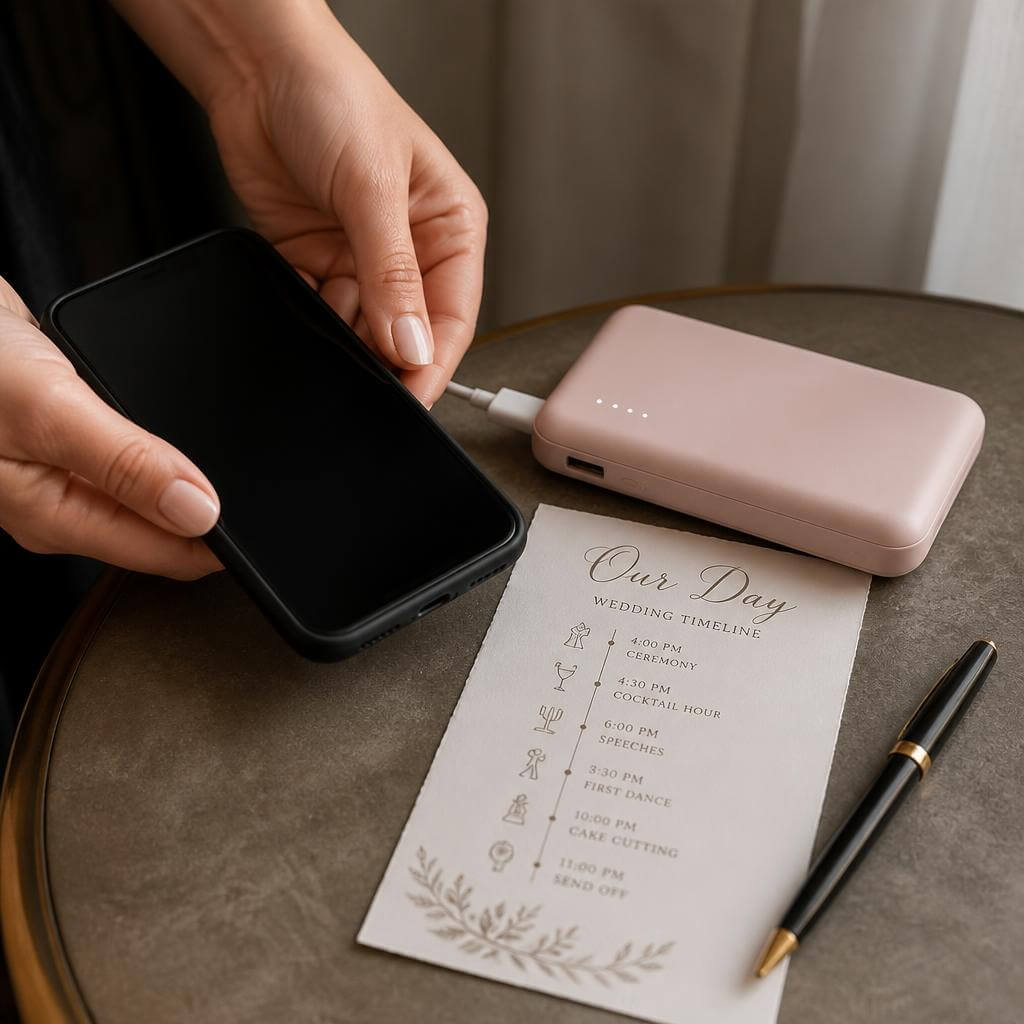
Phone Chargers and a Portable Battery
A dead phone on a wedding day is more than an inconvenience. It is the device coordinating timing with the photographer, fielding last-minute questions from vendors, and holding the playlist or speech notes someone forgot to print. Pack a portable battery pack along with the correct charging cables for the phones most likely to need them. A wedding day involves more photos, texts, and calls than almost any other day in a couple’s life, and batteries drain faster than anyone expects, particularly when a phone is also being used to play music during getting-ready time or pull up a seating chart for last-minute changes.
A multi-port charging cable or a battery pack with more than one output is worth the slightly higher cost, since it is rarely just one phone that needs charging by the time the reception is in full swing. Coordinators, photographers, and DJs all run on their own devices throughout the day, and a single shared battery pack in the emergency kit has bailed out more than one vendor mid-event.
Pens, Extra Vow Copies, and a Black Ink Pen
Printed vows go missing more often than couples expect, tucked into a jacket pocket that gets swapped or left behind in a getting-ready room during the rush to the ceremony. Pack a spare printed copy of both sets of vows, folded small enough to fit discreetly in the kit. A black ink pen belongs here too, useful for last-minute signage corrections, marriage license paperwork, or a guest book that someone forgot to set out a pen for.
Tissues for Tears and Allergies
Wedding days produce tears, happy ones during the ceremony and emotional ones during a parent dance or speech, plus the occasional allergy-related sniffle from flowers or outdoor pollen. Pack a small travel pack of tissues, ideally one with lotion built in, since standard tissues used repeatedly throughout a long day can leave noses raw by the end of the night. A small bottle of hand sanitizer is worth including in this same pocket of the kit, useful after the receiving line and before the cake cutting. For the bride specifically, a couple of waterproof under-eye patches or a small pot of concealer matched to her foundation shade is worth tucking in alongside the tissues, ready for a quick touch-up the moment the happy tears have passed.
Groom-Specific Emergency Kit Items

A Smaller Version for the Best Man to Carry
The groom rarely needs the full kit a bride carries, but he needs his own version, scaled down and carried by someone specific rather than left to chance. The best man is the natural choice here, since he is by the groom’s side from the getting-ready stage through the reception and is already responsible for keeping track of rings and other small details. A smaller pouch with the essentials below fits easily in a jacket pocket or is kept nearby without drawing attention.
If the best man has not finalized his toast yet, this is also a natural moment to mention that working from a list like best man speech ideas ahead of time means one less thing competing for his attention on the actual day, alongside everything else he is managing for the groom. A best man juggling a forgotten toast, a misplaced ring, and a wardrobe malfunction all at once is a recipe for a flustered groom right before the ceremony, which is exactly the scenario a little advance planning prevents.
What Grooms Actually Need on the Day
A groom-specific kit is lighter than a bride’s kit but covers similar ground: a stain remover pen for the inevitable drink or food spill on a white shirt, a small sewing kit, breath mints, deodorant, and pain relievers. Add a spare undershirt if the suit fabric is prone to showing sweat, particularly for an outdoor wedding in warm weather, along with a small tin of bandages for blisters from dress shoes that were likely worn for the first time that day.
Suits show wear differently than dresses do. A loose button on a jacket or a fallen hem on dress pants is just as common as a torn strap on a gown, and both are fixable in seconds with the same safety pins and sewing kit already in the bag. Pack a small lint roller specifically for the groom’s section of the kit as well, since dark suits show lint, pet hair, and stray confetti far more visibly than lighter-colored fabrics, and a quick roll-down before photos makes a noticeable difference.
Cufflinks, Collar Stays, and Tie Fixes
Cufflinks get lost with surprising frequency, usually set down on a counter during the getting-ready process and forgotten in the rush to the ceremony. Pack a backup pair in a simple, neutral style that works with most suits. Collar stays, the small plastic or metal inserts that keep a dress shirt collar crisp, are easy to lose and just as easy to forget entirely, so a spare set is worth the minimal space they take up.
For a bow tie or necktie that needs adjusting, a small reference card or printed diagram for tying a bow tie or a half-Windsor knot solves the problem of a groomsman who agreed to help but cannot quite remember the steps under pressure. A spare necktie or bow tie in the same color as the rest of the wedding party is worth packing too, since a stained or damaged tie is otherwise nearly impossible to replace on short notice once the day is already underway.
Seasonal and Venue-Specific Additions
Outdoor and Garden Wedding Additions
Outdoor weddings introduce variables an indoor venue never has to consider. Pack bug spray, ideally a fragrance-free formula that will not clash with perfume or interfere with photos, along with a portable, battery-operated fan for warm weather. Grass stains become far more likely, which makes the stain remover pen from earlier in this guide even more essential, and heel stoppers prevent the sinking-into-soft-ground problem that comes with grass or garden paths.
Wind is the variable most couples forget to plan for at an outdoor venue. A few extra bobby pins beyond the standard amount, a small can of strong-hold hairspray, and a handful of fabric weights or safety pins for securing a veil all earn their place in an outdoor-specific kit. A portable shade umbrella or a couple of paper fans for guests, while not strictly an emergency item, is a small touch that coordinators often pack alongside the kit for a garden ceremony with no natural shade.
Summer Wedding Additions
Heat changes what an emergency kit needs to cover. Sunscreen belongs in every summer kit, a lightweight, non-greasy formula that will not stain delicate fabric if it transfers from skin to dress during a hug or a dance. A portable misting fan helps prevent makeup from melting during outdoor photos, and extra water becomes even more critical than it already is in the health and comfort section above, since dehydration risk climbs quickly in direct sun.
Sweat is the other factor that summer weddings have to plan around, particularly for the groom and groomsmen standing in full suits for an outdoor ceremony. A few extra-strength antiperspirant wipes, packed alongside the standard deodorant, give a faster, more effective fix than a stick of deodorant alone when someone needs a touch-up between the ceremony and formal photos.
Winter Wedding Additions
Cold weather brings its own short list of additions. Hand warmers, the disposable kind that activate with a quick shake, are worth packing generously, both for the wedding party during outdoor photos and as a thoughtful touch for guests during an outdoor ceremony. A few safety pins specifically sized for securing a wrap or shawl over a sleeveless dress are useful too, along with static guard spray, since cold, dry air makes fabric cling in ways that are surprisingly visible in photos.
Lip balm and hand lotion deserve a second mention in a winter-specific kit, since cold air dries out skin and lips far faster than most people expect, especially during an outdoor photo session. A small travel umbrella for an unexpected flurry of snow, along with a compact, neutral-colored blanket for outdoor photos between the ceremony and reception, rounds out a winter kit without adding much bulk.
Destination Wedding Additions
A destination wedding multiplies the stakes of everything in this guide, since a forgotten item usually cannot be replaced with a quick trip to a nearby pharmacy. Pack a translated list of key medications if traveling internationally, along with copies of any prescriptions in case of an unexpected need to refill or explain medication at customs. Adapters for charging devices belong in the kit too, along with a slightly larger cash reserve than a local wedding would require, since currency exchange and unfamiliar payment systems can complicate even small purchases on short notice.
It is worth packing a small first aid kit beyond what a local wedding would need as well, including motion sickness medication if travel by boat or off-road vehicle is part of the itinerary, and a basic understanding of where the nearest pharmacy or medical clinic is relative to the venue. Most destination wedding coordinators can provide this information during a final planning call, and it is worth writing down and keeping with the kit rather than relying on spotty cell service to look it up in the moment.
Who Should Carry the Kit and Where to Keep It

Maid of Honor vs Wedding Coordinator vs a Trusted Friend
The maid of honor is the most common choice, and for good reason. She is close to the bride throughout the entire day, from getting ready through the reception, and is already managing details like the bustle and the timeline. A day-of wedding coordinator is another strong option, particularly if one is already hired, since managing logistics is literally their job and they likely already carry a basic kit of their own that yours can supplement.
A trusted friend or family member who is not in the wedding party itself is a solid third option, since they have more freedom to step away and retrieve items without disrupting their own responsibilities in the ceremony or photos. Whoever it is, the key qualifier is the same: calm under pressure, organized, and physically present near the action throughout the day rather than someone who disappears for long stretches.
It is worth having a short, direct conversation with whoever ends up carrying the kit before the wedding day, not just handing it over silently. Let them know it is acceptable, even expected, to step away from a photo or a conversation for thirty seconds to grab a safety pin or a stain remover pen. Some carriers hesitate to interrupt the flow of the day for what feels like a small request, and a quick conversation in advance removes that hesitation entirely.
Where to Store It During the Ceremony and Reception
During the ceremony, the kit should stay in the getting-ready room or with the designated carrier, somewhere accessible but out of sight of guests and photos. During the reception, a designated “home base,” often a gift table, sweetheart table area, or a spot near the DJ booth, works well, since it keeps the kit central without anyone having to track down which room it was left in. Avoid leaving it in a car, since that adds a five to ten minute delay to what should be a thirty-second fix.
For a venue with multiple buildings or a ceremony and reception in two different locations, it is worth splitting the kit into two smaller versions rather than relying on a single bag that has to travel between sites. A small personal pouch stays with the bride and groom directly through the ceremony and photos, while the larger, more complete kit travels ahead to the reception site with the coordinator or a designated driver, so it is already in place and ready by the time guests arrive.
How to Hand It Off at the Rehearsal
The rehearsal, not the morning of the wedding, is the right moment to hand the kit to its designated carrier. This gives them a chance to actually look through it, ask questions about anything unfamiliar, and mentally register where it will be kept throughout the following day. Handing off a kit the morning of the wedding, when everyone is already rushed, means the carrier is learning the contents for the first time exactly when they have the least bandwidth to absorb it.
A short, written note taped to the inside of the kit, listing anything especially time-sensitive, like a specific medication schedule or an allergy to flag, helps a carrier who is managing a dozen other things remember the details that matter most without having to ask the bride or groom directly in the middle of a busy day.
| Person | Best Suited For | When They Have It |
|---|---|---|
| Maid of honor | Full bride-focused kit | Getting ready through reception |
| Best man | Smaller groom-focused kit | Getting ready through reception |
| Wedding coordinator | Full, all-inclusive kit | All day, professional backup |
| Trusted family member | Backup or secondary kit | Reception only |
| Venue staff | Basic supplies only | On request during reception |
When to Assemble Your Wedding Emergency Kit
The Ideal Timeline Before the Wedding
Most wedding coordinators recommend starting to gather kit items four to six weeks before the wedding, which gives enough time to order specialty items, like a specific thread color or fashion tape brand, without paying for rush shipping. This is also a natural point in the planning process to think about timing more broadly. Knowing how long is a wedding from start to finish helps determine exactly how long the kit needs to stay accessible and at what points in the day it is most likely to get used, since a kit that is packed away in a car by the time the reception starts defeats its own purpose.
Building the kit early also means it can travel with everything else as wedding day logistics get finalized. Rather than treating it as a separate, last-minute errand, fold it into the same planning sessions where seating charts, vendor timelines, and final headcounts are getting locked in. A kit assembled alongside the rest of the planning, rather than squeezed in afterward, is far less likely to have an obvious gap.
Final Week Checklist Additions
In the final week, do a complete pass through the kit. Replace anything expired, particularly medications, and top off consumables like stain remover wipes or pain reliever packets that may have been used during a final dress fitting or other pre-wedding event. This is also the point to add anything specific to the final venue walkthrough, like discovering the ceremony location is on grass when you had assumed it was paved, or realizing the reception room runs cold and hand warmers should be added after all.
A final venue walkthrough in the week before the wedding is the single best opportunity to catch these gaps. Walk the actual ceremony path in the shoes that will be worn, check whether the getting-ready room has a mirror large enough for last-minute touch-ups, and confirm where the designated home base for the kit will actually sit during the reception. Small details discovered during this walkthrough, things no checklist could have predicted in advance, are exactly what separate a kit that looks complete on paper from one that is actually ready for the specific venue and day.
Staying organized through this final stretch is easier with a dedicated planner. The Knot Ultimate Wedding Planner and Organizer includes worksheets and checklists with pockets for exactly this kind of last-minute tracking, useful for confirming which emergency kit items have been purchased and packed alongside every other piece of wedding day logistics that needs a final check before the big day.
The Complete Wedding Emergency Kit Checklist
Use this table as your master reference, organized by category so nothing gets missed during final packing. It pulls together every item covered throughout this guide into one scannable list, which makes it easier to divide shopping between a few people or do a final inventory check the week of the wedding.
| Category | Items |
|---|---|
| Wardrobe fixes | Safety pins, sewing kit, fashion tape, stain remover pen, lint roller, heel stoppers |
| Beauty touch-ups | Bobby pins, hairspray, lipstick, oil blotting sheets, compact mirror, clear nail polish |
| Health and comfort | Pain relievers, allergy medication, Band-Aids, antacids, breath mints, deodorant |
| Practical items | Cash, phone charger, pens, extra vow copies, tissues, hand sanitizer |
| Groom specific | Collar stays, cufflinks backup, extra bow tie, small sewing kit |
| Seasonal additions | Sunscreen, bug spray, hand warmers, umbrella, blanket |
Print this table or save it directly, then check off each item as it goes into the bag. A kit assembled against a checklist is far less likely to have a gap discovered at the worst possible moment. If your wedding falls outside the standard seasons covered here, or your venue has a feature this guide has not addressed directly, treat the categories above as a starting structure rather than a strict limit. The best kits are the ones that started from a solid checklist and then got a few extra items added based on the specifics of the actual day.
Related Reading
If you are still working through earlier planning decisions, a few other guides on StyleSora cover ground that pairs naturally with this checklist. For couples who have not finalized their dress yet, when to buy a wedding dress walks through timing so alterations and a final fitting do not get rushed before the big day. And if the venue itself is still an open question, how to choose a wedding venue covers the practical factors worth weighing before signing a contract, including the kind of outdoor or indoor layout that influences which seasonal kit additions from this guide will actually apply.
Frequently Asked Questions
What should be in a wedding emergency kit? At minimum, pack safety pins in multiple sizes, a small sewing kit, fashion tape, a stain remover pen, pain relievers, Band-Aids and blister pads, breath mints, deodorant, cash, a phone charger, and tissues. From there, customize with personal items like specific medications, a backup lipstick shade, and anything specific to your venue or season, such as sunscreen for an outdoor ceremony or hand warmers for a winter wedding. The goal is covering wardrobe, beauty, health, and practical needs in one bag.
Who carries the wedding emergency kit? The maid of honor is the most common choice, since she stays close to the bride throughout the entire day, from getting ready through the reception. A day-of wedding coordinator or a trusted friend who is not part of the wedding party are both strong alternatives, particularly if the maid of honor already has a full plate of other responsibilities. The groom typically has a smaller, separate version carried by the best man rather than sharing the bride’s kit.
When should you pack a wedding emergency kit? Start gathering items four to six weeks before the wedding, which gives enough time to order specialty items without paying for rush shipping. Finish a complete check during the final week to replace expired items and top off consumables, then hand the finished kit to its designated carrier at the rehearsal, not the morning of the wedding, so they have time to actually look through it beforehand.
Is it worth buying a pre-made wedding emergency kit? Yes, particularly for couples short on planning time. A pre-made kit covers the basics, like safety pins, a sewing kit, fashion tape, and personal care items, in one purchase, and you then add personal items like medications and specific shade matches yourself. It is generally faster than building a kit entirely from scratch, since it removes the need to research and order dozens of individual items, though the final cost ends up similar either way.
What is the most commonly used item in a wedding emergency kit? Wedding coordinators most often name safety pins and a stain remover pen as the two items pulled out most frequently, used for everything from a fallen strap to a wine stain on a white dress. Pain relievers and blister pads follow close behind, particularly by the later hours of the reception when standing and dancing have taken their toll.
Does the groom need a separate emergency kit? Yes, though it can be much smaller than the bride’s kit. A groom-specific kit typically includes a stain remover pen, a small sewing kit, breath mints, deodorant, pain relievers, and backup cufflinks or collar stays, usually carried by the best man rather than packed into the same bag as the bride’s kit. Suits develop their own specific issues, like a loose button or a fallen hem, that a groom-focused kit is built to handle.
What should be in an outdoor wedding emergency kit? Add bug spray, sunscreen, heel stoppers for soft ground, and a portable fan or extra water for warm weather, alongside the standard wardrobe, beauty, health, and practical essentials covered in the main checklist. Wind is also worth planning for with extra bobby pins and stronger-hold hairspray, since outdoor ceremonies are far more likely to disrupt a carefully set hairstyle than an indoor venue.
How much does a wedding emergency kit cost? A pre-made kit typically runs $25 to $60. A fully custom, DIY-assembled kit often costs a similar amount once every individual item is purchased, though the price varies depending on how many specialty or seasonal items are included. Either way, the cost is small relative to the rest of a wedding budget, which is part of why it is worth not skipping.
Where should the wedding emergency kit be kept during the reception? Keep it at a designated “home base,” often near the gift table, sweetheart table, or DJ booth, somewhere central and easy for the carrier to access quickly without leaving the venue or searching through a parked car. For venues with a ceremony and reception in separate locations, consider splitting the kit so a smaller version stays with the bride and groom directly while the larger kit is already in place at the reception site.
What health items should be in a wedding emergency kit? Pack both ibuprofen and acetaminophen, allergy medication, Band-Aids, blister pads, antacids, and a small tube of antibiotic ointment. Anyone with a severe allergy should carry their own epinephrine auto-injector personally rather than relying solely on the shared kit, since a true allergic reaction requires an immediate response that a kit stored elsewhere in the venue cannot provide quickly enough.
Can a wedding coordinator provide an emergency kit? Many professional day-of coordinators already carry a basic kit as part of their standard services, but it is worth confirming directly and supplementing with personal items, like specific medications or an exact lipstick shade, that a general kit will not include. Ask during a planning call what their kit covers so you know exactly what gaps your own kit needs to fill.
What is often forgotten from wedding emergency kits? Cash, a portable phone charger, and a spare printed copy of the vows are the three items most frequently left out of otherwise well-stocked kits, mostly because they do not feel like “emergency” items in the traditional sense. Static guard spray, clear nail polish for hosiery runs, and a backup pair of foldable flats are also commonly overlooked until the exact moment they are needed.
A wedding emergency kit will not stop every small thing from going slightly wrong. Nothing can promise that. What it does is make sure none of those small things turn into a bigger distraction than they deserve to be, which is really the entire point of packing one in the first place. Build it early, hand it to someone steady, and let it sit quietly in the background of a day that deserves your full attention rather than a search for a safety pin.
About The Author


Leave a Reply