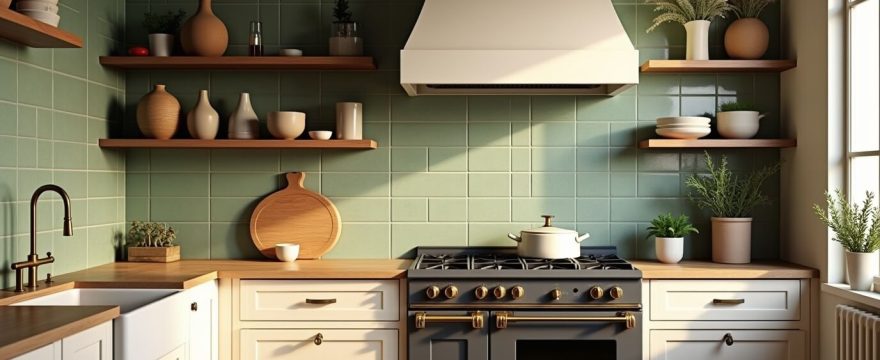
What Is a Farmhouse Kitchen Backsplash? (Definition, History & Why It Matters)
A farmhouse kitchen backsplash is a wall covering installed between the countertop and upper cabinets — or floor to ceiling — in a kitchen designed in the farmhouse style. It serves two purposes: protecting the wall from moisture, grease, and heat, and defining the visual character of the kitchen. If you are still figuring out the broader direction of your farmhouse kitchen design, the backsplash is the single best place to start — it anchors everything else. The best farmhouse kitchen backsplashes use natural or artisanal materials — white subway tile, shiplap, reclaimed wood, brick, stone, or handmade ceramic — that feel grounded, textured, and historically rooted rather than sleek or mass-produced.
Farmhouse kitchen design draws from two centuries of American agricultural and European cottage tradition. The original working farmhouses of the 1800s had kitchens built entirely for labor: stone walls, wooden beams, cast iron stoves, and surfaces tough enough to last generations. As those homes were renovated over decades, their patina and practicality became a design language that modern homeowners now deliberately recreate — prioritizing warmth, character, and livability over trend-chasing perfection. That same spirit carries through to everything in a farmhouse kitchen — from the backsplash on the walls to the meals prepared inside it. If you are deciding between a rustic direction and a cleaner modern aesthetic, our guide to modern farmhouse vs. rustic farmhouse style breaks down the key differences in detail.
The backsplash is the single element that most defines whether a kitchen reads as farmhouse or not. It sits at eye level, covers the most visible wall surface in the room, and bridges the two fixed anchors of any kitchen — the countertop below and the cabinets above. Get it right, and everything in the kitchen feels intentional. Get it wrong, and even beautiful cabinets and countertops feel disconnected. Choosing the right farmhouse kitchen sink and backsplash together, for instance, creates a cohesive focal wall that anchors the entire room.
At a Glance: Farmhouse Kitchen Backsplash Quick Facts
| Question | Answer |
|---|---|
| Total ideas in this guide | 50 farmhouse kitchen backsplash ideas |
| Most popular farmhouse backsplash | White subway tile with dark grout |
| Best budget option | Shiplap ($1–$4/sq ft materials) or peel-and-stick tile |
| Best DIY farmhouse backsplash | Shiplap, peel-and-stick, or basic ceramic subway tile |
| Most authentic / character-rich | Reclaimed wood, handmade zellige, natural stone, custom tile mural |
| Easiest to clean | Glazed ceramic tile, porcelain, glass tile, soapstone |
| Average installed cost | $8–$25/sq ft (varies widely by material) |
| Time to install (professional) | 1–2 days for a standard kitchen |
| Time to install (DIY) | 1–2 weekends for a standard kitchen |
| Best for resale value | White subway tile or neutral stone tile |
| Best for renters | Peel-and-stick farmhouse backsplash tile or grasscloth wallpaper |
| Most unique / bespoke option | Custom hand-painted tile mural |
Why the Farmhouse Kitchen Backsplash Is the Highest-Impact Design Decision You’ll Make
Interior designers and remodeling professionals consistently identify the backsplash as the highest-impact visual element in a kitchen renovation — and here is why that matters specifically for farmhouse kitchens:
- It sits at eye level. The zone between countertop and upper cabinets is exactly where your eyes go when you walk into a kitchen. No other surface gets more visual attention.
- It covers more area than you think. A standard kitchen has 30–40 square feet of backsplash. That is a significant canvas.
- It bridges your two fixed elements. Your countertop and cabinets are expensive to change. The backsplash is what makes them look like they belong together — or exposes that they don’t.
- It defines your farmhouse sub-style. White shiplap = modern farmhouse. Stacked slate = rustic farmhouse. Hand-painted Talavera = boho farmhouse. The backsplash is the clearest signal of which direction you’re going.
- It has excellent ROI. According to Remodeling Magazine’s annual Cost vs. Value Report, kitchen updates consistently recover 60–80% of investment at resale — and backsplash replacement is one of the most affordable kitchen upgrades with the highest visual impact.
What Makes a Kitchen Backsplash Look “Farmhouse”? (5 Key Qualities)
Not every tile or material qualifies as farmhouse. The aesthetic has a specific and recognizable visual vocabulary built from five core qualities:
| Quality | What It Means | Examples |
|---|---|---|
| Natural materials | Comes from the earth, not a factory | Wood, stone, brick, clay, marble |
| Handmade or artisanal feel | Slight imperfections, texture, color variation | Zellige, Talavera, handmade subway tile |
| Warm or neutral tones | Creams, whites, warm grays, terracotta, aged wood | Off-white tile, warm beige grout, reclaimed oak |
| Historical references | Rooted in 19th-century European or American design | Penny tile, brick, beadboard, subway tile |
| Layered character | Looks collected over time, not bought in an afternoon | Mixing materials, imperfect grout lines, patina |
Understanding farmhouse sub-styles helps you choose. Modern farmhouse leans white, clean, and minimal. Rustic farmhouse goes textured, warm, and imperfect. Coastal farmhouse adds soft blues and light woods. Boho farmhouse mixes global patterns and handcraft. Industrial farmhouse uses dark metal and raw surfaces. The right farmhouse color palette for your kitchen walls and cabinets will directly inform which backsplash material reads as cohesive versus jarring. All sub-styles share the same core quality — they feel genuinely lived-in rather than staged.
How Much Does a Farmhouse Kitchen Backsplash Cost? (Quick Answer)
The cost of a farmhouse kitchen backsplash ranges from $150 to $4,500+ for a standard 30 square foot kitchen, depending on material and whether you hire a professional or do it yourself.
- Budget DIY (shiplap or peel-and-stick): $50–$200 in materials
- Mid-range (ceramic subway tile, professionally installed): $300–$600
- Premium (natural stone or handmade tile, professionally installed): $800–$2,500+
- Luxury (marble slab or full-height zellige): $2,500–$5,000+
The biggest cost variables are the material you choose, whether you install it yourself, and how complex the pattern is — straight-set tile costs less in labor than herringbone or mosaic. According to the National Kitchen & Bath Association (NKBA), the average kitchen remodel in the U.S. runs $25,000–$50,000, meaning a backsplash upgrade is one of the most impactful low-cost changes you can make. For a full picture of where backsplash fits in your renovation budget, see our complete kitchen renovation cost guide.
Quick Answer: What Are the Best Farmhouse Kitchen Backsplash Materials in 2026?
The best farmhouse kitchen backsplash materials in 2026 are: white subway tile (most popular), shiplap (best for DIY and budget), reclaimed wood (most authentic rustic character), brick veneer (best for industrial or heritage farmhouse), natural stone such as slate or travertine (best for rustic mountain farmhouse), handmade ceramic tile or zellige (best artisanal option), and marble or marble-look porcelain (best for elevated farmhouse style). Subway tile with charcoal grout is the single most versatile and widely recommended choice. Shiplap is the top pick for budget renovations and DIY installations. Handmade tile and natural stone deliver the most authentic farmhouse character but require more maintenance and budget.
People also ask:
- What is the most popular farmhouse kitchen backsplash? → White subway tile with dark grout.
- Is shiplap a good kitchen backsplash? → Yes, when properly sealed — it’s the best budget farmhouse backsplash option.
- What tile looks most farmhouse? → Handmade white ceramic, zellige, or classic 3×6 subway tile with warm grout.
- What is the easiest farmhouse backsplash to install yourself? → Peel-and-stick tile or shiplap planks.
The 50 Best Farmhouse Kitchen Backsplash Ideas
1. Classic White Subway Tile Farmhouse Backsplash With Dark Grout
Best for: Modern farmhouse, transitional kitchens, first-time renovators
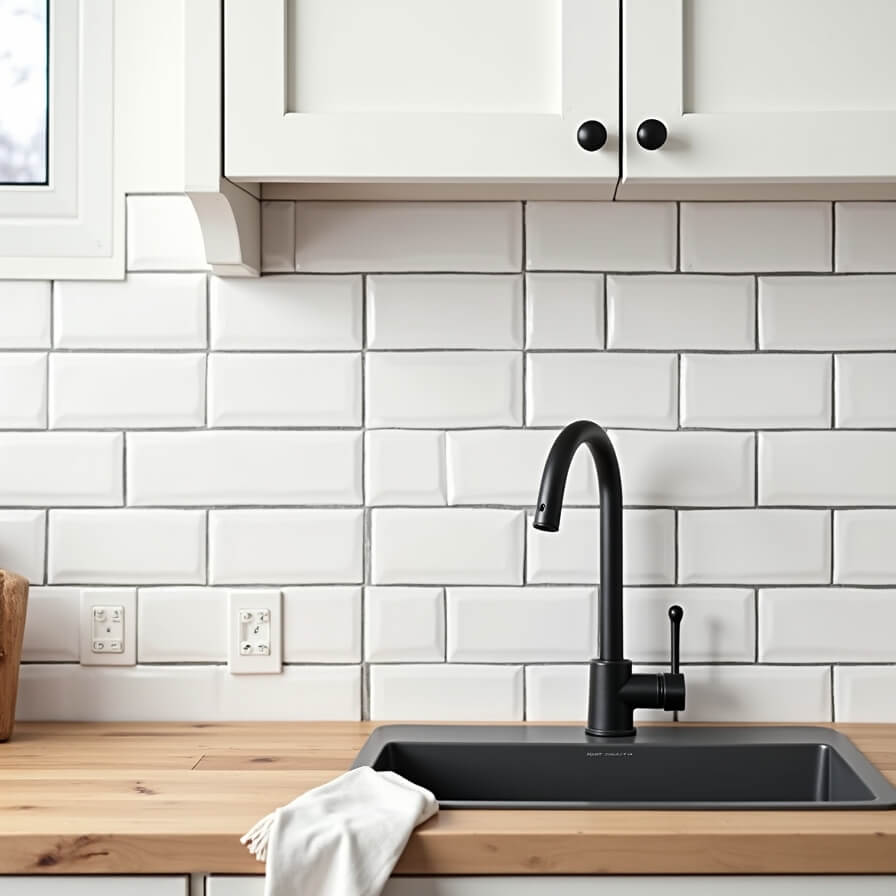
White subway tile is the canonical farmhouse backsplash choice — and for excellent reason. Originally installed in New York City subway stations at the turn of the 20th century, as documented by the New York Transit Museum, the 3×6 inch glazed white tile made its way into American kitchens in the 1920s and has never really left.
The genius of white subway tile is its adaptability. It works with natural wood tones, painted cabinets, butcher block countertops, and marble. It reflects light and makes small kitchens feel larger. And it costs less than almost any other tile option — basic subway tile typically runs $1 to $5 per square foot.
The grout makes the difference. Charcoal or dark gray grout creates definition between each tile, giving your backsplash that vintage, hand-set look that feels authentically farmhouse. If you are unsure which grout shade to choose, our guide to the best grout colors for white subway tile walks through every major option with real kitchen photos. Bright white grout reads more contemporary and hygienic — for farmhouse, go darker.
Pro installation tips:
- Use a brick-lay (running bond) pattern — each tile offset by half from the row above. This is the classic subway look.
- For a more traditional farmhouse feel, consider vertical stacking — see idea #28 in this guide — which reads as deliberately old-fashioned.
- Herringbone subway tile is more intricate but dramatically more beautiful — see idea #7 for the full breakdown.
- Choose beveled subway tile for added dimension and character.
Cost estimate: $3–$8/sq ft installed (basic), $8–$18/sq ft (handmade or specialty tile)
2. Shiplap Farmhouse Kitchen Backsplash (The Budget-Friendly Icon)
Best for: Budget renovations, DIY projects, modern farmhouse style
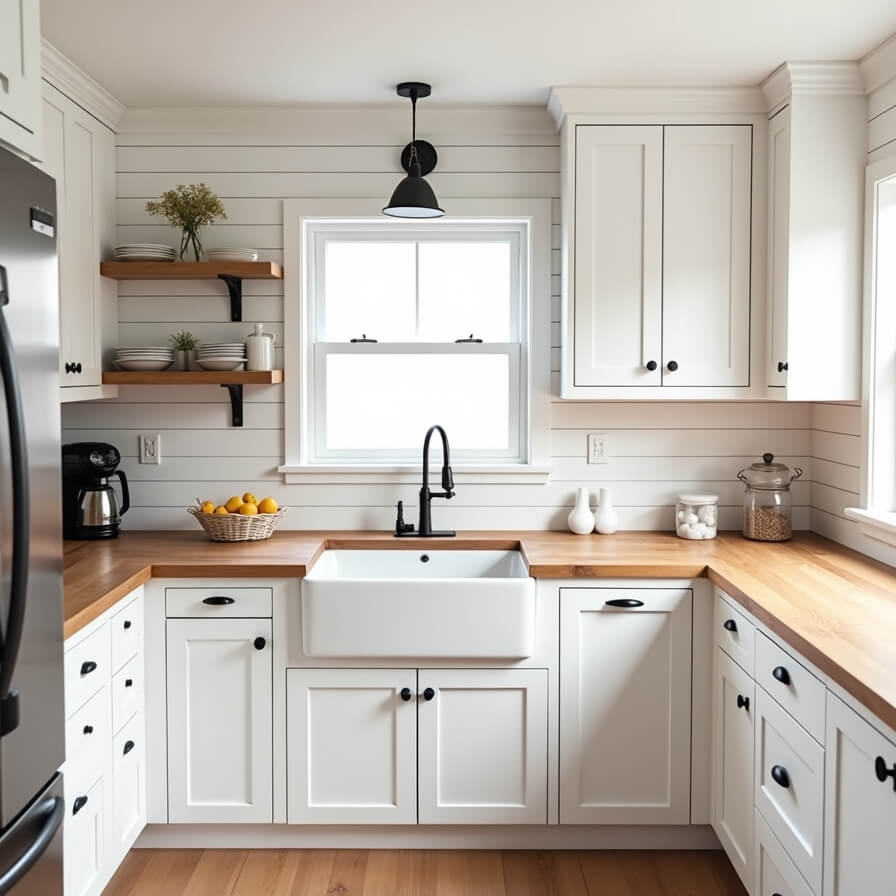
Shiplap — horizontal wood boards with a small reveal gap between each — became culturally synonymous with farmhouse design through television renovations, but its roots are genuinely historical. Shiplap was used in barns, farmhouses, and coastal structures for centuries because it was cheap, widely available, and easy to install by non-specialists.
As a kitchen backsplash, shiplap creates instant farmhouse credibility. Painted white, it feels clean and crisp. Left natural or stained warm, it reads rustic and cozy. Painted in a deep color like navy or black, it becomes surprisingly dramatic and contemporary. If you want to combine shiplap with open floating shelves for a full wall treatment, jump ahead to idea #24 in this guide, which covers that approach in detail.
Practical considerations for shiplap backsplashes:
- Always use moisture-resistant or exterior-grade wood behind the stove and above the sink.
- Apply multiple coats of a water-based polyurethane or a kitchen-safe sealant to protect against steam and splatter. For a detailed walkthrough, our guide on how to seal wood for kitchen use covers every finish type.
- Leave a small expansion gap (1/8 inch) between boards to account for humidity changes.
- Caulk all edges where shiplap meets cabinets, countertops, and walls to prevent moisture intrusion.
Cost estimate: $1–$4/sq ft (materials only), $4–$10/sq ft installed
3. Reclaimed Barn Wood Farmhouse Kitchen Backsplash
Best for: Rustic farmhouse, cottage style, character-forward kitchens
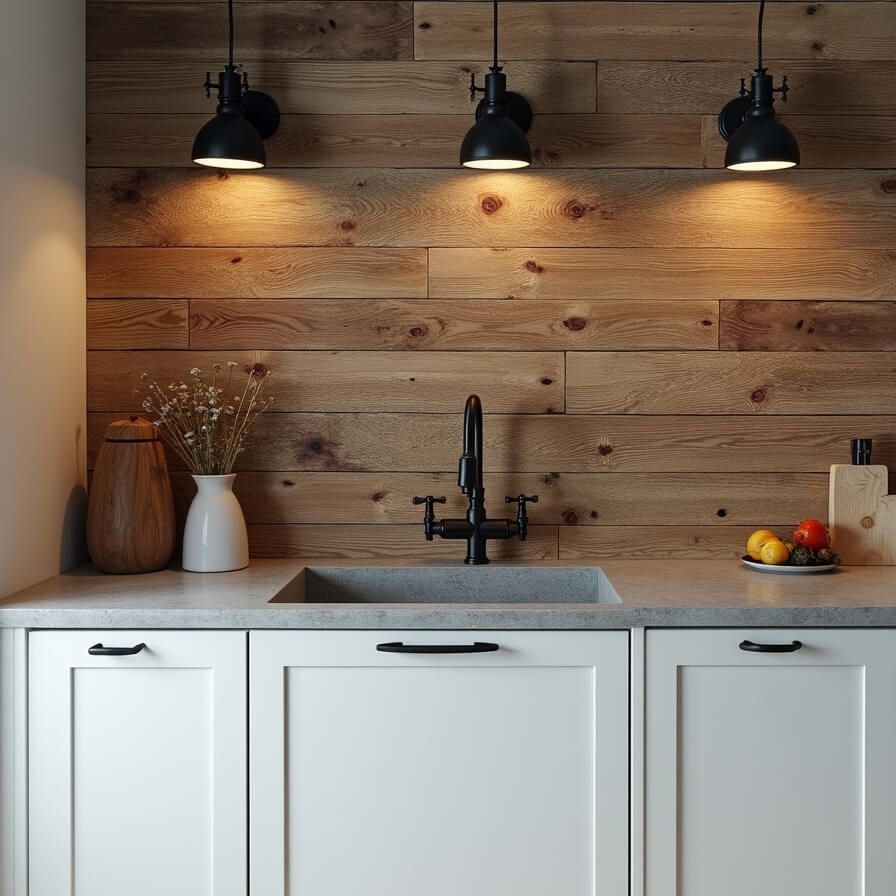
If subway tile is the Little Black Dress of farmhouse backsplashes, reclaimed barn wood is the vintage leather jacket — specific, memorable, and impossible to fake convincingly with a new substitute.
Real reclaimed wood carries authentic history in every knot, nail hole, and weathered grain. Old barn siding, fence boards, factory flooring, and even old shipping pallets have all been successfully repurposed into stunning kitchen backsplashes. The variation in color, texture, and wood species that happens naturally over decades of outdoor exposure creates the kind of visual depth that no manufactured product can replicate. If you are drawn to this look throughout your home, our reclaimed wood kitchen ideas guide covers floors, open shelves, and island cladding as well.
Where to source reclaimed wood:
- Architectural salvage yards and deconstruction centers
- Old barns being demolished (often free or very cheap)
- Craigslist and Facebook Marketplace (“barn wood,” “reclaimed lumber”)
- Specialty retailers like Elmwood Reclaimed Timber or Reclaimed DesignWorks
- Etsy shops that specialize in reclaimed materials
Installation and safety essentials:
- Treat all reclaimed wood for pests before installing (kiln-dry or apply a borate treatment).
- Sand surfaces that will be near food prep areas — rough splinters accumulate grease.
- Apply at minimum two coats of polyurethane or a food-safe tung oil finish.
- Install a heat-resistant barrier behind any wood surface near a stove.
- Keep the installation area away from open flame range burners — see the safety note in idea #2 above.
Cost estimate: $2–$10/sq ft (materials, depending on source), $10–$20/sq ft installed
4. Vintage Patterned Ceramic Tile Farmhouse Backsplash
Best for: European farmhouse, cottage kitchens, kitchens needing personality
Before the subway tile era, patterned ceramic tiles dominated kitchen design across Europe and the Americas. Spanish azulejos, Portuguese tiles, Dutch Delft, Italian maiolica — these handmade, hand-painted ceramic traditions stretch back 500 years, and they bring that centuries-long history directly to your kitchen wall. For Spanish and Portuguese pattern inspiration, the deep-dive Portuguese tile kitchen guide on this site is a useful reference.
Modern versions range from faithful reproductions to contemporary interpretations. Blue-and-white patterns evoke Dutch and Portuguese farmhouse kitchens. Terracotta and cream geometric patterns recall Moroccan and Spanish design. Pastel florals feel English cottage. Earthy folk patterns lean toward Mexican and Southwestern farmhouse. If the Southwestern direction appeals to you, see idea #11 on Talavera tile later in this guide.
How to use patterned tile without overwhelming a space:
- Use patterned tile as an accent behind just the range, not full wall coverage.
- Pair it with solid-color painted cabinets (white, soft green, navy) — avoid competing patterns.
- Keep countertops in a neutral, solid material (butcher block, plain quartz, white marble).
- Let the tile be the focal point and minimize other decorative elements on the same wall.
Cost estimate: $5–$40/sq ft depending on handmade vs. machine-made
5. Exposed Brick and Painted Brick Farmhouse Kitchen Backsplash
Best for: Industrial farmhouse, loft-style farmhouse, heritage renovations
Exposed brick is one of the oldest kitchen wall treatments in human history — because before tile was widely manufactured and affordable, brick was what kitchens were built from. Farmhouses across England, France, and early America had brick-surrounded hearths and cooking areas by necessity.
Today, you can achieve this look through actual exposed brick (if your walls already have it hiding under plaster or drywall), through brick veneer panels, or through thin-set brick slices that adhere like tile. If you want a lighter, more modern take on the same material, idea #18 in this guide covers white brick veneer specifically.
Painted brick is its own category entirely. Whitewashed brick — where diluted white paint is applied and then partially wiped away, letting the original brick color show through — creates a uniquely aged look that straight paint cannot replicate. If you are deciding between whitewash and limewash finishes, our whitewash vs. limewash brick comparison covers the differences in application and final look. Limewashed brick gives even more variation and depth.
Brick backsplash installation options:
| Type | Cost | Authenticity | Weight | DIY-Friendly |
|---|---|---|---|---|
| Real exposed brick | Free (existing wall) | Highest | Heavy | Moderate |
| Brick veneer panels | $3–$8/sq ft | High | Light | Yes |
| Thin brick slices | $4–$10/sq ft | High | Very light | Yes |
| Brick-look porcelain | $4–$12/sq ft | Medium | Light | Yes |
Important: All real brick surfaces in kitchens must be sealed — brick is highly porous and will absorb grease and moisture without treatment. The Brick Industry Association recommends a silane-siloxane-based penetrating sealer for interior brick surfaces near food preparation areas. Reseal every 1–2 years.
Cost estimate: Free (if exposing existing brick) to $12–$25/sq ft installed (thin brick or veneer panels professionally installed)
6. Marble Backsplash for Farmhouse Kitchens (Carrara, Calacatta & Honed Options)
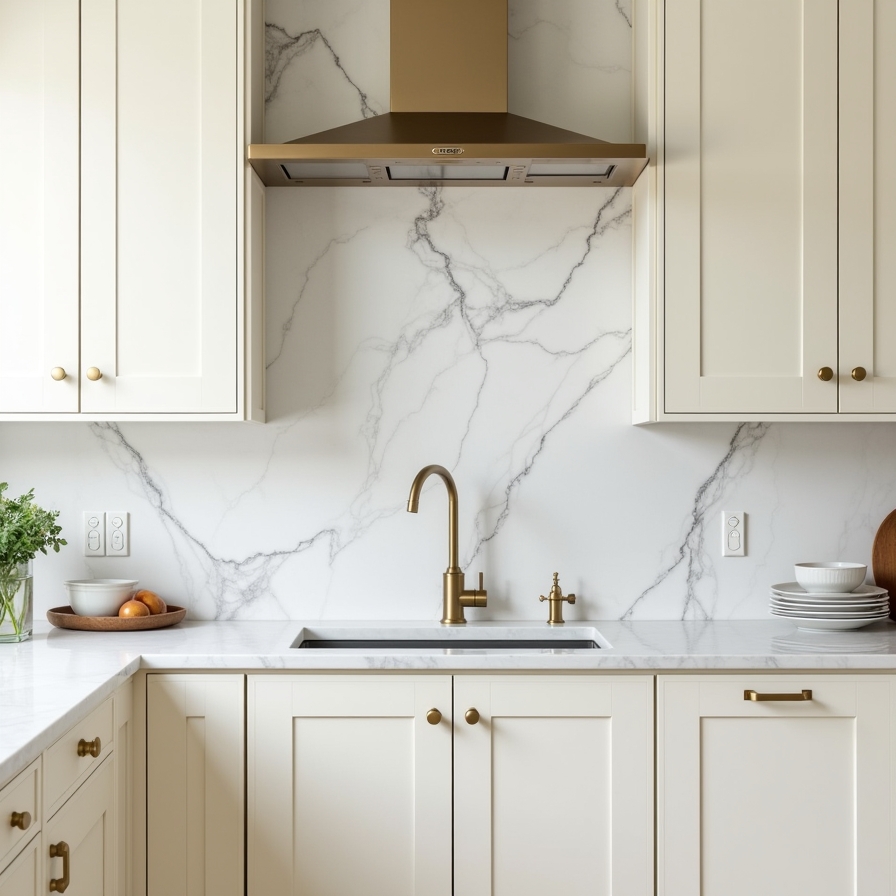
Best for: Elevated farmhouse, farmhouse-luxe, kitchen renovations with larger budgets
Marble has a surprisingly deep farmhouse history. Before synthetic surfaces existed, natural marble was used in home dairies and farm kitchens because its cold surface was ideal for butter-making, pastry work, and food storage. So while marble reads “luxury” today, it is historically a working farm material. If you are considering marble for your countertops as well, our marble countertops pros, cons & care guide is essential reading before you commit.
The most farmhouse-appropriate marble choices:
- Carrara: Soft white background, delicate gray veining — the most understated and kitchen-appropriate. For a full breakdown, see our Carrara vs. Calacatta marble comparison.
- Calacatta: Bold white background, dramatic gold and gray veining — more of a statement.
- Honed marble: A matte finish rather than polished. This reads authentically old-world and is significantly more forgiving of minor scratches and etching than polished surfaces.
Marble for the budget-conscious: Marble-look porcelain has become extraordinarily convincing. At $4–$12 per square foot versus $25–$75 for real marble, porcelain delivers the visual at a fraction of the maintenance commitment. The Tile Council of North America (TCNA) has published installation guides for both real marble and porcelain — highly recommended before beginning any installation.
Cost estimate: $15–$75/sq ft real marble installed; $8–$20/sq ft marble-look porcelain installed
7. Herringbone Tile Farmhouse Kitchen Backsplash
Best for: Kitchens that want visual interest without color, modern farmhouse, traditional farmhouse
The herringbone pattern — two rows of tiles or planks arranged in a V-shape that alternates direction — dates back to ancient Roman road construction. It has been used in flooring, weaving, fabric, and wall tile for thousands of years. In a kitchen backsplash, it adds sophisticated movement and visual complexity without requiring any change in color or material.
Herringbone works with nearly any tile:
- White subway tile in herringbone: Dramatically more interesting than horizontal subway, same clean color story. This is the easiest entry point if you have never done a non-standard layout before.
- Wood-look tile in herringbone: Adds richness and warmth, works beautifully with dark cabinets.
- Marble or marble-look tile in herringbone: The veining of marble follows the herringbone angles and creates extraordinary movement — this is one of the most striking combinations in farmhouse kitchen design.
- Small mosaic in herringbone: Delicate and intricate — works beautifully as an accent strip rather than full-wall coverage. See idea #8 for more on mosaic tile options.
- Reclaimed wood planks in herringbone: The most dramatic wood backsplash option — looks like a work of art.
Grout color matters enormously in herringbone. Dark grout on white tile makes each tile’s individual shape crisp and readable. Matching grout creates a more subtle, tone-on-tone effect. If you want to understand how grout color changes the final result before committing, our best grout colors for white subway tile guide includes herringbone-specific examples.
Installation note: Herringbone is significantly more labor-intensive than straight-set tile — expect to pay 20–40% more in labor costs, and plan for 10–15% more material waste due to the angled cuts at edges. Always hire a tile setter with specific herringbone experience. The difference between herringbone and chevron is commonly misunderstood — our herringbone vs. chevron pattern guide explains the distinction clearly.
Cost estimate: $12–$25/sq ft installed (20–40% labor premium over straight-set)
8. Mosaic Tile Farmhouse Backsplash (Penny Round, Hex & Stone Mix)
Best for: Artisan farmhouse, accent areas, smaller kitchens that need texture without scale
Mosaic tiles — small pieces of tile, stone, or glass arranged in patterns — are among the oldest decorative surface treatments on Earth, used in ancient Greek, Roman, and Byzantine architecture. In a farmhouse kitchen, they bring an artisanal, handcrafted quality that feels both historic and unique.
Popular mosaic formats for farmhouse kitchens:
- Penny rounds: Small circular tiles that evoke vintage American kitchens from the early 1900s. Cream, white, or earthy tones are most farmhouse-appropriate. For a full penny tile treatment, jump to idea #19.
- Hexagon mosaics: A honeycomb pattern that is simultaneously geometric and organic. For larger hex tile, see idea #23.
- Marble and stone mixes: Combining different natural stone chips creates a textured, organic surface. See the stone mosaic tile buying guide for material options and price comparisons.
- Subway mosaic sheets: Tiny subway tiles on mesh backing — creates the visual of a classic backsplash with much more texture.
Most mosaic tiles come mounted on mesh backing in 12×12 inch sheets, making installation manageable even for ambitious DIYers.
Cost estimate: $8–$35/sq ft depending on material (stone more expensive, ceramic more affordable)
9. Natural Stone and Slate Farmhouse Kitchen Backsplash
Best for: Rustic farmhouse, mountain farmhouse, kitchens with dark wood or exposed beam ceilings
Nothing grounds a farmhouse kitchen in genuine nature like real stone. Whether it’s stacked slate, river rock, ledgestone, travertine, or quartzite, natural stone delivers texture, depth, and an organic irregularity that no manufactured product can authentically replicate.
Stone types and their farmhouse characters:
| Stone | Color Range | Texture | Feel |
|---|---|---|---|
| Slate | Dark gray, charcoal, rust | Flat with layered edges | Rustic, rugged |
| Travertine | Cream, beige, walnut | Pitted, natural holes | Italian, old-world |
| Ledgestone / Stacked stone | Gray, brown, rust | Highly textured, dimensional | Mountain cabin |
| River rock | Multi-colored | Rounded, very dimensional | Cottage, boho |
| Limestone | White, gray, beige | Smooth to slightly textured | French farmhouse |
| Quartzite | White with movement | Smooth | Elevated rustic |
For a head-to-head comparison of the two most popular rustic options, our slate vs. travertine kitchen guide covers durability, cost, and maintenance side by side.
Maintenance reality check: All natural stone must be sealed before use and regularly resealed (typically annually for kitchen surfaces). Stone is porous and will stain from olive oil, red wine, and tomato sauce if unsealed. The Natural Stone Institute provides free care and maintenance guides for every stone type — read them before purchasing. For a step-by-step sealing process, our how to seal natural stone tile guide covers the full procedure.
Cost estimate: $10–$40/sq ft installed depending on stone type
10. Beadboard Farmhouse Kitchen Backsplash (Shiplap-Style Vertical Planks)
Best for: Cottage farmhouse, budget renovations, renters (with modification)
Beadboard — vertical tongue-and-groove boards with a small rounded bead between each plank — is even older in American residential design than horizontal shiplap. It was widely used as wainscoting and wall covering in Victorian-era homes and early 20th century cottages. In a farmhouse kitchen, it reads authentically historical and warm.
Unlike horizontal shiplap, vertical beadboard draws the eye upward, creating the impression of higher ceilings — which is why it pairs particularly well with ideas like vertical subway tile (idea #28) or beadboard (idea #10) for tight spaces. This makes it particularly effective in smaller kitchens or kitchens with standard 8-foot ceilings. The repeated vertical lines also create a rhythm and texture that plain drywall or flat tile simply cannot achieve. If you are trying to decide between shiplap and beadboard, our beadboard vs. shiplap comparison breaks down the visual and practical differences clearly.
Beadboard backsplash options:
- Traditional beadboard planks: Most authentic, requires proper sealing for kitchen use.
- MDF beadboard panels: Easier to install, more affordable, must be fully sealed and caulked (moisture-sensitive).
- PVC beadboard: Waterproof, easy to cut, excellent in high-moisture zones — less visually authentic but practical.
- Tile that mimics beadboard: Ceramic tiles molded with beadboard profiles — combines the look with the durability of tile.
Painting tips for beadboard backsplash: Classic white is the most farmhouse-appropriate. Soft cream or warm ivory reads even cozier. For a bolder look, deep navy or sage green beadboard against white cabinets creates striking contrast. Always use a semi-gloss or satin finish paint in kitchen environments — matte paint absorbs grease and is nearly impossible to clean. Our guide to the best paint finishes for kitchen walls explains the difference between each sheen level.
Cost estimate: $3–$10/sq ft installed (MDF panels), $8–$18/sq ft (tile version)
11. Hand-Painted Talavera and Mexican Tile Farmhouse Backsplash
Best for: Boho farmhouse, southwestern farmhouse, kitchens with personality
Talavera tile — the brightly painted, tin-glazed earthenware produced in Puebla, Mexico — brings an exuberance and craft tradition that few other backsplash materials can match. Authentic Talavera is hand-painted by artisans, and no two pieces are identical. The colors — cobalt blue, terra cotta, mustard yellow, forest green — are vivid and saturated. For more on pairing this style with your overall kitchen design, our southwestern farmhouse kitchen ideas guide covers cabinet colors, hardware, and flooring that work best alongside Talavera.
How to use Talavera without going overboard:
- Install as a full backsplash only if the rest of the kitchen is calm and neutral.
- Use as an accent strip — a border row at the top of a plain white tile backsplash.
- Feature a single panel of patterned tiles behind the range as a focal point. This approach is also covered in the bold tile accent wall section of idea #25.
- Mix with plain white Talavera (undecorated) to reduce visual intensity.
Note on authenticity: True handmade Talavera from certified artisans in Puebla carries a denomination of origin designation recognized by the Mexican government’s IMPI. The authentic version costs more — $20–$60/sq ft versus $8–$20 for machine-made imitations — but carries the quality and story that factory production cannot replicate. Before buying, our Mexican tile backsplash buying guide explains how to identify authentic Talavera from mass-produced lookalikes.
Cost estimate: $8–$20/sq ft (machine-made); $20–$60/sq ft (authentic handmade Talavera from Puebla)
12. Glass Tile Farmhouse Kitchen Backsplash for Modern Farmhouse Style
Best for: Modern farmhouse, bright kitchens, kitchens without enough natural light
Glass tiles occupy an interesting middle ground in farmhouse design — they are contemporary in material but available in shapes and colors that read warmly and naturally. Their most distinctive property is light reflection. Glass tile bounces natural and artificial light around a kitchen in a way that no other backsplash material does, making them especially valuable in darker kitchens or north-facing kitchens with limited sunlight. For more ways to brighten a dim farmhouse kitchen, see our piece on small kitchen backsplash ideas that make the room feel bigger.
Farmhouse-appropriate glass tile choices:
- Sea glass green: Evokes aged, tumbled glass found on beaches — inherently organic and natural. Pairs beautifully with the coastal farmhouse kitchen palette of white shiplap and natural wood.
- Frosted white: Reads clean and contemporary while staying warm.
- Pale gray or smoke: Neutral and sophisticated, works with any farmhouse palette.
- Soft blue-green: Coastal farmhouse at its cleanest.
- Amber or honey: Warm and rich, pairs beautifully with dark walnut or black-stained cabinets.
One significant practical benefit of glass tile: it is completely non-porous and requires no sealing. Grease wipes off with a damp cloth. For families with active kitchens, this matters enormously.
Cost estimate: $12–$30/sq ft installed (standard glass tile); $20–$50/sq ft (handmade or specialty art glass)
13. Copper and Pressed Tin Farmhouse Kitchen Backsplash
Best for: Victorian farmhouse, industrial farmhouse, kitchens with warm metal accents
Pressed tin tiles — embossed metal sheets stamped with ornate patterns — were a Victorian-era invention used as cheap ceiling and wall covering in everything from farmhouses to saloons to commercial buildings. Today, they are recognized as genuinely beautiful artifacts with real design character. If you are working on a Victorian-style renovation more broadly, our Victorian kitchen design guide covers period-accurate details for every surface.
Copper develops a patina over time — moving from bright, shiny copper to warmer, darker tones with green oxidation at edges. This aging process is considered an asset in farmhouse design: the tile improves and becomes more characterful with time rather than degrading. For help choosing between copper, brass, and bronze metal finishes throughout your kitchen, our kitchen hardware guide compares all three in depth.
Stainless steel offers a more professional, less romantic look — clean and durable, excellent for serious home cooks who want easy cleaning behind the range.
Installation options:
- Freestanding panels: Unframed sheets installed directly to the wall like tile.
- Framed panels: Individual tin tiles with frame borders, installed in a grid.
- Copper sheet: Single continuous piece of copper, custom cut — most expensive but most dramatic.
Cost estimate: $8–$25/sq ft for pressed tin, $15–$50/sq ft for copper
14. Zellige Moroccan Tile Farmhouse Backsplash
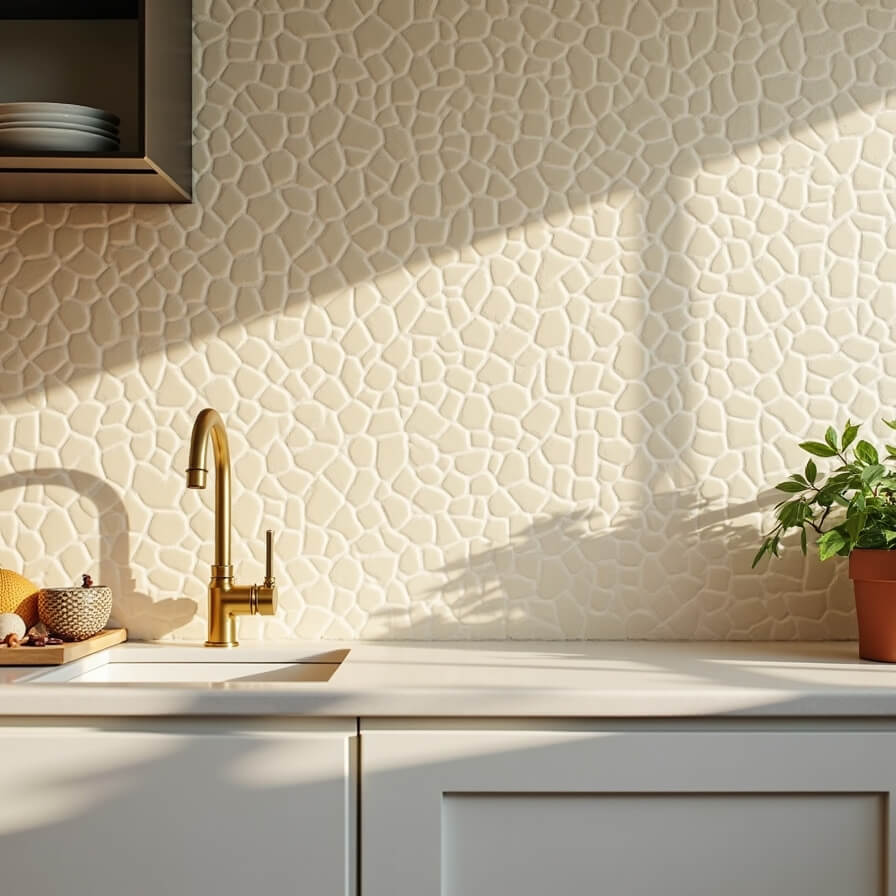
Best for: Boho farmhouse, artisan kitchens, maximalist farmhouse
Zellige tiles — handmade Moroccan clay tiles with hand-applied enamel glaze — are having a major moment in kitchen design, and for good reason. Each tile is made by hand, and the irregular thickness, slight warping, and variation in glaze color from piece to piece creates a shimmer and depth that no machine-made tile can replicate. Before purchasing, read our zellige tile complete buying guide to understand how to evaluate quality and avoid imitations being sold as authentic zellige.
In a farmhouse kitchen, zellige in white, off-white, or soft sage creates a backsplash with exceptional visual richness. The way light plays across the irregular surface throughout the day gives the wall an almost living quality — it looks different in morning sun than it does under evening lamplight. For the sage green color specifically, see how it performs in idea #36 on sage green tile.
Zellige is not a beginner’s tile. The irregular thickness requires an experienced tile setter. Grout lines will not be perfectly even. The overall installation is deliberately imperfect — and that imperfection is the entire point. If you want mathematical precision, idea #1 (subway tile) is your material. If you want something that feels genuinely handmade and old-world, zellige is extraordinary.
Cost estimate: $25–$60/sq ft tile + 20–30% premium on installation labor
15. Limewash and Textured Plaster Farmhouse Kitchen Backsplash
Best for: Minimal farmhouse, Mediterranean farmhouse, rental-friendly options
Before tile was widely available and affordable, farmhouse kitchen walls were covered in plaster — often lime plaster tinted with natural pigments. This ancient wall treatment — used for thousands of years across Europe, the Middle East, and the Americas — creates a surface with beautiful, organic variation in color and texture.
Limewash paint (diluted, mineral-based paint applied with broad brushstrokes and then wiped back) mimics this look without the need for actual plaster work. Applied over a properly primed wall, it creates a matte, slightly chalky, beautifully layered surface that looks genuinely aged. For a full how-to, our limewash paint application guide walks through surface prep, application technique, and topcoat options.
Venetian plaster takes it further — a multi-coat application of marble-dust plaster polished to create depth and subtle sheen. Less rustic than limewash, more appropriate for elevated or Mediterranean farmhouse styles. For broader Mediterranean farmhouse inspiration, our Mediterranean farmhouse kitchen design guide covers tile, color, and material pairings in detail.
Important: Neither limewash nor standard Venetian plaster alone is appropriate directly behind a stove or sink without a protective topcoat. Use only in lower-heat, lower-splatter areas, or apply a penetrating sealer rated for high-moisture environments.
Popular limewash brands for farmhouse kitchens: Portola Paints Roman Clay, Romabio Classico Limewash, and Faux Effects Lusterstone are all widely used by professional painters and produce beautiful, authentic results.
Cost estimate: $2–$6/sq ft (limewash paint + application); $15–$40/sq ft for professional Venetian plaster
16. Butcher Block and Wood Slab Farmhouse Kitchen Backsplash
Best for: Kitchen island backsplashes, fireplace surrounds, accent walls in farmhouse kitchens
While most backsplashes in the traditional sense cover the wall between countertop and upper cabinets, farmhouse kitchens often feature wood slab or butcher block elements in non-traditional locations: behind a kitchen island, around a range hood, or as a focal accent wall element. If you are considering butcher block for your countertops as well, our butcher block countertops pros, cons & maintenance guide is essential reading before you commit to this material throughout the kitchen.
End-grain butcher block, in particular, has a beautiful cellular pattern when viewed from above — concentric rings of wood fiber that create a visual complexity closer to natural stone than to planks.
Maintenance for wood backsplash areas:
- Apply mineral oil or beeswax finish monthly (butcher block) or as needed.
- Keep away from direct water contact — install a small strip of metal or tile at the most splash-prone zone.
- Lightly sand and refinish every 2–3 years to remove stains and restore surface.
Best wood species for farmhouse kitchen backsplash use: Hard maple (tight grain, resists moisture well), white oak (beautiful ray fleck pattern, very durable), and walnut (rich dark tone, pairs beautifully with white cabinets) are the top choices among furniture makers and kitchen designers. For more live-edge and slab wood applications in the kitchen, see our live edge wood kitchen ideas guide.
Cost estimate: $15–$45/sq ft installed (butcher block); $20–$80/sq ft for live-edge wood slab
17. Cement and Encaustic Tile Farmhouse Kitchen Backsplash
Best for: Global farmhouse, artisan kitchens, kitchens with black or dark cabinets
Encaustic cement tiles — made from pigmented cement layers pressed together, not kiln-fired like ceramic — have a visual richness and matte finish that ceramic and porcelain cannot replicate. They have been made continuously in Morocco, France, Portugal, and South America for over 150 years. Before purchasing, our encaustic cement tile buying guide covers the most reputable brands, price ranges, and what to look for in quality.
The colors are softer than ceramic glazes — more muted, chalky, and complex. The patterns range from simple geometric grids to elaborate medallions. Because they are made from cement rather than glass-coated ceramic, they have a completely matte, porous surface that absorbs color and light differently.
Maintenance requirement: Encaustic tile must be sealed before use and resealed regularly. Unsealed cement tile will absorb oil and stain permanently within hours. For the exact sealing process, our how to seal cement tile in kitchens guide covers every step. This is non-negotiable.
Pattern families for farmhouse kitchens: Geometric stars and crosses (Moroccan and Spanish origin), quatrefoil and medallion patterns (French and Portuguese tradition — see also idea #42), simple stripe and chevron designs (most modern-farmhouse compatible), and solid-color encaustic in earthy tones (most understated — lets texture do the work rather than pattern).
Cost estimate: $10–$35/sq ft tile + normal installation labor
18. White Brick Veneer Farmhouse Kitchen Backsplash
Best for: Modern farmhouse, transitional kitchens, apartment or condo kitchens
White brick hits a sweet spot between rustic texture and modern cleanliness that makes it one of the most versatile farmhouse backsplash options. Unlike raw red brick — covered in idea #5 — white brick stays light and fresh while still providing the irregular texture and grout-line shadow that make a surface visually interesting. This makes it particularly well suited to apartment and condo kitchens where a full exposed brick treatment is not possible. For more no-damage kitchen upgrade ideas, see our apartment kitchen backsplash guide.
Application methods:
- Actual brick veneer panels: Thin slices of real brick adhered to a backing panel — authentic texture, relatively easy installation.
- Faux brick panels: Pressed concrete or polyurethane panels molded to look like brick — most affordable, lightest weight, least authentic feel.
- Brick-look tile: Elongated ceramic tile with a slightly rough surface and varied coloring — durable, easy to clean, convincing from a distance.
Whitewashing existing red brick is another option. The process — diluted white paint applied with a brush, then wiped back — is covered in detail in our whitewash vs. limewash brick guide. The pigment stays in the pores and low spots while rubbing off the peaks, creating the appearance of naturally aged white brick.
Grout color for white brick veneer: Use a warm off-white or light gray grout — this keeps the surface reading as light and airy while providing enough contrast to define the individual bricks. Bright white grout on white brick washes out all definition. Dark grout on white brick creates a more graphic, high-contrast effect.
Cost estimate: $8–$18/sq ft installed (veneer panels); $12–$25/sq ft (real thin brick)
19. Penny Round Mosaic Farmhouse Kitchen Backsplash
Best for: Vintage farmhouse, cottage kitchens, farmhouse bathrooms that connect to kitchen aesthetic
Penny tile — small circular ceramic mosaics typically about 3/4 inch to 1 inch in diameter — was one of the dominant floor and wall tile patterns in American homes from roughly 1880 through 1940. Finding it in an old farmhouse renovation is genuinely exciting because it means the original owners had good taste. For more on vintage farmhouse renovation, our vintage farmhouse kitchen renovation guide covers before-and-after approaches for older homes.
In a contemporary farmhouse kitchen, penny tile brings that vintage authenticity with a softness (all those circles) that more geometric tiles do not have. It is particularly beautiful in off-white, cream, or a very pale sage — colors that read as aged rather than bright.
Practical note: Penny tile has a lot of grout lines. All those little circles mean a lot of joints. Choose a grout that is either very close in color to the tile (minimizes the visual of grout lines) or quite dark (celebrates them as part of the pattern). Grout sealer is essential — grout will stain without it. Our ranked list of the best grout sealers for 2026 identifies the most durable options for high-use kitchen surfaces.
Color options beyond white: Pale sage penny tile against white grout creates a delicate botanical feel. Black penny tile with white grout is graphic and vintage — particularly beautiful in a kitchen with black fixtures and hardware. Mixed-color penny tile in earth tones creates a mosaic-like warmth that feels collected and artisan. For penny tile in the bathroom adjacent to your farmhouse kitchen, see our penny tile bathroom floor ideas guide.
Cost estimate: $10–$30/sq ft installed (ceramic); $20–$50/sq ft (marble or stone penny rounds)
20. Peel-and-Stick Farmhouse Backsplash (Best Budget DIY Kitchen Option)
Best for: Renters, budget renovations, temporary installations, apartment kitchens
Modern peel-and-stick backsplash tiles have undergone remarkable improvement in the past five years. The best current options — typically made from PVC or thin aluminum with an adhesive backing — are genuinely convincing at normal viewing distance, easy to apply without tools, and completely removable without damaging walls. For a full tested review of the best products on the market, our best peel-and-stick backsplash tiles 2026 guide ranks and compares the top options.
Best peel-and-stick options for farmhouse style:
- White subway tile peel-and-stick
- Shiplap-look peel-and-stick panels
- Stone-look mosaic sheets
- Herringbone wood-look
What peel-and-stick does well: Quick installation, no mess, renter-friendly, very affordable (typically $5–$15/sq ft installed yourself), easy to change when you want an update. For more renter-friendly kitchen upgrades under $200, this is consistently one of the highest-impact options available.
What peel-and-stick doesn’t do well: High heat (avoid directly behind gas burners), very high humidity (edges can lift over time), convincing up-close texture, or the look of a permanent installation when inspected carefully.
Best practice: Use a craft heat gun to press edges firmly and improve adhesion. Clean walls with isopropyl alcohol before application. Do not use in direct steam zones.
Cost estimate: $5–$15/sq ft (materials only, full DIY — no installation labor)
21. Full-Height Farmhouse Kitchen Backsplash (Counter-to-Ceiling Slab Style)
Best for: Modern farmhouse with minimal upper cabinets, kitchen remodels with open shelving
A growing trend in farmhouse-influenced kitchen design is the full-height slab backsplash — running tile, stone, or wood from countertop all the way to the ceiling, typically combined with open shelving rather than upper cabinets. For the broader debate on this topic, our open shelving vs. upper cabinets guide covers the practical and aesthetic trade-offs in detail.
Materials that work especially well floor-to-ceiling:
- Large-format white tile (12×24 or 24×48): Clean, contemporary, farmhouse-adjacent.
- Stacked natural stone ledger panels: Dramatic and architectural — see idea #32 for the full treatment.
- White shiplap: Classic modern farmhouse — see idea #24 for the combined shiplap + open shelf approach.
- Marble slab: The most dramatic and expensive — single-piece slabs eliminate grout lines entirely.
The full-height approach works best with open floating shelves instead of upper cabinets — the shelves allow the backsplash material to be seen rather than hidden behind cabinet doors. For styling advice, see our how to style open kitchen shelves guide.
Design tip: When running tile floor-to-ceiling, keep the tile format large (12×24 minimum) to reduce the number of grout lines and maintain a clean, expansive look. Small tile on a very tall wall creates visual busyness that works against the drama of the full-height installation. See our large format tile in small kitchens guide for more on this principle.
Cost estimate: $15–$35/sq ft installed (large-format tile); $50–$150/sq ft (marble slab, full height)
22. Two-Tone and Mixed Material Farmhouse Kitchen Backsplash
Best for: Kitchens that want to break up a large backsplash area, farmhouses with complex cabinet layouts
Farmhouse kitchens historically evolved over time — additions were made, materials were mixed, different generations added their own touches. This gave old working farmhouses a layered, collected quality that modern design often deliberately recreates.
A mixed-material backsplash honors that spirit. Some effective combinations:
- White subway tile + wood plank insert: Subway tile as the main field, reclaimed wood as a horizontal accent band. See idea #3 for reclaimed wood specifics and idea #1 for subway tile guidance.
- Brick veneer behind range + shiplap on flanking walls: Creates a focused focal point. The range becomes a natural anchor — our range hood ideas for farmhouse kitchens shows how the hood design should relate to the backsplash material behind it.
- Plain white tile + patterned tile accent strip: A row of decorative tiles as a border or feature band — this approach is also covered in idea #4 on patterned ceramic.
- Stone field tile + smooth marble around the window: Two natural materials, unified by being both stone-based.
The key to mixing materials successfully: unite them through color or texture. Two very different materials work together when they share a tonal family (both warm, both cool, both earthy). The most natural transition point is at a design break — the edge of a range hood surround, a window frame, a change in cabinet height, or a deliberate horizontal band at counter height. Avoid random transitions with no structural logic.
Cost estimate: Varies by materials chosen; typically 10–20% more than a single-material installation due to additional planning and edge finishing
23. Honeycomb Hexagon Tile Farmhouse Kitchen Backsplash
Best for: Vintage farmhouse, cottagecore kitchens, kitchens with feminine aesthetic
Hexagon tile occupies a unique space in kitchen design: it is simultaneously geometric (each tile is a precise six-sided polygon) and organic (the hexagonal honeycomb grid appears in nature everywhere, from beehives to turtle shells to basalt formations). This combination — precise structure and natural pattern — makes hexagons feel inherently at home in farmhouse kitchens. For a broader cottagecore kitchen aesthetic that this tile fits perfectly, see our cottagecore kitchen ideas guide.
Farmhouse-appropriate hex tile options:
- White matte hexagons (1 inch): Classic, vintage, cottage-like. This is the same format used extensively in early 20th century American farmhouse kitchens — see also idea #19 on penny round tile for its circular counterpart.
- Soft gray hexagons (3 inch): More contemporary, cleaner.
- Mix of white and gray hexagons in a pattern: Creates a subtle dimensional effect. For all the ways to lay hex tile, our hex tile patterns guide shows 8 different layouts with photos.
- Terracotta hexagons: Rich, warm, immediately Mediterranean or Southwestern — pairs beautifully with the palette in idea #31.
Hexagon tile’s edges require a lot of cuts at walls and corners — budget for 15% extra material. Always use a grout release or tile sealer on porous hex tiles before grouting to prevent grout haze from embedding in the surface.
Cost estimate: $10–$25/sq ft installed (ceramic); $20–$50/sq ft (marble or stone hex)
24. Shiplap Farmhouse Backsplash With Open Floating Shelves (Full Wall Treatment)
Best for: Modern farmhouse, kitchens eliminating upper cabinets, kitchen renovation that replaces the entire wall
Rather than treating the backsplash as a separate element, some farmhouse kitchen designs integrate the backsplash directly into a full accent wall treatment. Shiplap covers the entire wall from countertop to ceiling (or even floor to ceiling), with open wood shelves floating directly in front of it. This is the full-wall evolution of the standard shiplap backsplash introduced in idea #2.
This approach eliminates the traditional division between “backsplash zone” and “upper cabinet zone” and creates a unified wall treatment with tremendous visual impact. For the broader decision about whether to remove upper cabinets entirely, our open shelving vs. upper cabinets guide gives an honest, practical breakdown of both sides.
What you’ll display on these shelves matters enormously. The shelves need to be styled with intention: a mix of functional items (dishes, glasses, jars of dry goods) and decorative ones (plants, vintage pottery, wooden boards). For a practical approach to shelf styling, our how to style open kitchen shelves guide walks through the process step by step.
Shelf material recommendations: White oak, walnut, or pine floating shelves all pair beautifully with white shiplap. Bracket style matters too — black iron pipe brackets are the most farmhouse-authentic choice. For product recommendations and installation guidance, see our floating shelf ideas for farmhouse kitchens guide.
Cost estimate: $5–$15/sq ft (shiplap material + paint); $50–$200 per shelf bracket and board depending on wood species and length
25. Bold Colorful Tile Farmhouse Kitchen Backsplash Accent Wall
Best for: Personality-forward farmhouse, eclectic farmhouse, kitchens with neutral cabinetry that need a focal point
The farmhouse aesthetic is not exclusively about restraint. Some of the most beautiful historical farmhouse kitchens — particularly those influenced by Portuguese, Moroccan, Mexican, and Eastern European craft traditions — were explosively colorful. Deep cobalt blue tile walls. Vivid green and yellow patterns. Rich terracotta with painted geometric borders.
In a contemporary farmhouse kitchen, a bold tile accent wall behind the range creates a focal point of remarkable impact. The key is balance: if the backsplash is very bold, every other element should be calm. For cabinet color guidance that pairs with a statement backsplash, our farmhouse kitchen cabinet colors guide identifies the best neutral shades that let bold tile take center stage.
Bold tile styles that read farmhouse rather than purely contemporary:
- Portuguese-style blue-and-white tiles — for a deep dive, see our blue and white kitchen ideas guide.
- Moroccan zellige in jewel tones — see idea #14 for zellige specifics.
- Hand-painted Italian maiolica — a more elevated version of the Talavera approach in idea #11.
- Spanish terracotta with geometric borders — see idea #31 for terracotta fundamentals.
- Eastern European folk-painted ceramic.
Cost estimate: $15–$60/sq ft installed depending on tile origin and whether handmade or machine-made
26. Soapstone Tile Farmhouse Kitchen Backsplash
Best for: Rustic farmhouse, kitchens with dark cabinets, serious home cooks
Soapstone is one of the most historically authentic farmhouse materials available. Before stainless steel, soapstone was the material of choice for farm sinks, countertops, and kitchen surfaces across New England and the American South — prized for its heat resistance, non-porous surface, and deep charcoal-gray color that darkens beautifully with age. If you are considering soapstone as a countertop material as well, our soapstone countertops pros, cons & cost guide covers everything you need to know.
As a backsplash, soapstone tile brings a richness and depth that few other materials can match. Its natural gray-green-black palette pairs beautifully with white cabinets (high contrast, dramatic), warm wood cabinets (moody and masculine), and sage or olive green cabinets (earthy and cohesive). For more on designing with dark, moody materials throughout the kitchen, our dark kitchen ideas guide covers cabinets, backsplashes, and countertops together.
Key advantages of soapstone backsplash:
- Completely non-porous — requires no sealing, ever
- Heat resistant — safe near stovetops and ovens
- Develops a natural patina over time that improves with age
- Very dense and durable — resists scratching and chipping
- Historically authentic to American farmhouse design
Cost estimate: $20–$50/sq ft installed
27. Whitewashed Stone Farmhouse Kitchen Backsplash
Best for: French country farmhouse, Provençal-inspired kitchens, cottagecore
Whitewashed stone — natural stone tile or ledger panels treated with a diluted white paint or limewash — creates a surface that feels simultaneously ancient and fresh. The white treatment softens the heaviness of raw stone while letting the texture and irregular surface fully show through. The result looks like a wall from a Provençal farmhouse kitchen — sun-bleached, aged, and quietly beautiful. For the full French country farmhouse aesthetic this material belongs to, our French country kitchen design guide covers complementary materials, colors, and fixtures in detail.
This technique works on limestone, travertine, sandstone, and even brick. The process involves applying diluted white paint (typically 1 part paint to 2 parts water) with a wide brush, then wiping back with a rag before it dries fully. Multiple applications build depth and variation. The same technique applied to brick is covered in idea #5 and idea #18.
Pairs best with: Linen-colored cabinets, unlacquered brass hardware, terracotta or flagstone floors, open wood shelving, and a farmhouse apron sink. For a full guide on choosing the right apron sink, our farmhouse apron sink buying guide covers every major brand and size.
How to whitewash stone tile yourself: Mix 1 part white latex paint with 2 parts water. Apply with a wide brush in the direction of the stone’s texture. Let sit 2–3 minutes, then wipe back with a damp rag. Repeat for more coverage. Seal with a penetrating stone sealer once fully dry.
Cost estimate: $12–$35/sq ft (stone tile materials); whitewash adds $1–$3/sq ft in paint and labor
28. Vertical Stacked Subway Tile Farmhouse Backsplash
Best for: Small farmhouse kitchens, kitchens with low ceilings, contemporary farmhouse
While horizontal brick-lay is the default subway tile pattern covered in idea #1, vertical stacking — where each tile is set directly above the one below rather than offset — creates an entirely different visual effect. Vertical lines draw the eye upward, making ceilings feel higher and the kitchen feel more expansive. This is a particularly valuable trick for the layouts covered in our small farmhouse kitchen design guide, where making the most of limited height matters enormously.
This is one of the easiest ways to get more visual interest from the most affordable backsplash tile on the market, with zero additional material cost — only a different installation layout. For a complete breakdown of all seven subway tile layout options, our subway tile layout patterns guide shows every variation with real kitchen photos.
When vertical stacking works best: In kitchens with low ceilings (under 9 feet), narrow galley kitchens, or any kitchen where the backsplash runs uninterrupted from countertop to upper cabinets without windows breaking it up. The unbroken vertical lines have the most impact on a continuous wall surface.
Grout line width matters: With vertical stacking, the grout lines form a strict grid rather than the offset pattern of running bond. Keep grout lines tight (1/16 inch) for a refined look, or slightly wider (1/8 inch) with a warm gray grout for a more traditional feel.
Cost estimate: $5–$12/sq ft installed — same tile cost as horizontal subway, no labor premium
29. Concrete Look Porcelain Farmhouse Kitchen Backsplash
Best for: Industrial farmhouse, minimalist farmhouse, kitchens with black or charcoal hardware
Concrete tile and concrete-look porcelain bring an urban, raw quality that works surprisingly well in industrial or modern farmhouse kitchens — particularly those that lean into dark metal hardware, open shelving, and exposed industrial elements like pipe shelving or factory-style pendant lights. For the complete industrial farmhouse kitchen aesthetic, our industrial farmhouse kitchen design guide covers every material and fixture category.
Large-format concrete-look porcelain (24×48 or larger) with minimal grout lines creates an almost seamless backdrop that makes other elements — open wood shelves, a statement range hood, butcher block — pop without visual competition. The matte, slightly textured surface absorbs light rather than reflecting it, creating a calm, grounded atmosphere.
Why porcelain over actual concrete: Real concrete backsplashes require sealing every 6 months and will stain from kitchen splatter without careful maintenance. Porcelain with a concrete print offers the identical look with zero porosity and no maintenance requirements.
Top brands for concrete-look farmhouse backsplash tile: Atlas Concorde, Flaviker, and Ariostea all produce exceptionally convincing large-format concrete-look porcelain. For budget options, MSI Surfaces and Daltile both offer accessible concrete-look lines that perform well in residential kitchens.
Cost estimate: $10–$25/sq ft installed (large-format porcelain)
30. Antique Mirror Farmhouse Kitchen Backsplash
Best for: Glamorous farmhouse, vintage farmhouse, kitchens needing light amplification
Antique mirror — glass with an aged, foxed, slightly smoky reflective surface — is an unexpected farmhouse backsplash choice that works brilliantly in the right kitchen. Unlike standard mirror (which reads modern and clinical), antique mirror has irregular spots of oxidation and variation in its reflective surface that make it look genuinely old and collected.
In a farmhouse kitchen, antique mirror behind open shelves or along a breakfast bar creates the impression of more space and more light while adding an undeniable glamour. It pairs naturally with the open shelf approach described in idea #24, where the shelves float in front of the reflective surface. For more ways to brighten and visually expand a dark or small farmhouse kitchen, see our how to make a small kitchen look bigger guide.
Practical notes:
- Antique mirror must be professionally cut and installed — it is fragile and expensive to waste.
- Keep away from direct steam and very high heat (near boiling pots).
- Clean only with a slightly damp cloth — harsh cleaners remove the antique finish.
- Best used as an accent rather than full-wall coverage.
Cost estimate: $25–$60/sq ft installed
31. Terracotta Tile Farmhouse Kitchen Backsplash
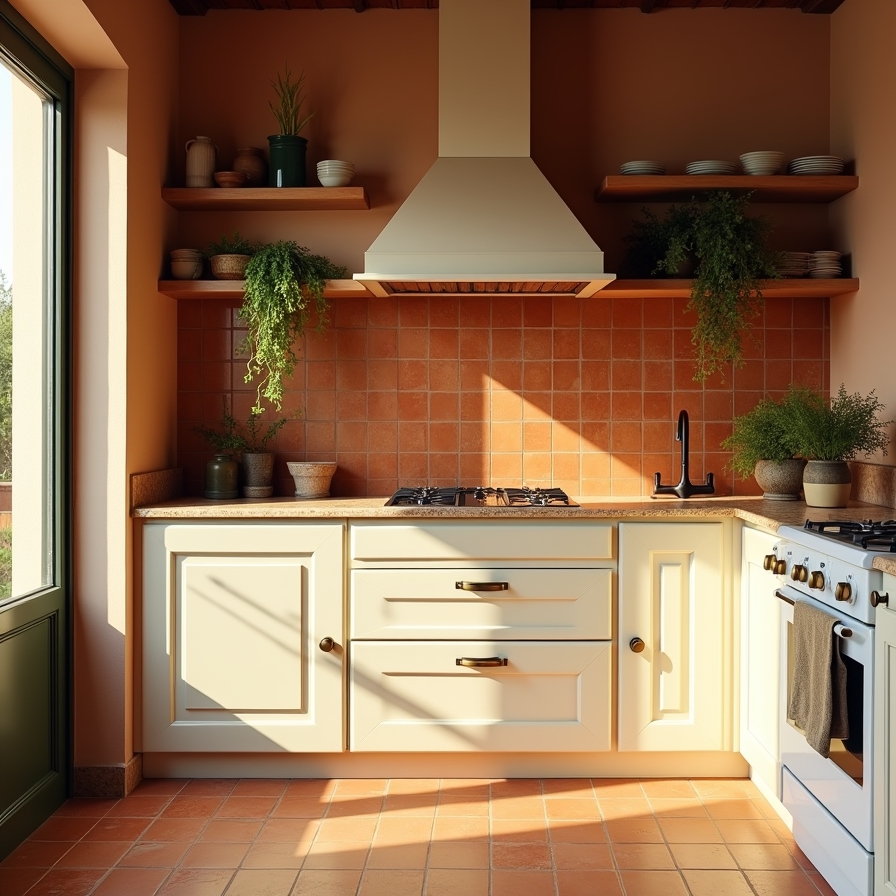
Best for: Mediterranean farmhouse, Tuscan farmhouse, boho farmhouse, warm-toned kitchens
Terracotta — literally “baked earth” in Italian — is one of the oldest building materials in human history. Clay tiles fired at low temperatures to a warm, earthy orange-red tone have been used in kitchens across Italy, Spain, Mexico, and the American Southwest for centuries. For the full Tuscan farmhouse kitchen aesthetic this material belongs to, our Tuscan kitchen design guide covers complementary stone, wood, and color choices throughout.
Modern terracotta tile comes in several formats:
- Traditional square terracotta (4×4 or 6×6): Classic, simple, immediate warmth. This is the same format used throughout the terracotta floors described in our terracotta floor tile in modern kitchens guide.
- Hexagonal terracotta: More geometric, still deeply warm — beautiful with Spanish or Moroccan influences. See idea #23 for the hex tile installation context.
- Rectangular terracotta (3×6 subway format): A warmer, earthier alternative to the white subway tile in idea #1.
- Handmade terracotta with variation: The most authentic — irregular edges, color variation, surface texture.
Important maintenance note: Unsealed terracotta is very porous and will stain immediately from kitchen oils and liquids. Always seal terracotta before use with a penetrating terracotta sealer, and reseal annually.
Color pairings: White cabinets (clean contrast), sage green cabinets (earthy harmony — see idea #36), cream cabinets (warm monochrome), navy cabinets (rich complementary contrast — see idea #37).
Cost estimate: $8–$30/sq ft installed
32. Stacked Vertical Stone Ledger Panel Farmhouse Backsplash
Best for: Mountain farmhouse, lodge-style farmhouse, kitchens with vaulted or high ceilings
Ledger stone panels — thin slices of natural stone (quartzite, slate, basalt, or sandstone) stacked horizontally and mounted on mesh backing — create a dramatic, three-dimensional backsplash with real visual weight. The individual stone pieces project slightly from the wall surface, creating deep shadow lines that make the wall look architectural rather than decorative. For a broader guide to the mountain farmhouse style this material belongs to, our mountain farmhouse design guide covers kitchens, living rooms, and materials throughout.
Installed vertically (stacking panels in a vertical orientation rather than horizontal), ledger stone creates a striking waterfall effect that draws the eye upward. This works especially well on a tall kitchen wall, behind a range with a floor-to-ceiling hood surround, or as a full feature wall in an open-plan kitchen-dining space. For a step-by-step installation guide, our how to install ledger stone backsplash guide covers every stage of the process.
Ledger stone color options for farmhouse kitchens:
- Gray quartzite: Cool, sophisticated, works with white or charcoal cabinets.
- Warm sandstone: Honey and amber tones, pairs with natural wood and cream.
- Charcoal slate: Dark and dramatic, best with light cabinets and bright countertops.
- Rustic brown/rust mix: Most traditional farmhouse — earthy and warm.
Cost estimate: $18–$45/sq ft installed
33. Arabesque and Lantern Shape Tile Farmhouse Kitchen Backsplash
Best for: Moroccan farmhouse, boho farmhouse, kitchens wanting pattern without color
Arabesque tiles — also called lantern tiles — are shaped like a pointed oval or Moorish arch, interlocking to create a continuous pattern across a wall. The shape references centuries of Islamic architectural tile work and brings a global, artisanal quality that feels collected and worldly rather than mass-produced. For the broader boho farmhouse kitchen aesthetic this tile fits into, our boho farmhouse kitchen ideas guide covers pattern mixing, plant styling, and collected décor in detail.
In white or off-white ceramic, arabesque tile reads simultaneously exotic and calm — the pattern adds visual interest without adding color, making it a safe choice for kitchens where you want personality without committing to a bold palette. In terracotta (see idea #31), sage green (see idea #36), or cobalt blue (see idea #37), the same shape becomes a bold design statement. For the history and full range of Moroccan tile patterns, our Moroccan tile patterns guide covers both arabesque and zellige in depth.
Best grout choice for arabesque tile: Dark gray or charcoal — the grout lines trace the shape of each tile and become part of the design. Light grout makes the shapes harder to read and diminishes the effect.
Scale considerations: Arabesque tile comes in sizes ranging from 2×3 inches (delicate, intricate) to 4×6 inches (bolder, more graphic). Smaller formats work best in smaller kitchens. Larger formats make more impact in bigger kitchens and are easier to install with less waste.
Cost estimate: $10–$30/sq ft installed
34. Scallop and Fan Shape Tile Farmhouse Kitchen Backsplash
Best for: Coastal farmhouse, cottage farmhouse, feminine farmhouse aesthetic
Scallop tiles — also called fish scale or fan tiles — are shaped like the overlapping scales of a fish or the petals of a flower, creating an organic, curved pattern that references both nature and traditional craft. The shape has roots in Victorian tile design and has been used continuously in residential design for over 150 years. For the coastal farmhouse aesthetic this tile works best in, our coastal farmhouse kitchen and bedroom style guide covers the complete material and color palette.
In a coastal or cottage farmhouse kitchen, scallop tile in white, pale aqua, soft sage, or warm gray creates a backsplash with undeniable personality and charm. The curved edges catch light differently depending on the angle, creating subtle dimension even in a monochromatic palette. For a complete guide to this tile format before purchasing, our fish scale tile buying guide covers sizing, materials, and installation considerations.
Installation note: Scallop tile requires more careful planning than rectangular tile — the scalloped edges at the top and bottom of the installation need finishing with cut pieces or a complementary border tile. Plan the layout carefully before ordering.
Where scallop tile shines most: Behind a farmhouse apron sink, where the curved shapes echo the rounded basin. Above a breakfast nook banquette — for breakfast nook design ideas that complement this style, see our breakfast nook design guide. As an accent strip at the top of a plain white tile backsplash.
Cost estimate: $12–$35/sq ft installed
35. Black and White Pattern Tile Farmhouse Kitchen Backsplash
Best for: Vintage farmhouse, Victorian farmhouse, kitchens with black hardware and fixtures
Black and white geometric tile — whether simple checkerboard, more complex Victorian floor tile patterns adapted to walls, or bold graphic prints — creates a high-contrast backsplash with enormous visual impact. In a farmhouse kitchen, black and white pattern reads as vintage rather than modern when the tile has a handmade quality, slightly irregular edges, or an encaustic cement finish (see idea #17 for encaustic tile specifics). For the complete Victorian farmhouse kitchen aesthetic, our Victorian kitchen design guide covers period-accurate details for every surface.
The most farmhouse-appropriate black and white patterns:
- Small diamond/argyle: Victorian farmhouse authenticity — see also idea #49 for the diamond layout.
- Encaustic cement geometric: Global farmhouse, artisan quality.
- Bold star-and-cross: Traditional Mediterranean or Spanish.
- Simple checkerboard: Casual, retro-farmhouse, highly versatile. For the broader black and white kitchen palette, our black and white kitchen ideas guide covers cabinet colors, hardware, and countertops that complete this look.
Key design rule: When using a bold pattern on the backsplash, keep everything else in the kitchen extremely simple. White cabinets, black hardware, plain countertops — the pattern does all the work.
Cost estimate: $12–$40/sq ft installed (encaustic cement on the higher end)
36. Sage Green Tile Farmhouse Kitchen Backsplash
Best for: English cottage farmhouse, garden-inspired farmhouse, kitchens with cream or white cabinets
Sage green — the muted, gray-green tone that evokes dried herbs, lichen on stone, and aged patina — is one of the most beloved colors in contemporary farmhouse design. As a backsplash tile color, sage green brings immediate warmth, botanical freshness, and a quiet sophistication that works across multiple farmhouse sub-styles. For a broader look at how sage green works throughout a farmhouse kitchen — on cabinets, walls, and accessories — our sage green kitchen ideas guide is a comprehensive visual reference.
Sage green tile pairs especially beautifully with:
- Cream or warm white cabinets — the green reads as an herbal accent against the warmth. For cabinet color recommendations, see our farmhouse cabinet colors guide.
- Natural wood cabinets — earthy and cohesive, like a garden-to-kitchen connection.
- Unlacquered brass hardware — the aged brass and the sage green are classic English farmhouse. For the full English cottage kitchen aesthetic, our English cottage kitchen design guide covers every material in this palette.
- Terracotta or stone floors — deeply earthy and harmonious. Pair with the terracotta tile in idea #31 for a fully cohesive floor-to-wall material story.
Best tile formats in sage green: Handmade subway tile (the slight variation in glaze makes the color come alive), zellige from idea #14 (the irregular surface catches light beautifully in green), or large square tiles (4×4 or 6×6) with a slightly rough surface texture.
Cost estimate: $10–$45/sq ft depending on handmade vs. standard ceramic
37. Navy Blue Tile Farmhouse Kitchen Backsplash
Best for: Coastal farmhouse, Dutch-inspired farmhouse, kitchens with white or cream cabinets
Navy blue is a farmhouse kitchen color with genuine historical roots — Dutch Delft tile, Portuguese azulejo, and English transferware all used deep blue extensively in domestic kitchen settings for centuries. In a contemporary farmhouse kitchen, a navy blue tile backsplash creates a bold, confident statement that feels simultaneously historical and current. For the Dutch and blue-and-white Delft-inspired aesthetic, our guide to Dutch-inspired kitchen design covers patterns, tiles, and décor in depth.
Navy works best as a full backsplash (not just an accent) against white or cream cabinets — the contrast is the entire effect. For the best navy cabinet and backsplash combinations, our navy blue kitchen cabinet ideas guide shows how cabinet color and backsplash color interact.
Navy tile format options:
- Solid navy subway tile in running bond — clean and classic. Apply the same layout guidance from idea #1.
- Navy and white pattern tile — more decorative, Dutch or Portuguese influence.
- Navy zellige from idea #14 — rich and dimensional, the irregular glaze creates a living navy surface.
- Navy hexagon from idea #23 — graphic and contemporary while staying farmhouse-adjacent.
Cost estimate: $10–$50/sq ft depending on material
38. Exposed Concrete Block Farmhouse Kitchen Backsplash
Best for: Industrial farmhouse, converted barn kitchens, loft farmhouse
In kitchens built within converted agricultural or industrial structures — barns, warehouses, old mill buildings — the existing concrete block walls are often worth preserving rather than covering. For a broader guide to converted barn and agricultural building kitchens, our barn conversion kitchen ideas guide covers the full range of exposed-material approaches.
If your kitchen doesn’t have existing concrete block, concrete block veneer panels (lightweight, adhered like tile) create a similar aesthetic without the structural requirements of actual block walls. The same industrial raw-material approach applied to concrete-look porcelain is covered in idea #29.
Sealing is non-negotiable: Unsealed concrete block is extremely porous and will absorb grease, moisture, and kitchen splatter permanently. Use a penetrating concrete sealer before the kitchen is in use, and reseal annually.
Paint options: If raw concrete block is too stark, a limewash treatment in warm white or pale gray — the same technique described in idea #15 — softens the surface while preserving all the texture. This is increasingly popular in converted loft and barn kitchen renovations where the structural concrete needs to stay but the raw industrial look needs warming up.
Cost estimate: Free (existing wall — cleaning and sealing only) or $8–$20/sq ft for veneer panels installed
39. Wainscoting-Style Tile Panel Farmhouse Kitchen Backsplash
Best for: Traditional farmhouse, Victorian farmhouse, formal farmhouse kitchens
Traditional wainscoting — decorative wall paneling that covers the lower half of a wall — translates beautifully into a kitchen backsplash treatment. Instead of running tile from countertop to upper cabinets only, wainscoting-style backsplash continues below the countertop (on kitchen island sides, peninsula sides, or un-countered walls) and often includes a chair rail or cap molding at the transition point. For more on this treatment applied to dining rooms and living areas of the same farmhouse, our wainscoting ideas guide covers every room.
The result is a kitchen that feels more formal, more finished, and more architecturally complete than a standard backsplash installation. For kitchen island cladding options that complement this approach, our kitchen island cladding ideas guide covers tile, wood, and stone options in detail.
Material options for wainscoting-style farmhouse backsplash:
- Painted beadboard panels — most traditional cottage/farmhouse (see idea #10 for beadboard specifics).
- White subway tile with a pencil liner or chair rail trim at the top (see idea #1).
- Shiplap continued below countertop level on island sides (see idea #2).
- Large format tile with a contrasting border tile as the cap.
Cost estimate: $8–$20/sq ft materials; labor varies significantly by complexity
40. Travertine Tile Farmhouse Kitchen Backsplash
Best for: Tuscan farmhouse, Mediterranean farmhouse, warm-toned kitchens
Travertine — a sedimentary limestone formed by mineral springs — has been used in building construction since ancient Rome. The Colosseum is largely built from travertine. In a farmhouse kitchen, travertine tile brings that weight of history along with its distinctive warm cream, beige, and walnut tones and characteristic surface texture. For the broader Tuscan and Mediterranean farmhouse aesthetics that travertine belongs to, both the Tuscan and Mediterranean farmhouse aesthetics lean toward natural, warm, aged materials throughout the kitchen.
Honed travertine (matte finish) is most appropriate for farmhouse kitchens — it reads genuinely old-world and pairs beautifully with warm wood, aged brass hardware, and terracotta or stone floors (see idea #31 for terracotta pairing specifically). Polished travertine is more formal and contemporary, less suited to the farmhouse aesthetic.
The pits and voids: Travertine’s natural surface pores can be left open (most authentic, most rustic, requires vigilant sealing) or filled with grout during installation (less rustic, easier maintenance). For kitchen backsplashes, filled travertine is the more practical choice.
Travertine finish options for farmhouse kitchens:
- Honed: Matte, smooth, most farmhouse-appropriate — reads old-world and understated.
- Tumbled: Rougher edges and surface, very rustic — best for informal country kitchens.
- Brushed: Textured surface with softened edges — sits between honed and tumbled in feel.
- Polished: Shiny surface — least farmhouse of the four; better suited to contemporary or formal kitchens.
Maintenance tip: Never use vinegar, lemon juice, or any acid-based cleaner on travertine — the acid etches the calcium carbonate surface permanently. The Natural Stone Institute recommends pH-neutral stone cleaners only. For a complete maintenance routine, see our how to clean and maintain natural stone tile guide.
Cost estimate: $15–$40/sq ft installed
41. Grasscloth and Natural Fiber Wallpaper Farmhouse Kitchen Backsplash
Best for: Boho farmhouse, casual farmhouse, low-heat backsplash areas away from stove and sink
Grasscloth — wallpaper made from natural plant fibers woven onto a paper backing — brings extraordinary texture and organic warmth to a kitchen wall. While not appropriate directly behind a stove or above a sink (moisture will damage it), grasscloth works beautifully as a backsplash treatment on walls that don’t receive direct water or heat. Before purchasing, our grasscloth wallpaper complete guide covers every type of natural fiber, durability ratings, and how to tell quality from cheap imitations.
In a farmhouse kitchen, natural grasscloth in honey, tan, or warm gray tones adds the kind of quiet texture that makes a room feel layered and collected without any single element competing for attention. For boho farmhouse kitchen ideas that pair naturally with this material, our boho farmhouse kitchen ideas guide covers the full aesthetic in detail.
Where grasscloth works safely in a kitchen:
- The wall between upper cabinets (no direct splash risk).
- A breakfast nook or eat-in area attached to the kitchen — for nook design ideas, see our breakfast nook design guide.
- The back wall of a kitchen peninsula (away from stove and sink).
- A mudroom wall that opens into the kitchen.
Texture variety in grasscloth: Fine weave reads more formal and refined. Chunky, open weave reads more boho and casual. Seagrass and jute weaves are the most farmhouse-appropriate — they have an earthy, harvested quality that references the land directly.
Cost estimate: $3–$12/sq ft materials; professional installation strongly recommended ($3–$8/sq ft labor)
42. Quatrefoil Pattern Tile Farmhouse Kitchen Backsplash
Best for: Romantic farmhouse, cottage farmhouse, kitchens with feminine or eclectic aesthetic
The quatrefoil — a symmetrical four-lobed pattern that appears in Gothic architecture, medieval tile work, and Victorian decorative arts — is one of the most recognizable historical tile patterns in Western design. In a kitchen backsplash, quatrefoil tile brings an unmistakably vintage, romantic quality with roots in real historical farmhouse and cottage design. This pattern also appears as an inset in encaustic cement tiles (see idea #17) and as the border motif in many Victorian farmhouse tile schemes (see idea #35).
In white on white (white tile, white grout), the pattern is subtle and textural. In black and white or navy and white, it becomes a bold graphic statement — the same palette covered in idea #35. In soft sage or dusty rose on cream, it reads as quietly romantic and cottage-inspired. For a broader guide to the romantic farmhouse aesthetic, our romantic farmhouse kitchen and bedroom ideas guide covers soft colors and vintage details throughout the home.
Cost estimate: $12–$35/sq ft installed
43. Split Face Stone Mosaic Farmhouse Kitchen Backsplash
Best for: Rustic farmhouse, mountain farmhouse, dramatic accent walls
Split face stone mosaic — natural stone tiles with a deliberately rough, fractured face surface, mounted on mesh backing — creates a backsplash with extraordinary three-dimensional texture. Each tile face has been mechanically split rather than cut smooth, exposing a raw, irregular stone surface with dramatic depth and shadow. This is the most dimensional of all the stone options in this guide — more textured than the smooth stone tile in idea #9 and more dramatic than the stacked ledger panels in idea #32.
The effect is significantly more dramatic than smooth stone tile — it reads as almost geological, like a cross-section of a canyon wall. In a large farmhouse kitchen with high ceilings, this creates an anchor wall of undeniable presence. For the broader stone accent wall treatment applied to living rooms and other rooms in the same farmhouse, the same approach works beautifully in living rooms and open-plan kitchen-dining spaces as a unified feature wall. For a step-by-step backsplash installation guide specific to this material, see our how to install ledger stone backsplash guide.
Available in: Quartzite, slate, sandstone, basalt, and mixed-stone blends in neutral earth tones.
Cost estimate: $20–$50/sq ft installed
44. Limerick or Clover Green Tile Farmhouse Kitchen Backsplash
Best for: Irish/Celtic cottage farmhouse, spring-inspired kitchens, kitchens with cream or white cabinetry
Deep, saturated greens — bottle green, forest green, hunter green — are having a significant moment in farmhouse kitchen design, referencing the green-painted Aga range kitchens of Irish and English farmhouses. The AGA range cooker is itself a British farmhouse icon — our AGA range kitchens guide covers the full aesthetic built around this stove. The bottle green tiles of French brasseries and the deep Victorian green that appeared in wealthy farmhouse kitchens of the late 1800s complete the historical lineage of this color.
A deep green tile backsplash against cream or white cabinets creates a kitchen of remarkable richness and depth. It works with aged brass or copper hardware, stone or terracotta floors (see idea #31), and open wood shelving (see idea #24). For a comprehensive look at how green works throughout the kitchen — on cabinets, backsplashes, and walls together — our green kitchen cabinet and tile ideas guide is the most complete reference.
Best deep green tile formats for farmhouse: Subway tile with a handmade glaze variation (the green shifts from bottle to forest depending on the light), zellige from idea #14 in deep green (the irregular surface makes the color shimmer), or large square tile in a matte finish.
Cost estimate: $12–$55/sq ft depending on handmade vs. standard
45. Fluted and Grooved Tile Farmhouse Kitchen Backsplash
Best for: Contemporary farmhouse, transitional farmhouse, kitchens wanting texture without pattern
Fluted tile — ceramic or porcelain tile with parallel vertical ridges molded into the surface — is one of the strongest emerging trends in farmhouse kitchen design for 2026. The ridges create strong vertical lines and deep shadow, giving a plain white tile enormous visual complexity without any pattern, color, or grout line variation. For a roundup of all the strongest tile trends this year, our trending kitchen tile designs for 2026 guide places fluted tile in the broader context of what is gaining momentum and what is fading.
The effect is architectural and three-dimensional in a way that flat tile simply cannot achieve. It references fluted columns in classical architecture while feeling completely contemporary. In white or off-white, fluted tile is the most sophisticated current evolution of the classic white farmhouse backsplash introduced in idea #1. For a broader exploration of texture-forward design choices, our texture in kitchen design guide covers how to layer depth without relying on pattern or color.
Installation note: Fluted tile requires perfectly level installation — any variation in the wall surface shows more dramatically in ridged tile than in flat tile. Ensure walls are properly prepared and leveled before installation.
Cost estimate: $15–$40/sq ft installed
46. Picket and Pointed Oval Tile Farmhouse Kitchen Backsplash
Best for: Vintage farmhouse, cottage farmhouse, kitchens wanting shape interest without color
Picket tiles — elongated, pointed-end tiles that interlock like the pickets of a fence — are a vintage tile format with roots in Art Deco and early 20th century residential design. They bring a graphic quality that is simultaneously retro and fresh, and they tile a wall in a way that is immediately distinctive without requiring any color or pattern. For the broader Art Deco farmhouse aesthetic, it pairs beautifully with black hardware, geometric countertop edges, and strong contrast throughout the kitchen For other non-rectangular tile shapes, our unique tile shapes for kitchens guide covers every format beyond the standard rectangle.
In white matte ceramic, picket tile creates a backsplash that looks nothing like subway tile but has the same restrained, neutral color story from idea #1. The pointed ends and interlocking layout create a subtle all-over pattern that adds interest at every scale — from across the kitchen to up close.
Cost estimate: $10–$25/sq ft installed
47. Hand-Stamped Moroccan Cement Tile Farmhouse Backsplash
Best for: Global farmhouse, boho farmhouse, kitchens with natural wood and warm tones
Hand-stamped Moroccan cement tiles — made by pouring pigmented cement into carved brass molds and pressing under a hydraulic press — are among the most labor-intensive tile products made anywhere in the world. Each tile takes minutes to produce by hand, and the result is a surface with genuine craft depth: slightly irregular edges, subtle color variation, a matte finish that no machine-made tile can replicate. For sourcing guidance, our where to buy authentic Moroccan tile guide covers both online retailers and artisan importers. For the broader Moroccan pattern context, see also idea #33 on arabesque tile and idea #14 on zellige.
The patterns range from simple geometric stars to incredibly complex interlocking mosaics. For farmhouse kitchens, geometric patterns in neutral palettes — cream and charcoal, terracotta and white, warm gray and sand — work better than very colorful or elaborate designs. The boho farmhouse kitchen aesthetic these tiles fit best into is covered in detail in our boho farmhouse kitchen ideas guide.
Non-negotiable: Seal before use, seal again after grouting, and reseal every 6–12 months. For the exact sealing procedure, our how to seal Moroccan cement tile guide covers every step. Unsealed cement tile stains permanently from kitchen use within days.
Cost estimate: $15–$40/sq ft tile + standard installation labor
48. Brick-and-Mortar Texture Wallpaper Farmhouse Kitchen Backsplash
Best for: Rental properties, temporary farmhouse kitchens, budget renovations needing instant character
High-quality brick-texture wallpaper — particularly vinyl-coated, washable versions designed for kitchen use — has improved dramatically in realism and durability. When well-chosen and properly installed, modern brick wallpaper is convincing at normal conversational distance and dramatically faster and cheaper than real brick veneer installation (compare to idea #5 and idea #18 for the real versions). For quality and durability-tested product recommendations, our best removable wallpaper for kitchens 2026 guide ranks the top options currently available.
For landlords, renters, or homeowners who want a farmhouse character upgrade without a permanent commitment, quality brick wallpaper installed on a painted accent wall can transform a kitchen in an afternoon for under $100 in materials. For more no-damage, renter-friendly farmhouse decor ideas, our renter-friendly farmhouse decor guide covers every surface and room.
What to look for: Vinyl-coated for washability, textured surface (not just printed flat), and a realistic color variation that includes mortar-line shadows baked into the design.
Cost estimate: $1–$5/sq ft materials; DIY installation
49. Geometric Diamond Pattern Tile Farmhouse Kitchen Backsplash
Best for: Victorian farmhouse, art deco farmhouse, kitchens with black and white palettes
Diamond-set tile — square tiles rotated 45 degrees and set on point — is one of the oldest and most elegant tile layouts in residential design. It appears in Victorian floor tile work, Edwardian bathroom tile, and farmhouse buttery and dairy rooms throughout the late 19th century. Applied to a kitchen backsplash, the diamond orientation transforms a plain square tile into something visually dynamic and historical — this is essentially the same material as idea #1 or idea #35, but installed at 45 degrees, which changes the entire character of the wall. For all the ways to lay diamond and square tiles, our diamond tile patterns guide covers floors, walls, and backsplashes with photos.
In white with dark grout, the diamond pattern reads as clean, graphic, and vintage. Combined with a contrasting small diamond as a decorative border, it creates a complete Victorian-farmhouse tile scheme — see our Victorian home renovation guide for period-accurate sources for reproduction tiles. In terracotta with cream grout, the same layout shifts to a warm Mediterranean farmhouse aesthetic (see idea #31 for terracotta context).
Cost estimate: $8–$25/sq ft installed (same tile cost as square-set; labor premium for diagonal cuts)
50. Custom Hand-Painted Tile Mural Farmhouse Kitchen Backsplash
Best for: Bespoke farmhouse kitchens, kitchens as the heart of the home, heirloom renovation projects
The most personal, most unique, and most thoroughly farmhouse backsplash option of all: a custom hand-painted tile mural. Working with a ceramic artist or tile painter, you commission a piece of art that is permanently integrated into your kitchen wall — a botanical illustration of your garden herbs, a pastoral landscape, a family crest, a map of your farm or property, or any other subject with personal meaning.
This is not a budget option. Custom hand-painted tile murals range from $500 for a simple 4-tile panel to $10,000+ for a large-scale, complex composition. But no other backsplash option delivers the same level of personal meaning, artistic quality, or uniqueness — your kitchen will literally contain a one-of-a-kind artwork that no other house in the world has. For guidance on the broader process of commissioning custom art for your home, our how to commission custom art guide covers finding artists, setting budgets, and managing the process.
Finding a tile painter:
- Search Etsy for “custom hand-painted tile” or “ceramic tile mural.”
- Contact local ceramic art studios or pottery schools.
- Search the American Pottery Alliance or National Council on Education for the Ceramic Arts (NCECA) artist directories.
Where to use a mural most effectively: Centered behind the range as a focal point, framed by plain tile on either side. The range hood above and the range below frame the mural like a picture frame, giving it the presentation it deserves. For range hood design options that complement a mural-centered backsplash wall, our farmhouse range hood ideas guide covers every style and material.
Cost estimate: $500–$15,000+ depending on size and artist; installation at standard tile rates
Farmhouse Kitchen Backsplash Cost Guide: How Much Does It Really Cost? (2026)
Understanding realistic costs is essential for planning a kitchen renovation. These are full installed costs including materials and professional labor for a typical kitchen (approximately 30 square feet of backsplash). Cost data is sourced from HomeAdvisor, Angi, and Fixr pricing surveys.
| Material | Cost Per Sq Ft (Installed) | Total for 30 Sq Ft | DIY Savings |
|---|---|---|---|
| Basic ceramic subway tile | $5–$10 | $150–$300 | 40–60% |
| Peel-and-stick | $5–$15 | $150–$450 | 90% |
| Shiplap (painted) | $6–$12 | $180–$360 | 50–70% |
| Herringbone subway tile | $10–$20 | $300–$600 | 40–60% |
| Glass tile | $12–$25 | $360–$750 | 40% |
| Brick veneer | $8–$18 | $240–$540 | 50% |
| Reclaimed wood | $10–$25 | $300–$750 | 60–70% |
| Natural stone (slate, limestone) | $15–$40 | $450–$1,200 | 30–50% |
| Marble tile | $20–$60 | $600–$1,800 | 30–40% |
| Handmade ceramic / zellige | $30–$80 | $900–$2,400 | 20–30% |
| Marble slab (full height) | $50–$150 | $1,500–$4,500 | Not recommended |
For a complete picture of how backsplash cost fits within your full renovation budget, cost data from HomeAdvisor and Angi provides the most current regional pricing. To get accurate quotes from contractors, our guide on how to get tile installation quotes explains what questions to ask and what to watch out for.
How to Choose the Right Farmhouse Kitchen Backsplash (Step-by-Step Decision Guide)
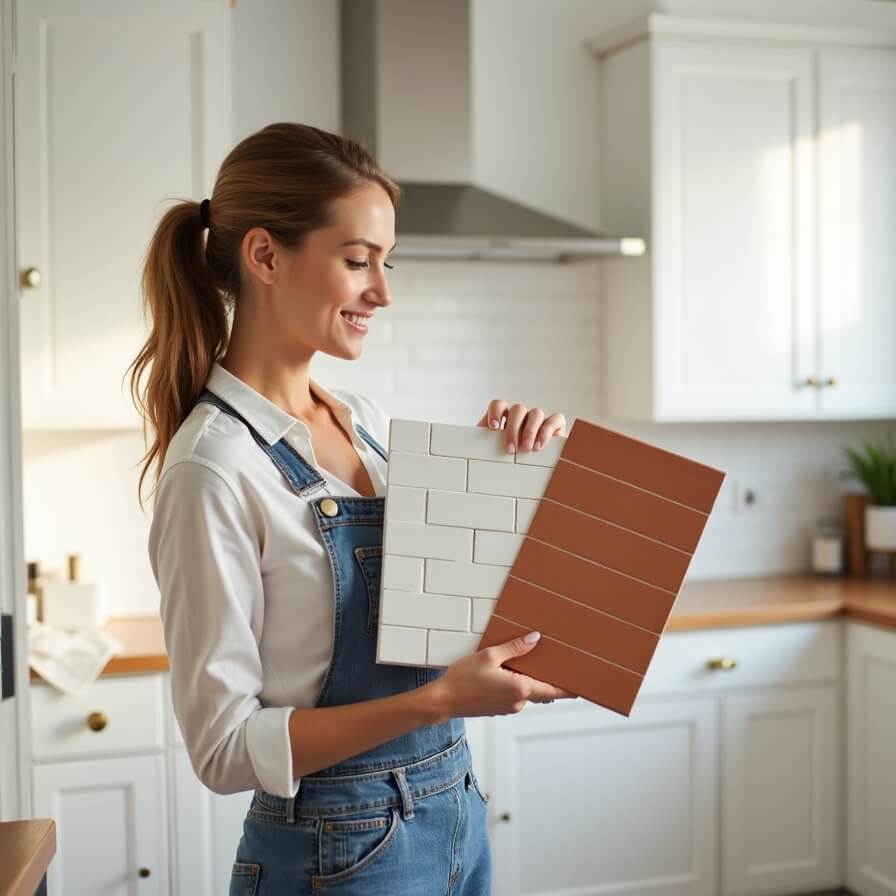
Step 1: Identify Your Farmhouse Kitchen Sub-Style Before Choosing a Backsplash
Farmhouse design is not monolithic. Before choosing a material, identify which farmhouse vocabulary your kitchen speaks:
- Modern Farmhouse: Clean lines, white palette, minimal pattern. Best backsplash: white subway tile (idea #1), white shiplap (idea #2), white brick (idea #18).
- Rustic Farmhouse: Rough textures, reclaimed materials, warm tones. Best backsplash: reclaimed wood (idea #3), stacked stone (idea #32), brick (idea #5).
- Cottage Farmhouse: Soft colors, floral or gentle pattern, vintage character. Best backsplash: patterned ceramic (idea #4), penny tile (idea #19), beadboard (idea #10).
- Boho Farmhouse: Global materials, pattern mixing, handcraft emphasis. Best backsplash: Moroccan zellige (idea #14), Talavera tile (idea #11), cement tile (idea #17).
- Coastal Farmhouse: Light and airy, whites and blues, beach-adjacent materials. Best backsplash: sea glass tile (idea #12), white subway with white grout (idea #1), shiplap (idea #2).
- Industrial Farmhouse: Dark metal, raw materials, masculine aesthetic. Best backsplash: pressed tin (idea #13), dark slate (idea #9), concrete-look porcelain (idea #29).
Step 2: Match Your Farmhouse Backsplash to Your Fixed Kitchen Elements
Before choosing a backsplash, look at what you cannot (or will not) change:
- Cabinet color and finish: What grays and whites and wood tones are already present? Our farmhouse kitchen cabinet colors guide shows which backsplash materials pair best with each cabinet color.
- Countertop material: Butcher block wants wood or white tile. Black granite wants contrast. White quartz wants something with warmth. For the countertop side of this decision, our butcher block vs. quartz countertops guide is the most direct comparison.
- Flooring: What material and color runs underfoot?
- Hardware finish: Brass, black, chrome, and nickel each pull the kitchen in different directions.
Your backsplash connects all these fixed elements. It should feel related to each of them without perfectly matching any of them.
Step 3: Evaluate Practical Requirements for Your Farmhouse Kitchen Backsplash
Be honest about how you use your kitchen:
- Do you cook frequently and vigorously? Choose easy-clean: glass tile (idea #12), glazed ceramic (idea #1), or porcelain (idea #29). Avoid unfinished wood or unsealed stone in the immediate cooking zone.
- Do you have children? Prioritize non-porous, easy-wipe surfaces — soapstone (idea #26) and glass tile (idea #12) are the best options.
- Is this rental property or a home you’re planning to sell? Classic and neutral (white subway, idea #1) serves resale better than bold and personal choices.
- Are you doing this yourself? Factor in installation complexity — idea #20 (peel-and-stick) and idea #2 (shiplap) are the most DIY-accessible options.
Step 4: Always Sample Your Farmhouse Backsplash Material Before Ordering
Always purchase samples before ordering. Tile and material samples placed against your actual cabinets, countertops, and flooring — in your actual kitchen lighting — will tell you far more than any computer rendering or magazine photo. The Lighting Research Center at RPI has published useful guidance on how warm vs. cool light temperatures affect surface color perception — worth reading before finalizing any tile purchase. For practical advice on ordering tile samples, our how to order tile samples guide covers what to request and how to evaluate them properly.
Farmhouse Kitchen Backsplash Installation Guide: DIY vs. Professional (What You Must Know)
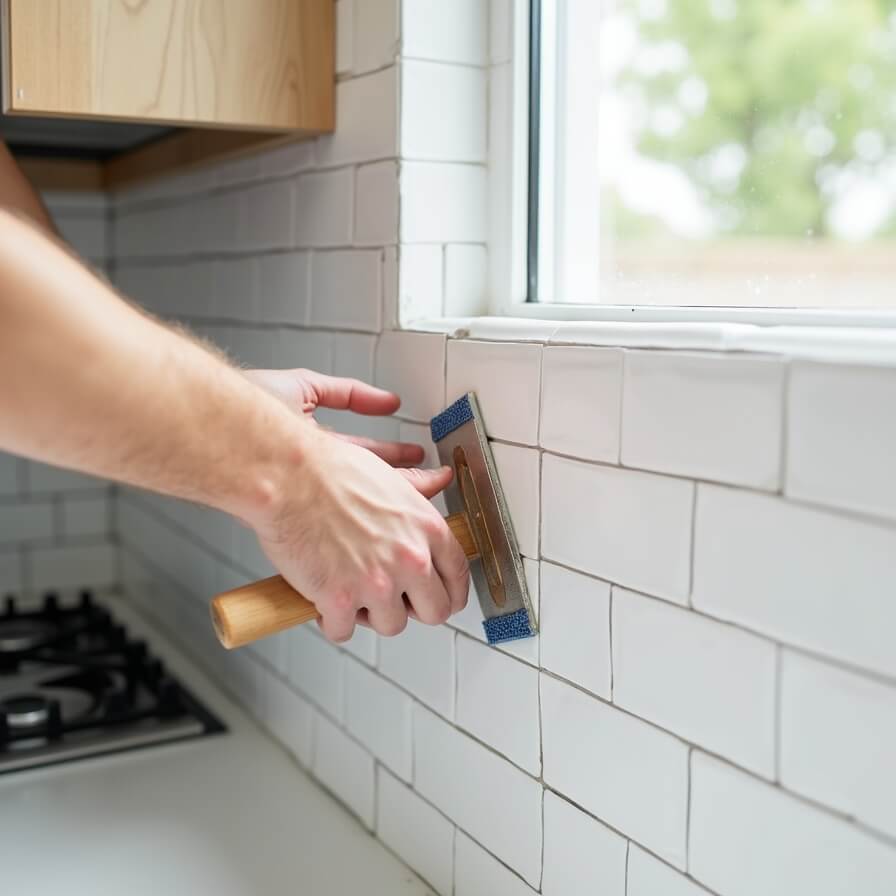
DIY vs. Professional Farmhouse Backsplash Installation: Full Comparison
| Factor | DIY | Professional |
|---|---|---|
| Cost | Materials only (save 40–70%) | Full installed price |
| Time | 1–3 weekends | 1–3 days |
| Risk | Tile waste, uneven lines, missed waterproofing | Very low |
| Result quality | Excellent (with preparation) | Consistently excellent |
| Best material for DIY | Subway tile, shiplap, peel-and-stick | Any material |
| Avoid DIY with | Natural stone, zellige, marble slab | N/A |
Essential Prep Steps Before Installing Any Farmhouse Kitchen Backsplash
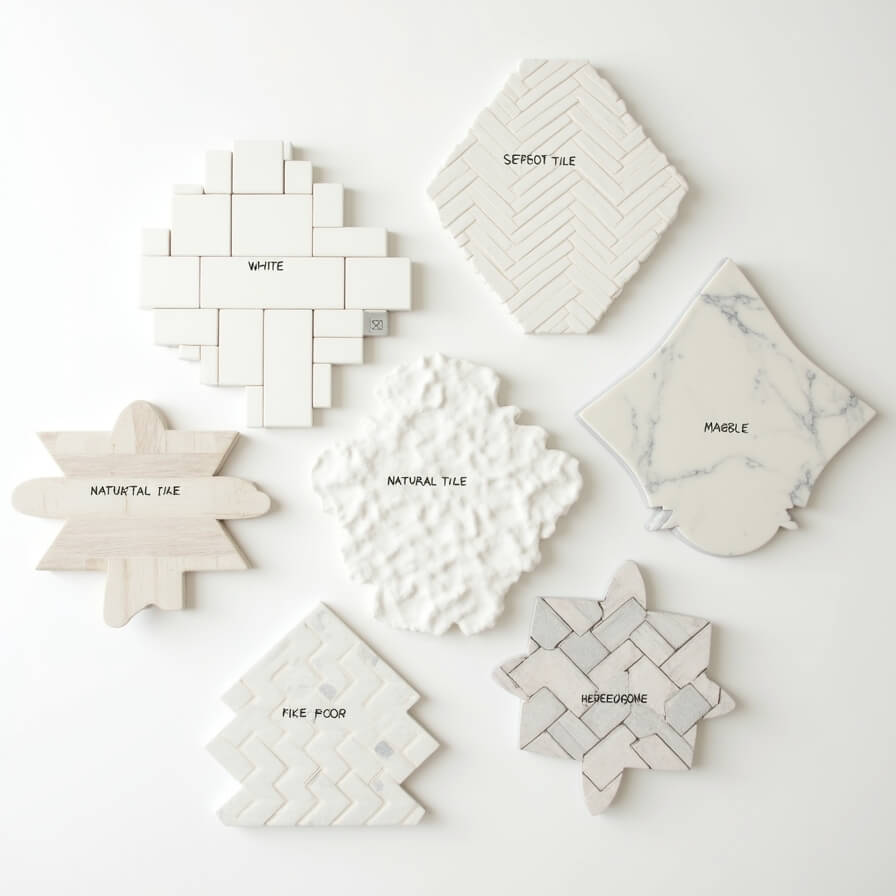
- Turn off power to outlets in the work area before starting.
- Remove outlet covers and switch plates. You’ll tile around the boxes, not the covers.
- Clean the wall thoroughly — grease and dust prevent adhesive bonding.
- Apply primer to unpainted drywall or painted surfaces.
- Find and mark studs — useful for screw-anchored materials like shiplap.
- Establish a level baseline — use a laser level or long bubble level to mark your starting line.
- Dry-fit before committing — lay out your tile pattern on the counter or floor before applying adhesive.
The Tile Council of North America (TCNA) publishes the industry-standard installation guidelines for every tile type — their TCNA Handbook is the reference professional tile setters use. For a beginner-friendly step-by-step guide to the grouting stage specifically, our how to grout tile guide covers the full process from mixing to sealing.
The Most Common Farmhouse Backsplash Installation Mistakes (And How to Avoid Them)
- Not waterproofing behind the sink: Use a waterproof membrane or cement board in high-moisture areas. Our waterproofing kitchen walls before tiling guide covers the right products and application sequence.
- Skipping grout sealer: Unsealed grout stains within weeks of normal kitchen use. See our best grout sealers 2026 roundup for the most durable options.
- Starting tiles without a level line: Slight initial error amplifies across an entire wall.
- Choosing grout that’s too close in color to the tile: This creates a muddy, undefined look. There should be deliberate contrast.
- Not accounting for outlets: Tile cut too close to outlet boxes looks amateurish.
- Under-ordering material: Always order 10% extra for cuts and breakage (15% for diagonal/herringbone patterns — see ideas #7 and #49).
Farmhouse Kitchen Backsplash FAQ: Every Common Question Answered
Q: What is the most popular farmhouse kitchen backsplash?
A: White subway tile with gray or charcoal grout is consistently the most popular farmhouse kitchen backsplash. It is versatile, affordable, easy to install, easy to clean, and works with virtually every cabinet color and countertop material (see idea #1 for the full rundown). Shiplap is the second most popular choice, particularly for modern farmhouse designs (see idea #2).
Q: Is subway tile going out of style in farmhouse kitchens?
A: No. Subway tile has been used continuously in American kitchens for over 100 years and shows no sign of disappearing. The format that is trending is larger subway formats (4×8, 6×12) and more creative grout choices (dark charcoal, warm beige). The basic 3×6 white tile remains a perennial classic. For more on emerging tile trends, see our trending kitchen tile designs for 2026 guide.
Q: How do I make my backsplash look more farmhouse?
A: The fastest ways to add farmhouse character to an existing backsplash: (1) replace white grout with a warmer or darker grout color (darker grout choices like charcoal or warm gray from Mapei or Custom Building Products are covered in the grout FAQ section below); (2) add open wood floating shelves above the backsplash (see idea #24); (3) replace hardware with matte black or unlacquered brass (see the design pairings table at the end of this guide); (4) add a vintage-style faucet (see our best farmhouse kitchen faucets guide). If replacing the backsplash entirely, choose materials with texture and natural imperfection.
Q: What grout color should I use for a farmhouse backsplash?
A: For white or light tile in a farmhouse kitchen, a medium to dark gray grout (such as Charcoal, Pewter, or Warm Gray from Mapei or Custom Building Products) creates the most authentic farmhouse character. Warm gray or buff grout reads less stark than pure charcoal and works beautifully with natural wood and warm white cabinets. Avoid bright white grout if you want a farmhouse look rather than a purely contemporary one.
Q: Can I put a wood backsplash behind my stove?
A: Yes, but with important precautions. Wood must be kept at least 6 inches horizontally from open flame burners. Behind electric ranges, properly sealed wood is generally safe. Behind gas ranges, install a non-combustible insert (stainless steel panel, stone tile, or fire-rated cement board) directly behind the burners, and use wood only on the flanking areas. Always check local building codes — the International Residential Code (IRC) Section R1004 provides guidance on combustible materials near heat sources.
Q: How long does backsplash installation take?
A: A professional installer can typically tile a standard 30 square foot backsplash in one day, with grout applied the following day (tile adhesive must cure first). DIY installation typically takes one to two full weekends for the same area, including prep, tile setting, grouting, and sealing.
Q: What’s the best budget farmhouse backsplash option?
A: Painted and sealed shiplap (idea #2) is the most affordable farmhouse backsplash, often achievable for $1–$4 per square foot in materials. Peel-and-stick tile (idea #20) is a close second and requires no tools. For a tile option on a budget, basic white ceramic subway tile (idea #1) from a home improvement store can be as low as $1 per square foot — the grout and installation materials will cost more than the tile itself.
Q: Do farmhouse backsplashes work with dark cabinets?
A: Absolutely. Farmhouse backsplashes pair beautifully with dark cabinetry — in fact, dark navy, forest green, or black cabinets often look better with textured, organic backsplash materials than all-white cabinets do. White subway tile (idea #1) against dark cabinets creates excellent contrast. Natural stone (idea #9) or reclaimed wood (idea #3) adds warmth to balance the darkness of heavy cabinetry. For a full visual guide to dark cabinet kitchens, see our dark cabinet kitchen ideas guide.
How to Clean and Maintain Your Farmhouse Kitchen Backsplash (By Material)
Cleaning Glazed Ceramic and Porcelain Farmhouse Backsplash Tile
- Daily: Wipe with a damp microfiber cloth.
- Weekly: Mild dish soap and warm water, rinse well.
- Monthly: Check grout for staining; apply grout cleaner if needed. If you also have a glass stovetop, our guide on how to clean the top of a glass stove covers daily kitchen surface maintenance using the same gentle approach. See our best grout cleaners 2026 guide for the most effective products.
- Annually: Reapply grout sealer.
Cleaning Natural Stone Farmhouse Backsplash (Marble, Slate, Travertine)
- Daily: Wipe immediately after any acid contact (lemon, vinegar, tomatoes).
- Weekly: Stone-specific pH-neutral cleaner only — never vinegar or bleach.
- Every 6 months: Reapply penetrating stone sealer. See our how to reseal natural stone guide for the step-by-step process.
- Never: Abrasive cleaners, steam cleaners, acidic products.
Cleaning and Maintaining a Wood Farmhouse Kitchen Backsplash
- Daily: Dry cloth wipe — do not leave water sitting.
- Weekly: Damp cloth only, followed by immediate drying.
- Monthly: Reapply oil or wax finish to butcher block areas. For product recommendations, see our butcher block countertops maintenance guide.
- Annually: Lightly sand and refinish if surface shows significant wear.
Cleaning a Brick Veneer Farmhouse Kitchen Backsplash
- Weekly: Stiff brush with mild soap and water.
- Annually: Reapply masonry sealer.
- Never: Acid-based cleaners (they dissolve mortar and grout).
Cleaning Glass Tile Farmhouse Kitchen Backsplash
- Weekly: Glass cleaner or mild soap and water — no abrasives.
- As needed: White vinegar solution for hard water spots.
- Never: Abrasive pads (they scratch glass permanently).
Farmhouse Kitchen Backsplash Design Pairings: What Cabinet, Counter & Floor Goes With Each Style
| Backsplash | Cabinet Color | Counter Material | Hardware | Floor |
|---|---|---|---|---|
| White subway tile | White, cream, navy, black | Butcher block, quartz, marble | Matte black, brass, nickel | Hardwood, limestone, concrete |
| Shiplap | White, sage, navy | Butcher block, concrete | Black, aged bronze | Wide-plank hardwood |
| Reclaimed wood | White, cream, natural | Concrete, soapstone, quartz | Black iron, aged brass | Stone, concrete, dark hardwood |
| Brick veneer | White, charcoal, green | Quartz, butcher block | Black, industrial chrome | Terracotta, concrete, wood |
| Marble tile | White, light gray, black | Matching marble slab | Chrome, nickel, gold | Marble, hardwood, stone |
| Patterned ceramic | White, cream, natural wood | Plain white quartz, butcher block | Brass, matte black | Terracotta, wood, stone |
| Stone / slate | Dark wood, white, charcoal | Quartz, granite, concrete | Black iron, bronze | Stone, wood plank |
| Zellige | White, sage, terracotta | Concrete, quartz, butcher block | Unlacquered brass | Terracotta, stone, wood |
For detailed pairing guidance on countertops specifically, the design pairings table above identifies which countertop materials work best with each backsplash type. For cabinet color guidance throughout, our farmhouse kitchen cabinet colors guide is the most comprehensive reference on this site.
Final Thoughts: How to Pick the Best Farmhouse Kitchen Backsplash for Your Home
The best farmhouse kitchens don’t look designed — they look lived in. They look like choices were made based on love rather than trend, on practicality rather than performance. A farmhouse backsplash should feel like it belongs there — not like it was installed, but like it always was.
Whatever material you choose, invest in proper installation and finishing. A mediocre material installed beautifully will always look better than a beautiful material installed carelessly. Take the time to prep surfaces, establish level lines, use quality grout and sealer, and finish edges cleanly.
And give yourself permission to love what you love. The farmhouse aesthetic is fundamentally about warmth, hospitality, and genuine character. A backsplash that makes you happy every time you walk into your kitchen — whatever it looks like, whatever it costs — is the right choice.
Keep exploring the farmhouse kitchen on this site: our kitchen guides on TikTok dinner ideas and easy camping meals show the same farmhouse spirit applied to the food side of kitchen life are the natural next steps after your backsplash is decided.
Sources: National Kitchen & Bath Association (NKBA) design surveys; Tile Council of North America (TCNA) installation guidelines; Remodeling Magazine Cost vs. Value Report 2024; Natural Stone Institute care guides; HomeAdvisor and Angi cost data.
Leave a Reply