
Quick Answer
A great wedding invitation in 2026 does three things: it tells guests everything they need to know, it sets the visual tone for the whole day, and it feels like something worth holding onto. The top trends right now are earth-toned palettes in terracotta, sage, dusty olive, and warm cream, plus die-cut shapes like arches and scalloped edges replacing the standard rectangle. Typography-led layouts with refined serif fonts and generous white space are defining the modern look, while bold jewel tones are dominating fall and winter weddings. A full invitation suite includes the main card, a details or information card, an RSVP card, and an outer envelope. Many couples are adding a vellum wrap or belly band for texture. Hybrid stationery that pairs a printed card with a digital RSVP or QR code is one of the most practical approaches right now, and it works beautifully for every budget.
What Goes in a Full Wedding Invitation Suite

Most couples underestimate how many pieces go into a complete suite. The good news is that you have real flexibility here. You can go minimal with two pieces or build out a full layered package. Knowing what each piece does helps you decide what your guests actually need.
The Main Invitation Card
The main card is the centerpiece of everything. It carries the essential information: your names, the date, the ceremony time, and the venue name and address. The wording tone matters as much as the design. A black-tie ballroom wedding calls for formal phrasing. A barefoot beach ceremony does not. Keep the main card clean. Guests should be able to read it at a glance. Standard sizes are 5×7 inches or A2, though die-cut and shaped cards break these conventions entirely. The paper stock you choose for this card sets the quality expectation for the whole suite, so invest here first and simplify elsewhere if budget is tight.
Details Cards, RSVP Cards, and Envelope Liners
The details card handles everything that won’t fit on the main invitation without crowding it: hotel room blocks, shuttle information, dress code reminders, parking notes, and your wedding website address. Keep it brief. Bullet points work well here even if the rest of your suite is typographically elegant. The RSVP card is often where couples cut corners, and it shows. Print it on the same stock as your details card at minimum. Pre-addressing the return envelope for guests is a small gesture that dramatically improves your response rate. Include a reply-by date that gives you at least three weeks before your final headcount is due to your caterer. Envelope liners are optional but impactful. A liner in a coordinating print, botanical pattern, or colored foil can turn opening the envelope into an experience of its own. For couples on a tighter budget, a solid-color liner in a shade pulled from the main palette does the same thing for less. Once you’ve finalized your design, you’ll want to know how to address wedding invitations properly, from titles and honorifics to the right format for families with children.
Vellum Wraps, Belly Bands, and Layering
A vellum wrap is a translucent sheet folded around the assembled suite. It adds a soft, layered look without obscuring the design underneath. You can see the invitation through it, which creates depth. Seal the vellum with a wax seal or a length of ribbon or twine. A belly band is a strip of paper or ribbon that wraps around the entire suite and holds the pieces together. It can be printed with your monogram, a short phrase, or left plain in a coordinating color. Both vellum wraps and belly bands are easy DIY additions that make a printed suite feel significantly more considered. These Vellum Wrap Sheets with Twine come in a pack of 50 translucent sheets paired with coordinating twine, which makes them a reliable option for DIY assembly at home. The translucency works particularly well over earth-toned or floral invitation designs where you want the print to show through.
2026 Wedding Invitation Trends Worth Knowing

Trends in invitation design move more slowly than fashion, which means the choices you make now will still look intentional and current in photos years from now. These are the directions actually shaping suites in 2026, not just niche trends from a handful of designers.
Earth-Toned Palettes Replacing Cool Greys and Blush
Earth-toned palettes such as terracotta, sage, dusty olive, and warm cream are replacing cooler grey and blush tones in 2026 wedding invitations. The shift reflects a broader move toward warmth and organic texture in wedding aesthetics generally. These tones photograph beautifully in natural light and coordinate with floral arrangements, table linens, and venue spaces more easily than cooler palettes tend to. Warm cream paper stock with deep terracotta ink is one of the most versatile combinations available right now. It reads rustic enough for an outdoor barn venue but refined enough for a restaurant wedding.
Die-Cut Shapes: Arches, Scallops, and Ticket Styles
Die-cut shapes, including arches, scallops, and ticket-style edges, are replacing traditional rectangular invitations as a 2026 design trend. An arch-top card has a soft, architectural quality that works with both botanical illustration and clean typography. Scalloped edges add a vintage or garden-party feeling depending on what you pair them with. Ticket-style cards, cut with rounded corners and a horizontal format, feel modern and editorial. They stand out in a stack of mail. Keep in mind that shaped cards often require additional postage, so check with your post office before ordering.
Typography-Led, Minimalist Layouts
Typography-led layouts, which use refined fonts and generous spacing instead of heavy ornamentation, are defining the modern wedding invitation look in 2026. A single elegant serif paired with a clean sans-serif for secondary information is doing a lot of heavy lifting in contemporary suites. The white space is deliberate. Nothing is crowded. This style works best when the paper stock and printing technique are exceptional, because there’s nothing else to distract from them. Letterpress on thick cotton stock is the classic pairing. Flat printing on smooth matte paper is the more budget-friendly version that still reads beautifully.
Bold Jewel Tones and Statement Color Pockets
Bold jewel tones, including deep forest green with white ink, midnight navy, burgundy, and plum, are appearing as statement color choices for fall and winter 2026 weddings. Deep green with gold foil lettering is particularly striking and works across formal and semi-formal settings. A color pocket envelope, where the inside of the outer envelope is printed or lined in the same jewel tone as the main card, ties the whole suite together visually without requiring additional printed pieces.
Texture You Can Feel: Vellum, Belly Bands, and Layered Suites
Why Tactile Details Are Defining 2026 Invitations
Tactile finishes such as letterpress, deep embossing, and edge painting add texture that couples and guests can feel, not just see. This is a direct reaction to the proliferation of digital everything. A physical invitation that feels substantial and considered communicates something that a flat-printed card on thin stock simply cannot. The most memorable suites combine at least two textural elements: a printed card with dimensional technique, plus a tactile outer layer like a vellum wrap or a ribbon tie. You don’t need all of them. Two done well beats five done averagely.
Mixing Paper Weights and Finishes in One Suite
Mixed paper stocks, such as a textured deckle-edge main invitation paired with a smooth RSVP card, add a layered, handmade feel to a suite. The contrast between papers is intentional and noticeable. A heavier, more textured main card signals quality and care. A lighter, smoother RSVP or details card is practical and easy to write on. When you mix finishes this way, the suite feels like it was assembled with intention rather than ordered as a single flat package.
Printing Techniques: What They Look Like and What They Cost

Choosing a printing technique is one of the most consequential decisions in the process. The same design can look entirely different depending on how it’s printed.
Letterpress and Deep Embossing
Letterpress is the gold standard for couples who want something tangible and timeless. The process presses the design into thick cotton or textured paper, leaving a debossed impression you can feel with your fingertip. It’s best suited for minimal, typography-forward designs because fine details and small type can lose clarity in the impression. Deep embossing creates a raised or recessed texture without any ink, which makes it ideal for monograms, borders, and accent details layered over a flat-printed design. Together, letterpress and embossing command the highest price point in invitation printing, usually running between $5 and $12 per suite for a full invitation, but many couples find the cost worth it when invitations are the first physical impression guests receive.
Foil Printing: Gold, Silver, Copper, and Rose Gold
Foil printing transfers a metallic or colored foil onto the paper surface, producing a reflective shine that catches light. Gold foil is the most classic choice. Copper has been popular for several years now and still looks fresh paired with cream or blush stock. Rose gold reads romantic and soft. Silver is crisper and more contemporary. Foil works best when used selectively: your names, the date, or a monogram rather than the entire invitation text. Full-foil cards can feel overwhelming. Pairing foil with flat-printed secondary text gives the metallic detail room to stand out.
Flat Printing and Digital Printing
Flat printing and digital printing are where most couples land when they want a beautiful result at a manageable price. Flat printing (offset printing) produces smooth, even color and crisp text. Digital printing offers faster turnaround and is often more cost-effective for smaller quantities. Both techniques support the full range of design styles. If you’re printing at home or using a local print shop, digital printing is what you’re working with. Quality varies with printer calibration and paper stock, so always print a test page before running your full quantity.
Printing Techniques Comparison Table
| Technique | Look and Feel | Best For |
|---|---|---|
| Letterpress | Debossed impression, tactile, subtle | Minimal or typography-focused designs |
| Foil Printing | Reflective shine in gold, silver, copper, or rose gold | Elegant and formal suites |
| Embossing | Raised or recessed texture without ink | Borders, monograms, and accents |
| Flat Printing | Smooth, even color, budget-friendly | Most styles, especially DIY and modern |
| Digital Printing | Fast turnaround, full-color, cost-effective | Budget-conscious and last-minute orders |
| Edge Painting | Colored edges on the card stock | Adding a pop of color to minimal designs |
Color Palette Ideas for Wedding Invitations
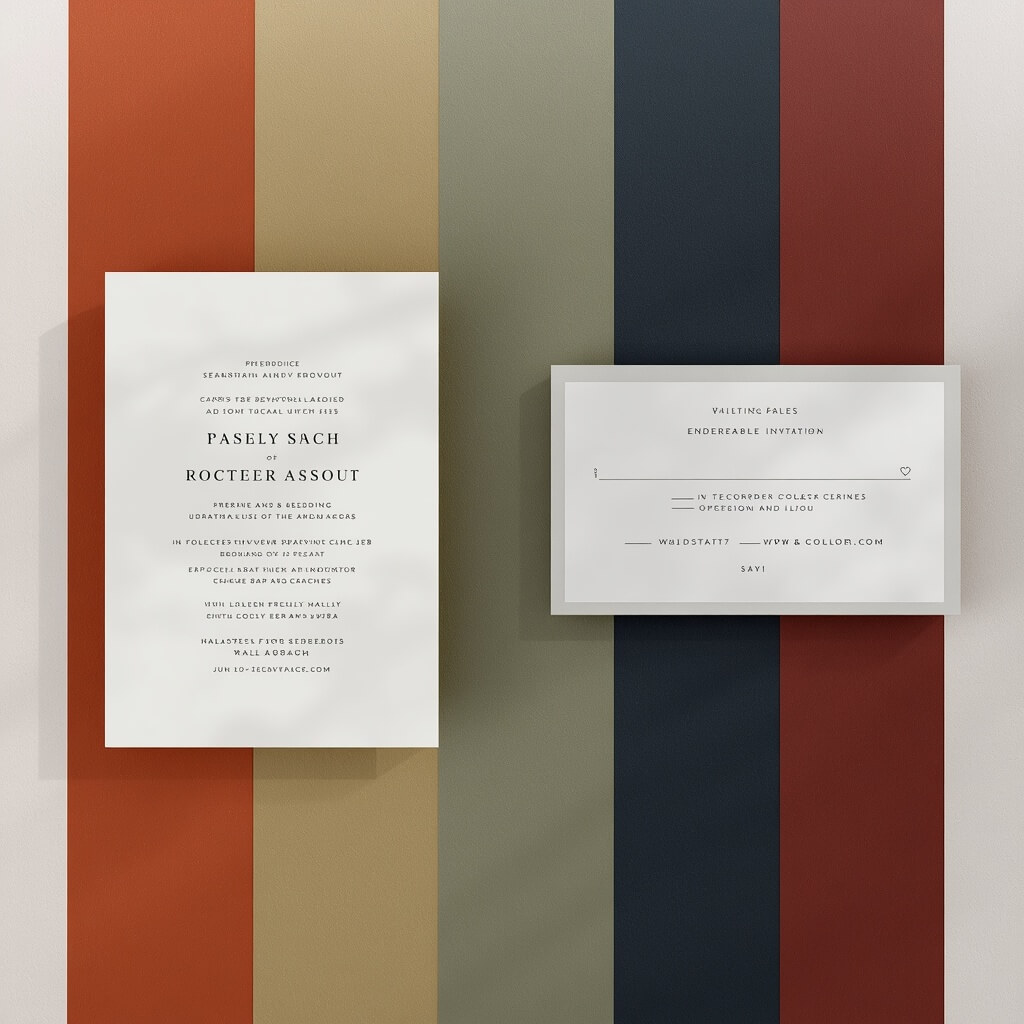
Your invitation palette is essentially the first chapter of your wedding’s visual story. Whatever colors appear on that card will set an expectation your guests carry with them through the day.
Earth Tones: Terracotta, Sage, and Dusty Olive
Terracotta ink on warm cream stock is one of the most requested color combinations in 2026 and for good reason. It feels current without being trendy in a way that will date quickly. Sage green pairs naturally with kraft paper for a more rustic approach, or with smooth ivory stock for something more polished. Dusty olive as an accent or primary color is slightly less common, which makes it feel more personal. Pair it with warm sand or off-white, and add a terracotta detail in the wax seal or ribbon for cohesion.
Deep Jewel Tones for Fall and Winter Weddings
Deep forest green with white or gold ink, midnight navy with silver, and burgundy with blush are all appearing consistently in fall and winter 2026 invitation designs. These are colors that read as intentional and luxurious without requiring an expensive printing technique to pull off. A navy envelope with a white wax seal and a sage-green belly band is an example of how jewel tones work best: in combination, with at least one lighter accent to keep the suite from feeling heavy.
Soft Watercolor Florals for Spring and Garden Weddings
Watercolor-style florals in muted dusty rose, lavender, soft blue, and warm ivory are the natural choice for garden, vineyard, and spring weddings. The key with watercolor designs is restraint in the typography. Let the illustration carry the visual weight and keep the text clean, small, and elegant. This style is widely available as a print-on-demand or downloadable template, which makes it very accessible for DIY couples. The trick is choosing a template that doesn’t look like everyone else’s, so look for designs with distinctive color palettes rather than generic pastel blends.
Monochrome and Black and White Palettes
Black ink on white or ivory stock is the most classic invitation combination that exists, and it’s never out of style. The sophistication comes entirely from typography, layout, and paper quality. A thick cotton stock with letterpress black text and a black edge-painted border is one of the most elegant suites you can produce. Monochrome doesn’t have to mean black and white. A suite printed in deep navy on pale blue-grey stock, or in forest green on sage paper, creates a tonal, sophisticated look that reads as deliberately modern.
Rustic Wedding Invitation Ideas
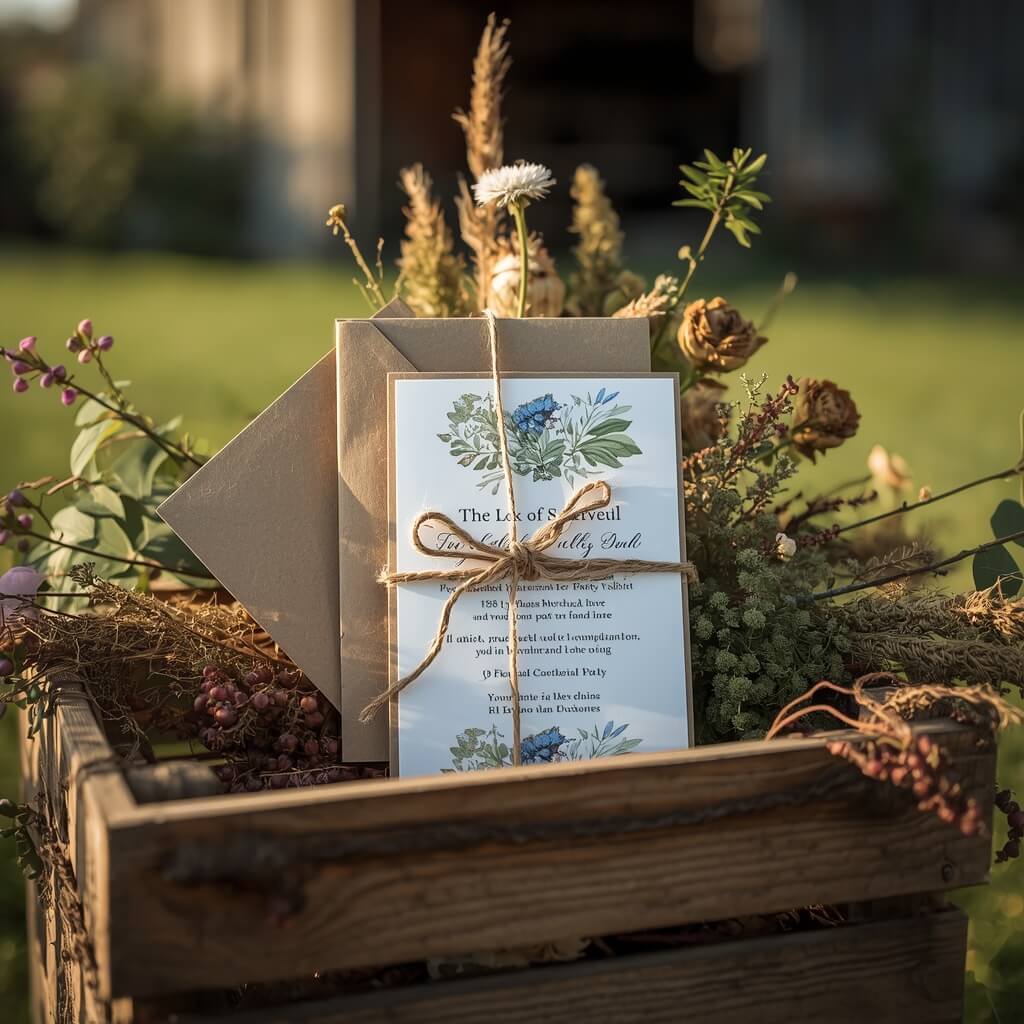
Rustic invitations have a warmth and handmade quality that works for barn venues, outdoor celebrations, backyard weddings, and farm-to-table restaurant receptions. The best rustic suites look intentionally crafted, not accidental.
Kraft Paper, Twine, and Botanical Illustrations
Kraft paper as a base stock immediately reads as rustic and organic. Pair it with warm brown, sage green, or deep terracotta ink, and add a botanical illustration or wreath motif to frame the text. Twine tied around the assembled suite or used to secure a vellum wrap adds a literal handmade quality. Specific example: a 5×7 kraft paper main card with a simple sage wreath around the couple’s names printed in a warm sepia ink, paired with a matching kraft details card and a smooth cream RSVP card for contrast. Tied with natural jute twine. This suite can be designed in Canva, printed at a local shop, and assembled at home in an afternoon.
Hand-Lettered and Hand-Illustrated Motifs
Hand-lettering as an invitation style means using script fonts that mimic the look of calligraphy, or commissioning actual hand calligraphy for a small guest list. Either approach adds organic warmth that printed block type doesn’t have. Hand-illustrated motifs, like a custom drawing of your venue, a botanical sprig, or a simple line-art portrait of the couple, make an invitation feel like nothing else out there. These are often commissioned from illustrators on platforms like Etsy and delivered as digital files you can take to any print shop.
Modern and Minimalist Wedding Invitation Ideas

Minimalist invitations do more with less. The design depends almost entirely on restraint: in color, in type choices, in the amount of information on the card.
Clean Typography and Negative Space
The defining feature of modern minimalist invitations is the amount of white space around the text. Nothing is crowded. The couple’s names might appear in a large, elegant serif. The event details below in a smaller, clean sans-serif. Nothing else. Specific example: a 5×7 white cotton stock card with the couple’s names in a 36-point elegant serif centered at the top, followed by event details in 10-point Helvetica Neue with generous line spacing. No border. No illustration. Printed flat in warm black ink. This suite photographs beautifully and reads as sophisticated at every price point.
Monochrome Palettes With a Single Accent Color
A single accent color does the work in a monochrome suite. Think white stock, black typography, and a single line of deep coral ink under the couple’s names. Or ivory stock, warm grey type, and a terracotta-painted edge on the card itself. Edge painting, where the thickness of the card stock is painted in a coordinating or contrasting color, is one of the most effective ways to add a pop of personality to a minimal design. It’s subtle in person and surprisingly striking in flat-lay photos.
Acrylic and Clear Invitation Suites
Acrylic invitations are the most dramatic version of the modern minimalist approach. A clear or frosted acrylic card with white or gold ink printed on its surface is unlike anything you can achieve with paper. They’re weighty, tactile, and unmistakably contemporary. The trade-offs are real: acrylic is significantly more expensive than paper, heavier to mail, and requires custom packaging. But for couples who want their invitation to make a strong, design-forward statement, it works exceptionally well in photographs.
Elegant and Formal Wedding Invitation Ideas
Formal wedding invitations are about precision and restraint. Every element is intentional. The suite is complete. Nothing is out of place.
Foil and Embossed Monograms
A foil-stamped monogram is the clearest visual signal of a formal invitation. Place it at the top of the card or on the envelope flap. Gold foil on ivory stock with a pearl finish is the most classic approach. Deep jewel-tone envelopes with a gold foil monogram seal are equally formal and considerably more dramatic. Embossed monograms, which create a raised impression without any ink or foil, are the quieter version. You notice them when the light hits the card at an angle. For some couples, that subtlety is exactly the point.
Deep Jewel Tones With Gold Accents
Deep forest green, midnight navy, and burgundy paired with gold foil, gold-edged envelopes, or gold ribbon are all reliably formal color combinations. A deep green card with gold foil typography, a white envelope liner, and a gold belly band is a complete suite that reads as unmistakably black-tie. These palettes work best when the paper stock is high-quality. On thin paper, jewel tones can look flat or oversaturated. On thick cotton or linen stock, they look rich and deliberate.
Layered Suites With Envelope Liners
A fully layered formal suite includes the main card, a details card, an RSVP card, a return envelope for the RSVP, an inner envelope, an outer envelope, and a liner in the outer envelope. That’s six or seven pieces, assembled in a specific order and tucked together. Not every formal wedding needs all of these. But if your guest list includes older relatives or more traditional families, the full suite signals that you’ve thought about every detail. The liner alone adds substantial visual impact and is worth including even if you simplify everything else.
Finishing Details: Wax Seals, Ribbons, and Monograms
Finishing details are what separate a well-designed suite from an exceptional one. They’re the last things guests see before opening the invitation and the things they notice most in unboxing photos. Wax seals are the single most popular finishing detail in invitation suites right now. They can be used on the envelope flap, to close a vellum wrap, or to secure a belly band. The color of the wax matters: clear or ivory wax reads delicate and botanical, terracotta or burgundy reads warm and rich, gold reads formal. This Custom Wax Seal Stamp Kit comes engraved with the couple’s initials or monogram and includes colored wax sticks, making it a practical option for adding a personalized tactile detail to envelope flaps or vellum wraps at home. The personalized stamp turns a functional step, sealing the envelope, into part of the design. Ribbons and silk cords are alternatives or complements to wax seals. A 6mm silk ribbon in terracotta, dusty sage, or ivory tied in a simple bow around the suite communicates the same handmade care at a lower cost per piece. Velvet ribbon reads more formal and luxurious in feel. Cotton or jute reads more rustic. Monograms appear throughout a suite: embossed on the main card, printed on the belly band, stamped in wax on the envelope. The key is using the monogram consistently, not on every single piece, but repeatedly enough that it reads as a cohesive design decision.
DIY Wedding Invitation Ideas
DIY invitations are entirely achievable if you’re honest about what the process actually requires. The savings are real. So is the time investment.
Printing at Home vs Using a Print Shop
Home printing works well for flat designs on standard paper sizes. The limitations are color accuracy, paper thickness (most home printers struggle above 80 lb cardstock), and registration if you’re printing front and back. A local print shop or online print-on-demand service gives you access to higher-quality paper stocks, better ink calibration, and printing techniques like letterpress or foil that no home printer can replicate. The cost difference is often smaller than couples expect, especially for quantities above 75. If you want the layered, handmade look of a deckle-edge suite without the custom stationery price tag, this Textured Deckle Edge Cardstock Paper Pack is a pack of printable cotton paper with a hand-torn edge that works at home or through a local print shop. The natural torn edge pairs well with botanical motifs, watercolor florals, and earth-toned palettes, and it mixes beautifully with a smooth RSVP card for that intentional contrast between pieces.
Templates vs Fully Custom Design
Downloadable templates are the most practical starting point for most DIY couples. You can purchase a template from an independent designer, replace the text with your own details in Canva or Adobe software, and take the file to a print shop or print it at home. Fully custom design means creating the layout and artwork from scratch, either yourself or by hiring a designer. This gives you complete creative control and a result that looks like nothing else. It also costs more and takes longer. For couples who want a personalized DIY result without starting from scratch, mixing a purchased template with custom elements, like a hand-stamped envelope or a custom wax seal, is the most efficient approach.
Budgeting for a DIY Invitation Suite
A realistic DIY budget breaks down like this: paper stock, printing costs (home or shop), extras like vellum, ribbon, or wax, envelopes, postage, and assembly time. Postage is often the forgotten line item. Shaped cards, heavy suites, or square envelopes all require additional postage. Always have a sample suite weighed and shaped-checked at the post office before ordering your full quantity. A full DIY suite for 100 guests printing locally on quality stock typically runs between $200 and $500 depending on finishes, which is significantly less than ordering the same suite through a stationery brand. The savings go up with your guest count.
Digital and Hybrid Invitation Ideas
When Digital Invitations Make Sense
Digital invitations make complete sense for casual weddings, elopements, and micro-weddings under 30 guests. They also work well as supplements: you send physical invitations to 80 guests and digital versions to the last-minute additions or overseas guests who don’t need a mailed card. Digital-only works best when all of your guests are comfortable receiving and acting on email or social media correspondence. For older guests, physical mail remains the most reliable delivery method.
QR Codes and Wedding Websites
Hybrid stationery, which pairs a printed invitation with a digital RSVP or QR code linking to a wedding website, is one of the most practical 2026 wedding invitation trends. The QR code handles the RSVP process digitally, reducing the need for a return envelope and allowing couples to track responses in real time. Print the QR code cleanly on the details card rather than the main invitation, with a short line of text explaining what it links to. If your guests can find your wedding website on The Knot, make sure that URL or QR code points there directly so they can access all the details, your registry, and travel information in one place.
Combining Print Elegance With Digital Convenience
The most effective hybrid approach treats the printed card as the experience and the digital component as the utility. The printed main invitation is beautiful, tactile, and worth keeping. The QR code or website link handles all the logistics: meal preferences, song requests, hotel blocks, and RSVP confirmation. This combination removes friction from the guest experience while still giving couples the physical invitation they’ve imagined. It also reduces the total number of printed insert cards, which brings the cost of the printed suite down.
Matching Your Invitations to Your Wedding Theme
Your invitation is the first chapter. The ceremony and reception are the rest of the story. When the design language carries through, the whole day feels cohesive.
Carrying Your Color Palette Through the Whole Day
The color palette on your invitation should appear again in the ceremony and reception. If your invitations feature sage green, warm cream, and terracotta, those same tones should show up in your florals, ribbon choices, linens, and stationery pieces at the reception. Your wedding table decoration ideas should feel like a natural continuation of the visual identity you established with the invitation. Start by choosing your palette at the design stage, before you finalize anything else. Everything else, from bridesmaids’ dresses to napkin colors, can be coordinated once the foundational palette is fixed.
Seasonal Considerations for Invitation Design
Season informs palette and motif more than any other single factor. Spring and early summer invite soft watercolor florals, botanical greenery, and pastel or muted tones. Late summer and fall call for deeper, warmer colors and richer textures. Winter weddings can support the most dramatic palettes: deep greens, midnight navy, jewel tones, and high-contrast black and white. Your printing choices can also reflect season. Edge-painted cards in warm amber or rust are particularly suited to autumn. A simple snowflake emboss or a silver foil border reads naturally for a winter wedding. These details don’t need to be literal, just tonally consistent.
Wording That Matches Your Tone
Wording is as much a part of the design as the paper and ink. Formal language, with full names, titles, and traditional phrasing, signals a black-tie or formal occasion. Relaxed, first-name wording tells guests they can exhale. The two biggest wording mistakes couples make are defaulting to excessive formality out of habit and mixing tones within the same suite. If your ceremony is barefoot on a beach, your invitation shouldn’t read like a state dinner. If your reception is a seated dinner with a dress code, your invitation should say so clearly. The wording is the guests’ first signal about what to expect, so use it intentionally.
Invitation Styles Reference Table
| Style | Key Elements | Best For |
|---|---|---|
| Rustic | Kraft paper, twine, botanical illustrations | Barn, farm, and outdoor venues |
| Modern Minimalist | Typography-led layout, negative space, monochrome | Industrial and contemporary venues |
| Elegant and Formal | Foil monograms, jewel tones, envelope liners | Ballrooms and black-tie weddings |
| Garden and Watercolor | Soft florals, muted palettes, airy layouts | Garden, vineyard, and spring weddings |
| Acrylic and Clear | Sleek transparent cards, minimal text | Couples wanting an ultra-modern look |
| Die-Cut and Shaped | Arches, scallops, ticket-style edges | Couples wanting a design-forward statement |
Common Wedding Invitation Mistakes Table
| Mistake | Better Approach |
|---|---|
| Choosing a design before setting a color palette | Settle on your overall palette first, then design around it |
| Overcomplicating wording with excessive formality | Match wording tone to your wedding’s formality level |
| Ignoring postage requirements for shaped or heavy suites | Check weight and shape with the post office before ordering |
| Skipping a proof before full printing | Always order a sample or proof first |
| Mixing too many fonts or design elements | Limit to two or three complementary fonts |
| Forgetting to include all suite pieces guests need | Confirm RSVP, details card, and envelope are all included |
| Not considering how the design photographs | Check how textures and colors look in flat-lay photos |
| Ordering too few extras for keepsakes or mistakes | Order 10 to 15 percent more than your guest count |
Related Reading
Frequently Asked Questions
What are the best wedding invitation ideas for 2026?
The strongest 2026 invitation ideas combine an earth-toned or jewel-tone palette with at least one tactile element, either a shaped card, a textural printing technique, or a vellum wrap. Earth-toned palettes in terracotta, sage, dusty olive, and warm cream are replacing the cool greys and blushes of recent years. Die-cut shapes including arches, scallops, and ticket-style edges are replacing the standard rectangle. Typography-led layouts with refined serif fonts and generous white space are defining the modern look, while hybrid suites that pair a printed card with a digital RSVP via QR code are among the most practical choices for 2026.
What colors are trending for wedding invitations in 2026?
Earth-toned palettes such as terracotta, sage, dusty olive, and warm cream are the leading color trend in 2026 invitation design, replacing the cooler grey and blush combinations that dominated recent years. For fall and winter weddings, bold jewel tones including deep forest green with white or gold ink, midnight navy, and burgundy are appearing as statement color choices. Monochrome palettes, particularly black on white or ivory cotton stock, remain a strong choice for formal and minimalist designs.
What goes in a wedding invitation suite?
A full wedding invitation suite typically includes the main invitation card, a details or information card, an RSVP card, and an outer envelope. Some couples add an inner envelope, an envelope liner, a vellum wrap, and a belly band or ribbon. Two-piece suites, where couples invest in a well-designed main invitation and a simple RSVP card, are a practical and increasingly common alternative to the full layered suite.
Are digital wedding invitations acceptable?
Digital invitations are completely acceptable for casual weddings, elopements, and micro-weddings. For larger, more formal events, most couples find that physical invitations are still expected by a meaningful portion of their guest list, particularly older relatives. Hybrid invitations, which pair a printed physical card with a digital RSVP via QR code, offer the best of both approaches and are one of the most practical trends in 2026 wedding stationery.
What is the difference between letterpress and foil printing?
Letterpress is a printing process that presses the design into the paper, leaving a debossed impression you can feel by touch. It uses ink and works best on thick cotton or textured stock. Foil printing applies a metallic or colored foil to the surface of the paper, producing a reflective shine. Letterpress reads as subtle and tactile. Foil reads as dramatic and eye-catching. Both are premium techniques. Many elegant suites combine flat printing for the body text with a foil-stamped monogram or letterpress-printed names as the focal detail.
How do you choose a wedding invitation color palette?
Start with your venue and season, then work outward. A garden venue in spring calls for a different palette than a ballroom in December. From there, choose one or two primary colors and one supporting neutral. Make sure the palette works in natural light, in photographs, and against the paper stock you’re considering. Test your ink colors on an actual sample of your chosen paper before ordering. Colors look different on cream stock versus white versus kraft.
What are good rustic wedding invitation ideas?
Kraft paper with warm sepia or sage green ink and a botanical illustration is the foundation of most rustic suites. Pair it with a natural twine tie, a simple wax seal, and a matching kraft envelope for a cohesive result. Hand-lettered script fonts and hand-illustrated motifs like botanicals, leaves, or simple wreath designs all work within the rustic style. Deckle-edge paper adds a handmade quality that fits naturally with the aesthetic.
Can you DIY your own wedding invitations?
Yes. DIY invitations are achievable for most couples with access to a home printer or a local print shop. The most practical approach is purchasing a downloadable template from an independent designer, customizing the text, and having it printed on quality card stock. Adding DIY finishing details like a wax seal, ribbon, or vellum wrap makes the result look significantly more polished. For quantities above 75 and suites requiring special finishes like foil or letterpress, using a professional printer while handling the assembly yourself is often the most cost-effective approach.
What shapes are trending for wedding invitations?
Die-cut shapes are replacing the standard 5×7 rectangle across all invitation styles in 2026. Arched-top cards have a soft, architectural quality that works with both botanical and minimal designs. Scalloped edges add a vintage or garden quality. Ticket-style cards, with rounded corners and a horizontal format, feel modern and editorial. Wave-cut edges are a newer, more organic option. All shaped cards require confirmation with your local post office before ordering, as they may require additional postage or hand-cancellation fees.
How early should you send wedding invitations?
Standard timing is six to eight weeks before the wedding date for domestic guests. If a significant number of your guests need to book travel or arrange time off from work, eight to twelve weeks gives them adequate notice. For destination weddings, twelve weeks minimum is the standard. Save-the-dates should go out six to twelve months in advance for destination weddings, or four to six months for local celebrations. Include an RSVP deadline that gives you at least three to four weeks before your final headcount is due to the venue and caterer.
What is a vellum wrap on a wedding invitation?
A vellum wrap is a translucent sheet of vellum paper folded around the assembled invitation suite. Because the vellum is semi-transparent, the design of the main invitation shows through it, creating a soft layered effect. Vellum wraps are typically sealed with a wax seal, tied with ribbon, or secured with twine. They add a tactile, layered quality to the suite and make assembly feel intentional and special. They’re particularly popular with botanical, watercolor, and earth-toned invitation designs where the print benefits from that soft, layered visual.
How do you match invitations to your wedding theme?
Start by identifying your wedding’s dominant color palette, mood, and venue type, then design the invitation to reflect all three. A barn wedding calls for different design choices than a ballroom wedding, even if both couples like jewel tones. The specific colors on your invitation should reappear in your florals, linens, and decor. The typography and paper quality should match the formality level of the event. The wording tone, casual or formal, should align with what guests will actually experience on the day. Treating the invitation as a preview, not just an announcement, is the key to making everything feel cohesive.
Your invitation is one of the few pieces of your wedding that every single guest holds in their hands before the day arrives. The design, the paper, the finishing details, all of it sets a tone. Getting it right is worth the time.
About The Author


Leave a Reply