
Quick Answer
A wedding arch is a freestanding structure placed at the front of the ceremony space, giving the couple a defined backdrop and giving guests a clear focal point. In 2026, the most popular arch styles are sculptural geometric metal frames, overgrown wild greenery installations, asymmetrical floral designs, and oversized fabric-draped backdrops. For DIY builds, wood and metal pipe are the most practical frame materials because both are affordable, sturdy, and easy to decorate. If you want to skip flowers entirely, sheer fabric panels, eucalyptus garlands, macrame, pampas grass, and ribbon swags all work beautifully. For outdoor ceremonies, anchor a wooden or metal frame with weighted bases or ground stakes. For indoor venues, go for a lighter frame dressed with fabric or greenery to keep proportions clean.
What Is a Wedding Arch and Why It Matters

The Arch as the Visual Focal Point of the Ceremony
Every ceremony needs a place for the eye to land. The arch is that place. It gives guests a clear center of attention the moment they walk in, and it gives photographers a frame to work with throughout the entire event.
Your arch also does the storytelling before you say a single word. A bare hexagon frame with one greenery swag reads completely differently from a reclaimed wood arch loaded with garden roses and lanterns. It sets your aesthetic before the music even starts.
From a photography perspective, the arch is one of the hardest-working elements in your budget. A photographer can shoot through it during the processional, frame the couple within it during the vows, and use it for portraits afterward. One structure. Dozens of photos.
It also gives your florist or DIY decorator a defined canvas with real dimensions rather than a vague “front of the space” to fill.
Cultural Ceremony Structures: Chuppahs, Mandaps, and Canopies
Not every overhead structure at a wedding is technically an arch, and knowing the difference saves confusion when talking to venues and vendors.
A chuppah is used in Jewish weddings. It is a fabric canopy held up by four poles, and it carries religious meaning: the fabric top represents the couple’s new home, and the open sides represent the welcome they extend to their community. The canopy element is required.
A mandap is central to Hindu weddings. It is a more elaborate pavilion, usually four decorated pillars with a canopy overhead. The mandap is the sacred space where all the ceremony rituals happen and is typically loaded with marigolds, jasmine, and vibrant fabric in gold, red, and saffron.
Floral canopies, common in bohemian and garden weddings, borrow the overhead look without any religious requirements. They create an intimate ceiling above the couple using flowers or greenery suspended between two uprights. If you love the idea of something above you rather than behind you, a canopy gives you that feeling without the structural complexity.
Arch Placement and Why It Affects Your Photos
Where the arch goes is just as important as what it looks like. The default spot is centered at the end of the aisle, and that works for most venues. But it is not always the best position.
For outdoor ceremonies with a water view, mountain backdrop, or garden vista, move the arch slightly forward of that scenery. Your photographer gets the arch in the foreground and the view layered behind you.
For indoor venues with high ceilings, a tall arch fills the vertical space and gives the room a sense of scale. For low-ceiling venues, go wider rather than taller. A horizontal rectangular frame works with the architecture instead of fighting it.
Sun position matters more than most couples think. If your ceremony starts at 2 PM and guests face west, they are squinting directly into the sun. Work with your photographer and coordinator to align the arch position with the light at your specific ceremony time.
2026 Wedding Arch Trends Worth Knowing

Architecture as Design: Sculptural and Custom-Built Structures
In 2026, wedding arches are treated as architecture rather than backdrop, with sculptural shapes, custom-built structures, and bold geometric forms framing the entire ceremony. Couples are moving past simple frame-and-flowers setups toward deliberate structural moments: asymmetrical uprights, double-arch configurations, and platform-style builds that extend the ceremony design beyond a single frame.
Custom structures in raw steel, painted MDF, and reclaimed timber are showing up at wedding editorials and high-end venues. Even couples renting standard arches are layering decor to get that architectural, purpose-built feeling.
Overgrown Florals and Wild Greenery Arches
Overgrown, wild floral arches with vines and oversized greenery are a leading 2026 wedding arch trend, replacing neat, symmetrical arrangements. The shift is toward organic density. Florals pile up on one side, vines trail to the ground, and parts of the frame are left deliberately bare.
This look needs volume. Expect to use three to five times the greenery you would for a traditional arrangement. The result is an arch that looks like it grew there, and it photographs with a richness that neat, symmetrical designs rarely match.
Lighting Built Into the Arch: Chandeliers and Neon
Lighting is now treated as a core part of arch design in 2026, with chandeliers, neon signs, and string lights built directly into the structure. A small chandelier hanging from the apex of an arch is one of the most photographable moments you can create. It adds warmth, pulls the eye upward, and glows beautifully in evening shots.
Neon signs with initials, dates, or a short phrase mounted within the arch frame add personality for modern and eclectic couples. String lights woven through greenery garlands create a soft ambient layer perfect for outdoor sunset ceremonies.
Asymmetrical Arches for a Modern, Editorial Look
Asymmetrical arches, where florals or greenery cover one side more heavily than the other, create a modern, editorial look that photographs well. This trend comes straight from fashion and editorial photography, where breaking the symmetry creates visual tension.
Practically, asymmetrical designs also cost less than full coverage. You are loading one side and leaving the other lighter, which means less total volume of flowers or greenery. Higher visual impact for less spend.
DIY Wedding Arch Ideas: Building Your Own

Choosing the Right Frame: Wood, Metal, or PVC
The frame is the foundation of everything. Your material choice determines the finished weight, outdoor stability, and how much decoration the arch can hold.
Wood is the most beginner-friendly and versatile option. A basic A-frame from standard 2×4 lumber costs under $30 in materials. A ready-made folding frame costs more but sets up without any tools and looks polished right out of the box. Wood accepts staples, screws, zip ties, and twine, so attaching decor is easy. The natural tone works with every aesthetic from rustic barn to clean modern.
This foldable natural wood arch frame sets up in minutes and works as a blank canvas for florals, drapes, or greenery garlands. It is sturdy enough for outdoor ceremonies and easy to load into a car, which makes it ideal for couples who want a clean DIY build without the construction stress.
Metal pipe (electrical conduit or copper pipe) gives you a cleaner, more geometric look. Square and rectangular metal frames suit modern and industrial aesthetics. Metal is heavier than PVC and more stable outdoors. You connect sections with elbow fittings and finish the whole frame with spray paint.
PVC pipe is the lightest and cheapest choice. It bends into curves, which makes it useful for arch-shaped or circular builds. The catch is stability: PVC is light enough to tip in moderate wind and needs weighted bases or ground stakes outdoors.
Shapes That Work: Square, Round, Triangle, and Freeform
Shape affects the entire mood of the finished arch. A square or rectangular frame reads as structured and formal, which suits modern, geometric, and minimalist styles. A round or circular frame reads as soft and romantic. Ovals and irregular organic curves feel more artistic and bohemian.
Triangular arches, where two poles meet at a peak overhead, create a strong visual line that works well with minimal decor. A greenery swag at the peak and fabric draping down both sides is honestly all you need.
Freeform arches, where two separate uprights lean slightly inward without connecting at the top, feel open and airy. Great for boho outdoor ceremonies where a heavy overhead structure would feel too formal for the space.
Tools and Time: What to Expect From a DIY Build
A wooden arch built from lumber takes two to four hours with a drill, screws, and sandpaper. Add staining or painting time if you want a finished look. A folding pre-made frame is under thirty minutes from box to setup.
Plan two to three extra hours for decorating on top of build time. Attaching greenery garlands, wrapping fabric, and positioning florals always takes longer than you expect, especially on a day when everything matters. Build and decorate the arch at home first, photograph the finished look, then take it apart for transport. You want zero surprises on the wedding day.
Floral and Greenery Wedding Arch Ideas

Full Floral Coverage vs Accent Florals
Full floral coverage means flowers from top to bottom with the frame completely hidden under blooms and foliage. This is the editorial, luxury look you see in high-end wedding photography. It takes a significant volume of fresh or faux florals and typically runs $300 to $1,000 or more in fresh flowers depending on what you choose.
Accent florals place arrangements at the corners, apex, or base of the arch and leave the frame visible in between. A square metal arch with two corner clusters and a trailing greenery swag at the top is a clean, modern look that costs a fraction of full coverage and photographs just as well.
Wild and Overgrown Greenery Looks
The wild greenery arch puts volume, texture, and movement above symmetry. Start with eucalyptus garlands wrapped loosely around the frame as a base. Layer in long trailing vines, oversized tropical leaves, and bunches of Italian ruscus. Tuck a few statement blooms in at random intervals, not evenly spaced.
These realistic faux eucalyptus and vine garlands can be layered or wrapped around an arch frame to create the overgrown, wild greenery look trending in 2026. They are reusable, require zero maintenance, and hold up through a full day of ceremony and portrait time without wilting.
Let the greenery stay loose at the base so it appears to spill toward the ground. Secure it at the back of the frame with floral wire where it will not appear in photos.
Seasonal Flowers That Work Best on Arches
Not every flower handles arch installation well. Some blooms hold up for hours; others start drooping within an hour of being placed.
Roses are reliable. Garden roses and hybrid teas both stay open and upright for twelve to sixteen hours after cutting, which covers the ceremony and portrait session easily.
Greenery is the backbone. Eucalyptus, fern, Italian ruscus, and smilax vine all hold well without water for several hours, which makes them ideal for garlands installed the morning of the ceremony.
Dahlias look stunning but wilt faster than roses. Keep them in water until the last possible moment and install them as late as you can before the ceremony starts.
Baby’s breath and Queen Anne’s lace fill space beautifully and add an airy, romantic texture at a fraction of the cost of statement blooms.
Tropical leaves like monstera, palm fronds, and bird of paradise add structure and drama to wild and lush arch designs and hold up well in heat.
Wedding Arch Ideas Without Flowers

Fabric Draping and Sheer Panel Backdrops
Fabric is one of the most underused arch decorations and one of the most impactful. Long sheer panels draped over the top of an arch and let fall on both sides create an elegant, oversized backdrop that photographs as well as a full floral installation at a fraction of the cost.
These long sheer chiffon panels drape over an arch frame to create a soft, sculptural fabric moment. They come in multiple colors to match jewel-tone or pastel palettes and layer easily with greenery or string lights for a full, dimensional look.
For more structure, gather the fabric and tie it at intervals with ribbon or twine to create a pleated swag effect along the frame. Layer a sheer white outer panel with a jewel-toned inner panel for depth and color with zero flowers required.
Wood, Macrame, and Textured Material Arches
A bare wood frame with a single large macrame wall hanging at its center is a complete arch design. No florals needed. The knotted fiber texture adds warmth and bohemian character that suits barn and outdoor ceremonies well.
Pampas grass is another strong non-floral option. Two large bunches anchored at the base corners of a rectangular arch, with long plumes trailing upward, creates a neutral, earthy aesthetic that pairs with almost any color palette.
Dried botanicals, including preserved lunaria, dried palms, and wheat stalks, create an arch that holds its look well before the ceremony and photographs with beautiful organic texture in natural light.
Balloon, Paper, and Lightweight Decor Arches
Balloon garlands are a completely legitimate ceremony backdrop for casual, colorful, or budget-focused weddings. A two or three-color palette balloon garland draped over a frame takes about two hours to build and runs $30 to $60 in supplies. The look is festive, graphic, and very photogenic.
Large-scale crepe paper blooms add color and dimension to an arch without the cost or fragility of fresh florals. A cluster of oversized paper flowers in a corner or at the apex position looks intentional and artistic.
Ribbon wands, tassel garlands, and hanging origami can all be layered onto a frame for a whimsical, textural look that suits garden parties and boho outdoor ceremonies.
Greenery-Only and Foliage-Focused Arches
A greenery-only arch built entirely from eucalyptus, fern, ivy, and tropical leaves is a sophisticated and cost-effective option. The range of green tones, from silvery eucalyptus to deep hunter fern, creates enough visual complexity to hold the eye without a single flower.
For full coverage on a standard 6×6 foot frame, plan on fifteen to twenty garland strands. Layer different species for texture: eucalyptus as the base, Italian ruscus for structure, and long trailing ivy to create movement and that spilling effect at the base.
Rustic Wedding Arch Ideas
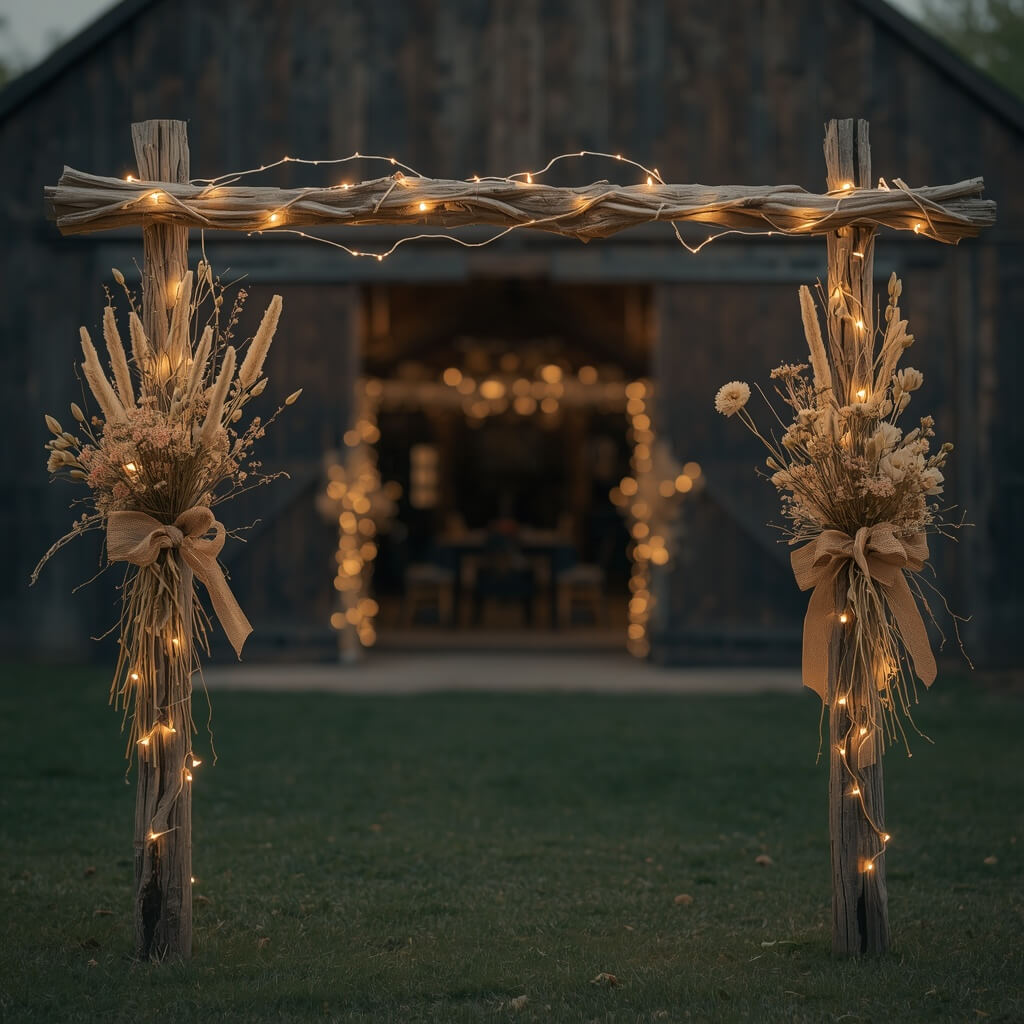
Reclaimed Wood and Natural Branch Arches
The most authentic rustic arch is built from materials that look like they came from the land. Two natural branches or small tree trunks lashed together at the top feel organic and site-specific. For barn and farm weddings, sourcing branches from the property itself adds meaning to the structure.
Reclaimed wood boards assembled into a square frame and left unsanded or lightly sanded photograph beautifully against green landscapes and golden-hour light. The weathered gray tones need no staining.
For a structured rustic look with personality, two ladders leaning against each other at the top create a quirky, informal backdrop. Hang mason jar vases from the rungs, fill them with wildflowers, and drape a loose fabric swag across the top beam.
Burlap, Twine, and Wildflower Accents
Burlap ribbon wrapped around the uprights of a wooden arch adds texture and warmth for almost no cost. Pair it with clusters of dried wildflowers, baby’s breath, or sunflowers tucked into the wrapping at uneven intervals. Twine bows at regular points along the frame add visual rhythm without adding weight.
Wildflower bundles secured with twine at the base corners of the arch create a loose, meadow-like feel. Lavender, chamomile, and goldenrod together give you a fragrant, soft palette that works for late spring and summer ceremonies.
String Lights for Evening Rustic Ceremonies
String lights change the mood of a rustic arch entirely for evening ceremonies. Warm white Edison bulb strands woven through greenery garlands or draped across the horizontal beam add romantic ambient light that photographs warmly even in low-light conditions.
For a barn ceremony, run string lights from the arch outward to nearby posts or fence elements to extend the glow into the surrounding space.
Solar-powered string lights are worth using for outdoor venues without convenient access to power.
Modern and Minimalist Wedding Arch Ideas
Geometric Metal Frames: Square, Hexagon, and Circle
Modern arches are about clean lines and deliberate proportion. A matte black square frame with minimal decor, maybe a single trailing greenery swag or two white roses at the top corners, is a complete design statement. The frame itself carries the aesthetic.
Hexagonal frames add geometric interest without the density of a full floral installation. The six-sided shape photographs with sharp angles that suit editorial and fashion-forward wedding styles.
Circular metal frames, commonly called moon arches, are among the most popular modern arch shapes. The complete circle creates a natural frame-within-a-frame effect for ceremony photography and works well with minimal decor: a few pampas plumes, a single ribbon, or nothing at all.
Monochrome and Single-Color Arch Designs
A monochrome arch works by committing fully to one tone. All-white with white fabric, white blooms, and a white frame creates a clean, ethereal look. All-green with dense eucalyptus, fern, and ivy from top to bottom has an organic, lush quality. All-black with dark foliage and deep burgundy or near-black dahlias feels dramatic and editorial.
Monochrome designs photograph with more contrast and graphic impact than mixed-palette arches, which is a practical advantage when you want strong ceremony images.
Mirrored and Chrome Accents for a Retro-Modern Look
Mirrored surfaces and chrome accents are resurfacing in 2026 as part of a broader retro-glam aesthetic that pairs well with modern geometric arch frames. A hexagonal chrome frame left mostly bare, dressed with only an asymmetrical floral arrangement on one side, creates a high-impact look that suits ballroom and industrial venues.
Small mirrored tiles or panels fixed to sections of an arch frame create a disco-ball effect when light hits them. This works well for couples whose ceremony aesthetic flows into a glam, playful reception.
Outdoor and Garden Wedding Arch Ideas
Working With Natural Backdrops Like Trees and Water
Outdoor venues give you a natural backdrop that does a significant portion of the design work. When you are marrying in front of a tree line, lake, vineyard, or garden, the arch needs to complement the scenery rather than compete with it.
For green settings, choose an arch that adds structure without blocking the view. A lightweight A-frame or open two-post design lets the scenery read through. Decorate with florals that match the tones of the setting: blush and white for formal gardens, coral and terracotta for earthy vineyard landscapes.
For beach ceremonies, a driftwood arch or a lightweight bamboo frame with sheer white fabric keeps the structure proportionate to an open-sky backdrop. Heavy, ornate arches look out of place against a wide horizon.
If you are planning a garden ceremony, it is worth thinking through guest attire as well, since natural settings call for specific footwear and outfit considerations. The what to wear to a garden wedding guide covers exactly what guests need to know.
Weather-Proofing an Outdoor Arch
Wind is the single biggest threat to an outdoor ceremony arch. Even a moderate breeze can tip an unsecured structure, scatter loose florals, and turn fabric panels into sails. Plan for it from the start, not the day before.
Weighted bases that clamp onto the uprights keep the arch steady on hard surfaces. Metal ground stakes driven beside each leg work well in soil. For pavement or polished venue floors, sandbags tied to the frame base are the practical option.
Fresh floral stems need water until the last moment. Use floral water tubes for any stems that need hydration and install arrangements as close to ceremony time as possible. Tie fabric panels at multiple points along the frame so they cannot billow and lift.
Garden-Inspired Arch Color Palettes
Garden wedding palettes lean toward soft, natural tones. Blush, ivory, sage, lavender, and dusty blue all feel right at home in a garden setting. For a richer look, add deep burgundy or terracotta as accent tones within an otherwise gentle palette.
A high-contrast color combination, like hot pink and black, will compete with a garden backdrop rather than sit within it. Save bold contrasts for indoor or industrial venues where there is no natural scenery to clash with.
Indoor Wedding Arch and Backdrop Ideas
Arches for Low-Ceiling Venues
Low ceilings change what you can build. A tall, narrow arch in a room with an eight-foot ceiling looks cramped and out of proportion. Going wider than you go tall is a smart adjustment. A rectangular frame that emphasizes horizontal width creates a focal point that works within the space rather than fighting it.
If a freestanding arch feels like too much for the ceiling height, a backdrop panel or curtain structure that fills the wall behind the couple achieves the same visual purpose without the vertical constraint.
Backdrops That Double as Photo Walls
Indoor arches and backdrops earn their cost most when they are used twice: once during the ceremony and once as a portrait station or guest photo backdrop during cocktail hour and the reception.
A simple greenery panel placed behind the sweetheart table serves as a portrait background all evening. Guests naturally want to stand in front of it.
Design the ceremony backdrop with the second use in mind. Keep decor removable so it can be repositioned. Avoid staples or adhesives that damage the structure and prevent reuse in a different spot.
Lighting Considerations for Indoor Arches
Indoor venues give you more control over lighting than outdoor spaces, and your arch design should use that advantage. If the venue has uplighting, coordinate its color with your arch palette. Adding a chandelier or pendant light to hang from inside the arch requires confirming with the venue that the structure can support the weight.
For arches with neon signs, locate a nearby power source during your venue walkthrough. Battery-powered neon signs avoid visible extension cords and give you more flexibility with arch placement.
Wedding Arch Ideas by Budget
Under $50: Frame Plus Simple Decor
A basic wooden or metal arch frame can be decorated for under $50 using ribbon, greenery garlands, and fabric draping. This is the entry-level DIY arch and it is genuinely achievable with a little planning.
Buy or build a folding wooden frame. Wrap the uprights with ribbon or fabric strips. Add two or three faux greenery garlands draped along the top beam. Tie a sheer fabric panel across the top. Materials total: $30 to $50.
Keep the decor sparse and intentional at this budget level. Simple and deliberate reads as styled. Cramming in too many elements on a tight budget reads as cluttered.
$50 to $150: Florals, Fabric, and Greenery Combined
At this range, you can layer fresh or high-quality faux florals with fabric and greenery for a real sense of depth and texture. Spend $40 to $60 on a garland set, $20 to $30 on two fresh floral bunches for corner accents, and $15 to $25 on fabric panels.
The resulting arch has material variety and visual interest. This is where most well-planned DIY arches land when couples source materials a few weeks ahead.
$150 and Above: Full Installations and Rentals
At $150 and up, you are looking at full fresh floral coverage, professional-quality faux installations, or venue rental packages that include frame delivery, setup, and retrieval. Rental fees typically start around $150 to $300 for a basic frame and climb with decor complexity.
Full florist-installed arch arrangements start around $300 for simple fresh greenery and can reach $1,000 or more for dense, full-coverage installations using premium blooms.
Matching Your Arch to Your Overall Theme
Color Palette Consistency From Ceremony to Reception
The arch is the first large-scale design element guests see, and the colors in it set expectations for everything else. The tones you use on the arch should reappear in your table linens, centerpieces, stationery, and bridesmaid attire.
Start with the arch palette and build backward. Once you have two or three tones locked in, matching those across every other element becomes straightforward. For table decor inspiration that flows naturally from the ceremony arch, the wedding table decoration ideas guide covers how to carry your color palette through the full reception.
Reusing the Arch: From Ceremony Backdrop to Reception Decor
Reusing the ceremony arch as a reception backdrop, sweetheart table frame, or portrait station is one of the smartest ways to stretch your decor budget. Plan for this from the beginning by sizing and styling the arch for both locations.
A ceremony arch placed behind the sweetheart table at the reception creates a visual connection between the two spaces. A greenery or fabric backdrop arch becomes an automatic portrait station that guests use throughout the evening.
Talk with your venue coordinator and decorator about the transition timing. The arch needs to be moved, possibly refreshed for fresh florals, and repositioned between the end of the ceremony and the start of the reception.
Personalizing Your Arch: Signage and Monograms
A wooden or acrylic sign with the couple’s names, wedding date, or a phrase that means something to them is a personal touch no florist can provide off a standard menu. Laser-cut wooden signs, acrylic panels, and hand-lettered calligraphy boards all attach easily to arch frames.
Monogram initials in wire or floral form suspended from the arch apex create a distinctive personalized moment. Neon monograms add a modern twist for couples who want their arch to also function as a graphic design element.
Practical Considerations Most Couples Forget
Wind, Weather, and Outdoor Stability
A tipping arch during a ceremony is a safety problem before it is a photography problem. Treat outdoor arch anchoring seriously. Weighted bases or ground stakes should be part of the plan from day one, not something you figure out the morning of the wedding.
If the arch base will appear in ceremony photos, use sandbags in canvas or burlap covers rather than bare plastic. Position them where fabric draping or floral arrangements at the base will hide them.
Venue Rules on Structures and Anchoring
Venues have rules about what can be installed, how it can be anchored, and what impact on floors, walls, or grounds is acceptable. Driving stakes into a manicured lawn, mounting anything to a historic building’s walls, or suspending weight from a ceiling light fixture all require explicit venue approval.
Get those details confirmed in writing before finalizing your arch design. Finding out on the wedding day that your arch cannot be installed as planned is an expensive and stressful problem that is completely preventable.
Setup and Teardown Time
Arch decoration takes longer than most couples budget for. A florist installing a full fresh floral arch may need three to four hours. A DIY couple attaching faux garlands and fabric panels still needs at least one to two hours.
Block out setup time on your ceremony day timeline before locking in the ceremony start. If the venue opens at noon for a 3 PM ceremony, three hours sounds like plenty until you factor in transportation, setup of other decor, and the arch itself. Build in a buffer.
Teardown timing matters too. Many venues charge per-hour fees once vendors go past the contracted end time.
Arch Styles Reference Table
| Style | Key Elements | Best For |
|---|---|---|
| Rustic | Wood, branches, burlap, wildflowers | Barn, farm, and outdoor venues |
| Floral Statement | Full floral coverage, lush and layered | Garden, vineyard, and luxury venues |
| Modern Geometric | Metal frames, clean lines, monochrome | Industrial and contemporary venues |
| Wild and Overgrown | Vines, oversized greenery, asymmetry | Couples wanting a bold, organic look |
| Fabric Draped | Sheer or solid panels, oversized drapes | Indoor venues and budget-friendly setups |
| Retro-Modern | Mirrored accents, chrome, geometric shapes | Couples wanting a bold, editorial statement |
Arch Ideas by Venue Type Table
| Venue Type | Best Arch Style | Why It Works |
|---|---|---|
| Garden or Outdoor | Floral or wild greenery arch | Blends with natural surroundings |
| Beach | Lightweight wood or fabric drape | Withstands wind, photographs well against open sky |
| Barn or Rustic Venue | Reclaimed wood or branch arch | Matches existing natural textures |
| Ballroom or Banquet Hall | Modern geometric or fabric drape | Creates a focal point in a large open space |
| Industrial Venue | Retro-modern metal frame with mirrored accents | Complements exposed brick and metal finishes |
| Small or Intimate Venue | Compact floral or greenery arch | Fits tighter spaces without overwhelming the room |
Common Wedding Arch Mistakes Table
| Mistake | Better Approach |
|---|---|
| Choosing an arch too large for the venue | Measure the ceremony space before ordering or building |
| Not securing the arch for wind or movement | Use weighted bases, stakes, or sandbags outdoors |
| Ignoring venue rules on anchoring or structures | Confirm what is allowed before finalizing the design |
| Overloading a lightweight frame with heavy florals | Match decor weight to frame strength |
| Forgetting how the arch looks from the guest’s view | Check sightlines from seated guest positions before the wedding |
| Not planning for reuse at the reception | Design with a second placement in mind to save costs |
| Choosing colors that clash with the overall palette | Tie arch colors to invitations and table decor |
| Underestimating setup time on the wedding day | Build in extra time for decorating before the ceremony |
Related Reading
Frequently Asked Questions
What are the most popular wedding arch ideas for 2026?
The most popular wedding arch ideas for 2026 include sculptural geometric metal frames, overgrown wild greenery arches with heavy asymmetrical arrangements, fabric-draped backdrops in sheer or jewel-toned panels, arches with built-in lighting like small chandeliers or neon signs, and arches styled with dried botanicals and pampas grass. The direction in 2026 is toward arches that feel like intentional architectural elements rather than simple ceremony props, with bold structure, organic texture, and personalized details.
How do you decorate a wedding arch on a budget?
Start with a simple frame, either a folding wooden arch or a PVC pipe structure, and focus the decor on two or three elements rather than trying to cover everything. Faux greenery garlands layered along the frame cost $20 to $40 and create a full, lush base. Sheer fabric panels run $10 to $20 and add softness. A few fresh flower stems tucked into the greenery for $15 to $25 add color. Total spend under $100 for an arch that looks styled and intentional. Buying materials online a few weeks ahead cuts costs significantly compared to last-minute craft store prices.
What can you use for a wedding arch besides flowers?
You can skip flowers entirely and still build a beautiful arch using sheer or solid fabric panels draped over the frame, faux eucalyptus or vine garlands, macrame wall hangings, pampas grass bunches, dried botanicals, balloon garlands in a palette-matched color scheme, paper flowers, ribbon swags, or neon signage. A greenery-only arch using eucalyptus, fern, and trailing ivy looks full and polished without a single bloom. A fabric-only arch using layered chiffon panels creates a soft, romantic backdrop that works in almost any venue.
What is the best material for a DIY wedding arch?
Wood is the most practical all-around material for a DIY arch. It is affordable, easy to work with, stable outdoors when properly anchored, and compatible with every type of decor from fabric to florals to greenery. A foldable pre-made wooden frame removes the construction step entirely. Metal pipe, specifically electrical conduit, is the next best option for a cleaner geometric look. PVC pipe works for budget builds but needs more anchoring effort outdoors because of how light it is.
How tall should a wedding arch be?
A wedding arch should be tall enough for both partners to stand under it comfortably with clear space above their heads. Seven feet is the minimum practical height. Eight feet is more comfortable and more photo-friendly for most couples. For ceremonies on a raised platform or step, add height to maintain proper proportions. For low-ceiling indoor venues, a wider, shorter structure often works better than a tall vertical arch.
Can you reuse a wedding arch for the reception?
Yes, and it is one of the smartest ways to reduce total decor spend. The arch can be moved during cocktail hour and repositioned behind the sweetheart table, at the reception entrance, or as a portrait backdrop for guests throughout the evening. Plan the transition in advance, confirm the move with your venue and decorator, and design the arch decor so it can be taken apart and reinstalled without damage.
What shape should a wedding arch be?
The right shape depends on your aesthetic and your venue. Square and rectangular frames suit modern, geometric, and minimalist styles. Circular moon arch frames create a romantic, softly framed focal point that works beautifully in garden and boho settings. A-frame or triangular arches fit rustic and outdoor ceremonies. Hexagonal frames are an editorial choice for couples who want something less conventional. For low-ceiling indoor venues, a wide rectangular frame often works better than a tall arch.
How do you secure an arch for an outdoor ceremony?
Use weighted bases that clamp onto the uprights, metal ground stakes driven beside each leg into soil, or sandbags tied to the base of each leg for hard surfaces. For soil, diagonal stakes provide the strongest hold. For pavement or polished venue floors, weighted bases or sandbags are your only real options. Test the arch stability before the wedding day by pushing it from multiple angles. If it moves easily, add more weight.
What is a chuppah and how is it different from a wedding arch?
A chuppah is a canopy structure used in Jewish wedding ceremonies, consisting of a fabric top held up by four poles. It carries religious and symbolic meaning: the fabric represents the couple’s new home, and the open sides represent the welcome extended to family and community. A wedding arch is a secular structure that serves a decorative and visual function with no religious requirements. The arch frames the couple from behind; the chuppah creates a covered space above them.
Should the arch match the wedding color palette?
Yes, the arch colors should reflect the overall palette even if they do not replicate every tone exactly. Pick two or three colors from the full palette and use them as the foundation of the arch decor. If the palette is blush, sage, and ivory, those three tones should appear in the arch florals, fabric, and any ribbon or signage. The arch is usually the first large design element guests see at the ceremony, and colors that clash create a disconnected feeling even when everything else in the room is perfectly coordinated.
How much greenery do you need to cover an arch?
For a standard 6-foot-by-6-foot arch frame, a single base layer of eucalyptus garlands requires eight to twelve strands, each about six feet long. For a layered, full-coverage look with multiple greenery types, plan for fifteen to twenty strands total. Asymmetrical designs that concentrate greenery on one side use roughly half that amount. Buying faux garlands in multi-strand packs lets you judge how much coverage you have before committing to more.
What are good indoor wedding arch alternatives?
Good indoor alternatives include fabric backdrop panels hung from a ceiling track or tension rod frame, faux or fresh greenery walls mounted to a panel frame, flower walls made from preserved or silk blooms, paper flower backdrops for colorful and budget-friendly coverage, balloon walls or organic balloon garlands in palette colors, and neon sign frames where a single illuminated element serves as the full ceremony backdrop. For venues with strict height limits or rules about freestanding structures, a backdrop panel mounted to or suspended from the wall is often the most practical choice.
Your arch is where the ceremony begins visually. Get the frame right, anchor it properly, and decorate it in a way that actually reflects your style rather than what you think a wedding arch is supposed to look like.
About The Author


Leave a Reply