
To pick a wedding date, start by setting your budget range, choosing a preferred season, and checking venue availability before committing to any specific date. The right order matters: venue availability drives your date more than any other factor. Key considerations include your budget (day of week and season affect pricing by 10 to 40 percent), guest availability, and personal significance.
Picking a wedding date sounds simple until you realize how many moving parts it involves. Budget, venue availability, guest schedules, seasons, and personal meaning all pull in different directions at once. Most couples either freeze up or rush to pick a date before they have enough information to make a good call. The factors that matter most are not obvious upfront, and the order you consider them changes everything. This guide walks you through every factor in the right sequence so you land on a date that works practically and means something personally.
Start Here: The Order That Actually Works
Most couples try to pick a date and then find a venue. That is the wrong order. The right sequence is: set your budget range first, decide your season preference second, check venue availability third, then lock the date. Venue availability drives the date more than anything else for popular locations, and no amount of emotional attachment to a specific date will matter if the venue you want is already booked.
Working in the right order also prevents the most common early-planning mistake, which is falling in love with a vision before you know what is actually available. Couples who start with a venue shortlist instead of a date consistently make faster, less stressful decisions across every step that follows.
Quick decision framework:
| Step | Action |
|---|---|
| 1 | Set a rough budget range |
| 2 | Choose preferred season |
| 3 | Shortlist 2 to 3 venues |
| 4 | Check their available dates |
| 5 | Cross-reference with guest availability |
| 6 | Lock the date |
A dedicated wedding planning binder organizer keeps your venue shortlist, budget notes, and guest list in one place from the first week of planning. A structured complete wedding planner book for couples walks you through every decision in the right order, starting with date and venue before anything else.
Factor 1: Your Budget
Your date directly controls your budget more than most couples expect. Saturday weddings during peak season (May through October) command the highest venue rates. The same venue on a Friday costs 15 to 25 percent less. On a Sunday, 10 to 20 percent less. On a Tuesday through Thursday, up to 25 to 30 percent less than Saturday.
Off-peak months (November through April, excluding Valentine’s Day and New Year’s Eve) give you better rates, more vendor availability, and more negotiating room. Vendors who are less busy are also more likely to offer extras at no additional cost, whether that is a longer photography session, upgraded catering options, or a complimentary rehearsal dinner space.
The budget-date connection is simple: the more flexible you are with your date, the more budget you free up for everything else. A couple who moves from a peak Saturday to an off-peak Friday can redirect thousands of dollars toward catering, photography, or honeymoon travel without changing anything else about their plans.
Estimated savings vs. peak Saturday:
| Date Type | Estimated Savings |
|---|---|
| Peak season Sunday | 10 to 20% |
| Peak season Friday | 15 to 25% |
| Off-peak Saturday | 20 to 30% |
| Weekday (any season) | 25 to 35% |
| Off-peak weekday | Up to 40% |
A wedding budget planner notebook lets you map out date-based cost differences side by side before committing to any venue deposit.
Factor 2: Season and Weather
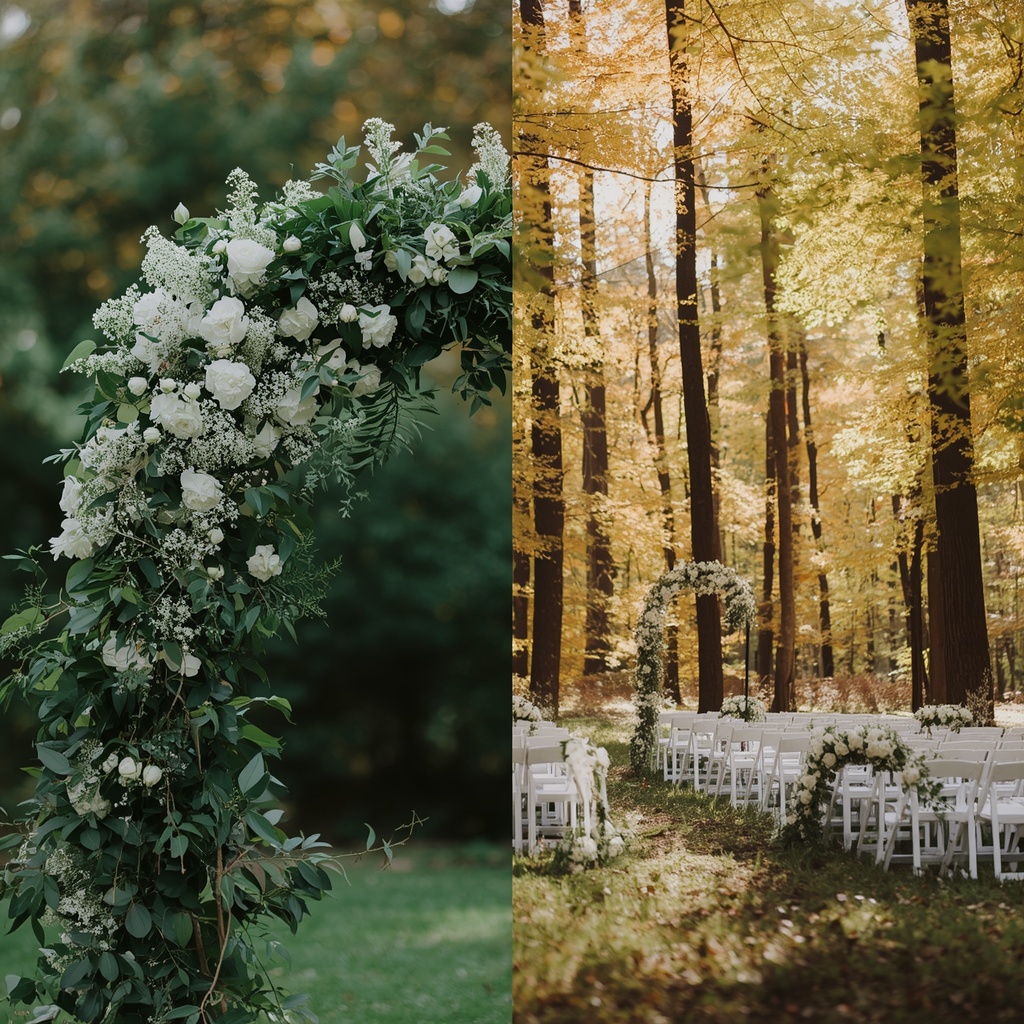
Season is the second biggest decision after budget. Every season has real advantages and genuine trade-offs. The right season for your wedding depends on your aesthetic preferences, your tolerance for weather risk, and how far in advance you are planning.
Spring Weddings (March, April, May)
Spring is among the most popular seasons alongside fall. Mild temperatures and natural blooms make outdoor ceremonies work well, but peak demand means venues book 12 to 18 months out. March and early April carry lower demand and better pricing than May. May sits at the highest demand point in spring, so book early if that is your target.
Rain risk varies significantly by region in spring, and this is worth researching specifically for your area. Always have a backup plan for outdoor venues, whether that is a tent option, an indoor overflow space, or a venue with both covered and open-air areas.
Clear bubble umbrellas double as a practical rain backup and a genuinely charming photo prop for spring outdoor ceremonies.
Summer Weddings (June, July, August)
June is the single most popular wedding month in the US. Heat is the primary challenge for outdoor ceremonies, and evening ceremonies starting at 6pm or later solve most of that problem by avoiding the midday peak. School holidays mean family guests, especially those with children, travel more easily than at other times of year.
Photographer golden hour falls later in summer (8pm or later in many regions), giving more flexibility for outdoor portraits after the ceremony. July and August see slightly lower demand than June, which means more venue availability and somewhat better pricing if you have flexibility within the summer window. Check your specific venue on guest comfort, since reception spaces without air conditioning become a real issue in July and August heat.
Personalized hand fans for wedding guests are a practical and appreciated gift for outdoor summer ceremonies where temperatures run high. A portable misting fan station near the ceremony seating keeps guests comfortable without disrupting the setup.
Fall Weddings (September, October, November)
September and October are the most popular months overall in the US, and with good reason. Rich foliage, cooler temperatures, and golden afternoon light for photography make fall a strong choice across almost every dimension. September is still warm enough for outdoor ceremonies in most regions without the heat risk of summer. October brings peak foliage in most parts of the country alongside peak demand and peak pricing.
November drops off significantly in demand, offering better pricing while still being visually striking for indoor receptions. For couples with budget flexibility, September and October are worth the premium. For couples who want fall aesthetics with better pricing, early November is an underused window worth considering. Book fall Saturday dates 12 to 18 months in advance regardless of which fall month you target.
Fall wedding decorations in warm amber, burgundy, and gold work across venues from rustic barns to formal ballrooms.
Winter Weddings (December, January, February)
Winter offers the lowest demand outside of December holiday dates and Valentine’s Day. January and February bring the best pricing of the year across venues, caterers, photographers, and florists. Indoor venues are where winter weddings shine, with fireplaces, candlelight, and rich textures creating an atmosphere that no other season matches as naturally.
Holiday weekends in December (Christmas and New Year’s Eve in particular) are actually peak demand and peak pricing, which surprises many couples who assume all of December is affordable. January and February mid-week dates are the most affordable wedding dates available in any given year. The main practical risks with winter are weather-related travel disruptions and vendor availability during snowstorms, so build contingency plans for both.
A faux fur wedding wrap stole keeps the bride warm for outdoor winter portraits without covering the dress entirely. Candle-heavy centerpieces are the most practical and atmospheric choice for winter receptions where natural light is limited.
Factor 3: Venue Availability
Popular venues in most US cities book their peak Saturday dates 12 to 18 months in advance. Some high-demand venues in major cities book 18 to 24 months out. If you have a specific venue in mind, start there before committing to any date. The venue dictates your date far more than your date dictates your venue.
The practical approach: shortlist 2 to 3 venues, contact all of them within the same week, and ask for their available dates in your preferred season window. Then choose your date from what is actually available, not from what you imagined before you started looking. Couples who do this consistently report less frustration and faster decisions than those who set a date first and then search for venues.
Flexibility on day of the week or time of year dramatically opens up your options. A Friday or Sunday at your first-choice venue beats a Saturday at your third-choice venue in almost every scenario. Know when to send wedding invitations once you have a date locked so your timeline stays on track. Review the wedding dress code guide early too, since season affects guest attire expectations.
Booking timeline by wedding type:
| Wedding Type | How Far Out to Book |
|---|---|
| Popular venue, peak Saturday | 12 to 18 months |
| Popular venue, Friday or Sunday | 9 to 12 months |
| Smaller venue, peak season | 9 to 12 months |
| Any venue, off-peak season | 6 to 9 months |
| Destination wedding venue | 12 to 24 months |
A wedding venue checklist notepad keeps your questions organized across multiple venue tours so nothing gets forgotten between visits.
Factor 4: Guest Availability
Your date has to work for the people you most want there. Before locking anything in, mentally check three groups: immediate family, wedding party, and any guests traveling from far away. These are the people whose absence would genuinely affect your day, so they deserve a check before any deposit is paid.
The most common mistake couples make at this stage is assuming people will make it work. They usually will, but when a date conflicts with a fixed commitment (a sibling’s graduation, a parents’ milestone anniversary trip, or a wedding party member’s work blackout), you end up with avoidable gaps in your photos and at your table.
Check that your date does not conflict with school exam periods, major local sporting events, religious holidays significant to your family, existing family commitments (other weddings, graduations, milestone birthdays), or long-distance guests’ travel blackout periods. For large guest lists, a quick informal poll of key guests before any deposit goes down saves significant stress later. A text or email to five or six people takes ten minutes and catches most conflicts before they become problems.
Dates to generally avoid without checking first: Memorial Day weekend, Labor Day weekend, Thanksgiving weekend, Christmas week, New Year’s Eve, and any date that falls within the same month as another close family wedding. Also pay attention to semi-formal wedding guest outfits expectations when choosing your season, since guest comfort and appropriate attire changes significantly from January to July.
A wedding guest list tracker notebook lets you cross-reference availability notes against your shortlisted dates before making any venue commitments.
Factor 5: Personal Significance
Many couples want their date to carry some meaning. This is entirely personal and ranges from numerology to anniversaries to seasons with family history. None of these factors should override venue availability or guest access, but within a flexible window of acceptable dates, personal significance is a good tiebreaker.
Anniversary alignment. Some couples choose a date that matches their first date, the date they got engaged, or a meaningful family anniversary. A date that already carries weight in your relationship history adds a layer of meaning that no numerology chart can replicate.
Numerology. In 2026, repeating and pattern dates carry particular appeal. Dates like 6/6/26, 10/10/26, and 2/22/26 have natural symmetry that photographs well on paper and is easy for guests to remember. Numerologically, 2026 is a Universal Year 1, a fresh start year, which many couples consider favorable for beginning a marriage. The Farmers Almanac wedding date guide is a useful external reference for couples who want a traditional framework for date selection alongside the numerological angle.
Astrology. Couples who follow astrology often look for favorable Venus or Jupiter alignments and avoid Mercury retrograde periods. Strong astrologically supported dates in 2026 include February 18, April 13, June 10, July 20, and September 10.
Simplicity. Some couples choose dates purely because they are easy to remember (10/10, 11/11, etc.) or look clean on stationery. There is nothing wrong with choosing a date because it is satisfying on paper and impossible to forget every year.
A numerology guide book lets you calculate your combined life path number and cross-reference it against your shortlisted dates.
Factor 6: Your Anniversary for Life
The date you choose becomes your anniversary every year for the rest of your marriage. Most couples think about the wedding day itself but not about what it feels like to celebrate that same date every year for decades. This is worth a few minutes of honest thought before you commit.
Ask one practical question before locking in any date: will you be able to celebrate this date easily every year? A date that lands in the middle of your industry’s busiest season means anniversary dinners get pushed, anniversary trips get cancelled, and the day quietly fades into a background obligation rather than something you look forward to.
Dates to think carefully about include those that fall during a recurring career crunch, dates that share a month with a major family obligation that will repeat annually, and dates in months when airline and hotel prices consistently spike. A date in late January or early February, for example, gives you a clear anniversary window every year with no competing holiday, lower travel costs, easy restaurant reservations, and zero risk of it blending into a holiday celebration.
Also consider whether the date falls so close to a major holiday that anniversary gifts and dinners become absorbed into the surrounding event. A December 20th anniversary, for instance, will compete with Christmas shopping, holiday parties, and travel congestion every single year. A date with breathing room on either side holds its own identity better over time.
Dates to Avoid (And Why)
Holiday weekends with mandatory travel are among the most problematic choices for wedding dates. Memorial Day, Labor Day, and Thanksgiving weekends mean guests are already navigating family obligations, high travel prices, and booked accommodation well before your invitation arrives. Attendance rates drop and your costs for venues and catering rise, since venues know demand is high and price accordingly.
Valentine’s Day creates a different kind of problem. Restaurants, hotels, and venues charge elevated rates on February 14th because they can. Florists are at their busiest and most expensive of the year. Guest travel becomes difficult when hotels are fully booked with couples celebrating independently. If the romantic symbolism matters to you, the weekend closest to February 14th is a better practical choice than the day itself, giving you the association without the price spike.
New Year’s Eve is the most expensive single night of the year for venues, catering, and accommodation in most cities. Guest attendance is often lower than expected because people have competing plans that were locked in before your invitation arrived. Vendors charge premium rates across the board, and those who do attend often have an early exit in mind.
Dates during major local events create a logistics problem for out-of-town guests specifically. A weekend when your city hosts a major sporting championship, music festival, or large conference means hotel rooms are either unavailable or priced at three to four times their normal rate. Your guests absorb that cost or choose not to come.
Dates that conflict with your own career calendar are easy to overlook in the excitement of planning but matter enormously once the wedding is over. Tax season for accountants, retail peak for store managers, harvest season for farmers, school exam periods for teachers: your anniversary falls on that same date every year, and if celebrating it requires taking time off during your busiest professional stretch, you will feel that trade-off annually.
Best Wedding Dates in 2026 (By Season)
These recommendations are based on day of week, demand level, pricing patterns, and practical considerations for 2026 specifically.
Spring 2026 strong options: March 14 (Saturday, pre-peak pricing, good vendor availability), April 18 (Saturday, mid-spring warmth with moderate demand), and May 2 (Saturday, early May before peak demand spikes fully in mid-month).
Summer 2026 strong options: June 13 (Saturday, early June before the height of peak demand), July 11 (Saturday, slightly lower demand than June with good weather), and August 8 (Saturday, late summer with softer pricing than June).
Fall 2026 strong options: September 12 (Saturday, early fall with warm temperatures and manageable demand), October 3 (Saturday, peak foliage timing in many regions), and November 7 (Saturday, lower demand and better pricing with full indoor elegance).
Winter 2026 strong options: January 17 (Saturday, lowest demand of the year), February 7 (Saturday, pre-Valentine’s pricing before florists and venues spike), and December 5 (Saturday, before holiday pricing takes hold mid-month).
| Season | Best Date Options | Demand Level | Pricing |
|---|---|---|---|
| Spring | March 14, April 18, May 2 | Medium to High | Medium |
| Summer | June 13, July 11, August 8 | High | High |
| Fall | September 12, October 3, November 7 | Very High to Medium | High to Medium |
| Winter | January 17, February 7, December 5 | Low to Medium | Low to Medium |
For more on how each month stacks up across the full year, see the guide to the best months to get married and a deeper breakdown of the cheapest times to get married if budget flexibility is your main driver.
The 5-Step Decision Process
Step 1: Set your season preference. Choose spring, summer, fall, or winter based on your aesthetic vision and weather tolerance. This immediately narrows your date search to a 3-month window and gives every subsequent conversation with venues and vendors a clear frame.
Step 2: Set your budget anchor. Decide whether a Saturday is worth the premium or whether Friday, Sunday, or a weekday opens up more budget for other priorities. Off-peak season adds another layer of savings on top of the day-of-week discount. Knowing your budget position before you call venues means you can have an honest conversation about what is available at what price point.
Step 3: Contact 2 to 3 venues. Ask for availability in your preferred season window. This is the step most couples delay, but it should happen before any other planning decision. Venue availability is the most concrete constraint in the whole process, and everything else adjusts around it.
Step 4: Cross-reference with key guests. Before paying any deposit, confirm that your shortlisted dates work for immediate family and the wedding party. A five-minute call to each person in your inner circle catches conflicts before they become expensive or emotionally charged problems.
Step 5: Add a tiebreaker. If two dates are equally practical, use personal significance to make the final call. Numerology, the anniversary of when you met, a season that has family meaning, or simply a date that looks right on paper are all legitimate final tiebreakers when the practical factors are equal.
A wedding planning checklist pad with a built-in timeline keeps the five-step date decision process on track without anything falling through the cracks.
Frequently Asked Questions
How do you pick a wedding date?
To pick a wedding date, follow this order: set your budget range first, choose your preferred season second, contact 2 to 3 venues to check availability third, cross-reference your shortlisted dates with key guests, then lock the date. Saturday peak season dates (May through October) cost the most, while off-peak weekdays cost up to 40 percent less. Once venue availability narrows your options, use personal significance (numerology, anniversaries, or meaningful seasons) as a final tiebreaker between equally practical dates.
How far in advance should I pick a wedding date?
For peak season Saturday weddings at popular venues, start 12 to 18 months before your target date. For off-peak dates or smaller venues, 9 to 12 months gives you enough runway to make good decisions without feeling rushed. The minimum comfortable timeline for any wedding with more than 50 guests is 9 months from date selection to wedding day. Less than that and you will be making rushed decisions on vendors who have already booked their best dates, leaving you with whoever happens to be available.
What is the most popular wedding month?
September and October are consistently the most popular wedding months in the US, followed closely by June and May. Fall weddings dominate because of the cooler temperatures, natural foliage, and favorable light for photography. If you are targeting these months, book your venue earlier than you think you need to, because the 12 to 18 month window is not an exaggeration for popular locations in fall.
What is the cheapest month to get married?
January and February (excluding Valentine’s Day weekend) are the least expensive months for most venues and vendors. November is the next most affordable option within the calendar year. Weekday dates in any of these months combine off-peak pricing with weekday discounts for the lowest total cost. Couples who choose January weekdays report savings of 30 to 40 percent compared to equivalent Saturday bookings in peak season, which is a meaningful budget shift.
Should I avoid holiday weekends for my wedding?
Most wedding planners recommend against major holiday weekends (Memorial Day, Labor Day, Thanksgiving, Christmas, New Year’s Eve) for practical reasons. Guest travel costs are higher, venues charge premium rates, and competing family obligations reduce attendance in ways that are hard to predict until after the RSVPs come back. The exception is if a long weekend is the only way your key guests can attend due to travel distance, in which case the trade-offs may be worth it for your specific situation.
Is it OK to get married on a Friday or Sunday?
Yes, and it is increasingly common. Friday and Sunday weddings save couples 15 to 25 percent on venue costs compared to Saturday, and many guests appreciate having a long weekend option around the event. The main consideration is that some guests may not be able to attend due to work or childcare constraints. For a guest list that is mostly local, Friday and Sunday work well. For a guest list with significant out-of-town travel, a Saturday gives everyone the cleanest travel window on both sides of the event.
Does the day of the week affect wedding photography?
Not significantly. Your photographer’s availability and the time of your ceremony matter more than the day of the week. The golden hour window (1 to 2 hours before sunset) is the same regardless of what day you marry. The practical photography advantage of a weekday wedding is that popular outdoor locations are less crowded, which gives your photographer more flexibility with location shots and candid moments in public spaces.
What is a good wedding date for numerology in 2026?
In 2026, dates with repeating numbers carry the most symbolic appeal: 2/2/26, 6/6/26, and 10/10/26. Numerologically, 2026 is a Universal Year 1, which represents new beginnings and is considered favorable for starting a marriage. If numerology matters to you, calculate your combined life path number and look for dates that complement it rather than conflict with it. Within any practical shortlist of dates, numerology works well as a final tiebreaker rather than a starting point.
An astrology compatibility guide helps couples identify favorable planetary periods for major life events like marriage. A wedding date keepsake journal lets you document the story behind how you chose your date, a detail that reads beautifully at anniversary dinners years later. You can also use The Knot wedding website to track RSVPs and share your confirmed date with guests in one place.
About The Author


Leave a Reply