Quick Answer
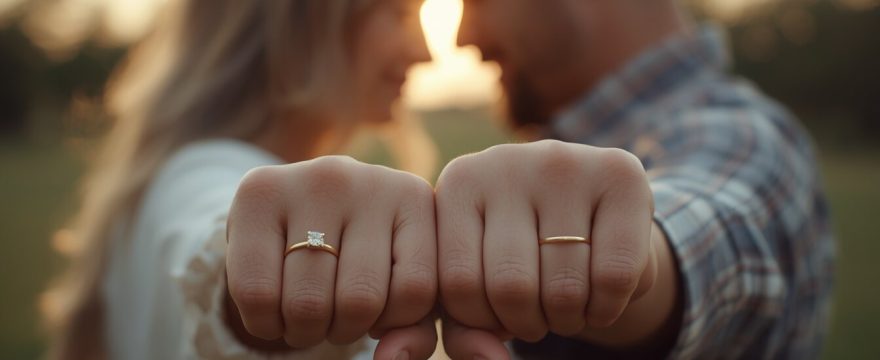
Yes, men do wear engagement rings, and the practice is more common than most people in Western countries realize. It is still not the norm in the United States or the United Kingdom, but interest is rising steadily, especially among younger couples and same-sex partners who want a shared symbol of commitment. In countries like Chile, Sweden, and Brazil, men wearing engagement rings has been standard practice for generations, with both partners receiving a ring the moment they get engaged. A typical men’s engagement ring is a plain metal band in gold, platinum, titanium, or tungsten, worn on the left hand in most Western contexts and the right hand in several South American and Nordic traditions. It usually gets simpler treatment than a woman’s ring, favoring understated bands over stone-set designs.
The Short Answer: Yes, and It Is More Common Than You Think
Men wearing an engagement ring used to raise eyebrows in the United States or the United Kingdom. That reaction is fading. More couples are treating engagement as something both partners mark physically, not just the partner who traditionally received the proposal.
This shift did not appear overnight. It grew out of a mix of cultural exchange, celebrity visibility, and a broader rethinking of what engagement is supposed to symbolize. Understanding the difference between an engagement ring and a wedding ring helps explain why this question comes up at all. An engagement ring marks a promise. A wedding band marks the marriage itself. Once you separate those two ideas, there is no obvious reason only one partner should wear a promise ring during the engagement period.
How Common Is It Really in Western Countries
Still a minority practice, but not a fringe one. It is nowhere close to standard in the US, UK, Canada, or Australia, and most men in these countries still go without a ring until the wedding itself. But “still uncommon” and “unheard of” are two very different things now, and jewelers and wedding industry writers who cover the space consistently describe interest as rising rather than flat, even if hard, standardized data on exactly how many men wear one is limited.
A few plausible factors help explain why the shift feels gradual but real rather than a passing fad. Social media likely plays some role, since a ring on a man’s hand now gets photographed and shared just as easily as a woman’s. Same-sex marriage legalization created a large group of couples with no default single-ring assumption to follow, which by itself pushed more households toward considering a ring for both partners. And younger generations, broadly, tend to be less attached to rigid gender roles in how relationship milestones get marked. None of that means the shift is dramatic year over year. It reads more as gradual and steady than sudden.
It also helps to separate two different groups of men who end up wearing engagement rings in Western countries. One group actively wants a ring as a personal choice, independent of any cultural background, simply because they like the idea of a visible, mutual symbol. The other group has direct cultural ties, through family, heritage, or a partner’s background, to a country where the tradition was never in question to begin with. Both groups are contributing to the same overall trend, just from different starting points.
Where the Practice Has Always Been Normal
While Western countries are catching up, other parts of the world never treated engagement rings as women-only in the first place. Chile, Sweden, Norway, and Brazil all have long histories of both partners receiving a ring at the moment of engagement. For people from these cultures now living in the US, UK, or elsewhere, the question “do men wear engagement rings too” probably sounds a little strange. Of course they do. It’s just that Western wedding culture drifted a different direction for a while.
The History of Men’s Engagement Rings

To understand why this feels new in some places and completely normal in others, it helps to look back further than most people expect.
Ancient Rome and the Original Betrothal Ring
The betrothal ring predates the modern diamond engagement ring by close to two thousand years. In ancient Rome, a groom would give his betrothed an iron ring, known as the anulus pronubus, as a pledge tied to a formal betrothal agreement between two families. It functioned more as a contract marker than a romantic gesture, and the practice was documented by Roman writers including Pliny the Elder.
The ring itself, in Roman practice, went from the man to the woman rather than being exchanged both ways. What’s worth noting is why it existed at all: it marked a legal agreement between two families, not a decorative gift. That framing, a ring as proof of an agreement rather than a purely one-sided romantic token, is part of why the concept of a ring for both partners doesn’t require inventing something new. It’s closer to reviving what a ring was originally supposed to represent, even if the mutual version isn’t literally how the Romans did it.
Later medieval betrothal customs in parts of Europe did move toward mutual token exchange in some cases, including gimmel rings, interlocking bands where each partner wore one half during the engagement and the pieces were reunited into a single ring at the wedding, often worn by the wife afterward as her wedding band. That’s a closer historical parallel to modern matching men’s and women’s engagement rings than the original Roman custom, since it involved both people physically carrying a piece of the same symbol during the engagement itself rather than one person holding the only token.
How Western Culture Made It a Women-Only Tradition

The shift toward “engagement ring equals something a man gives a woman” solidified over centuries, accelerated heavily by 20th-century diamond marketing campaigns that positioned the ring as proof of a man’s commitment and financial capability. The now-famous “two months’ salary” guideline and diamond-centric advertising built an entire cultural expectation: she gets the ring, he pays for it, and that’s the extent of ring-based symbolism in the relationship.
This wasn’t universal. It was a specific commercial and cultural pattern that took hold most strongly in the US and UK, spreading outward through Hollywood films, magazine advertising, and later television, all of which reinforced the same visual: a man on one knee, a small box, and a ring destined for one hand only. Other countries, particularly in South America and parts of Northern Europe, never fully adopted the one-ring, one-partner model, largely because their own engagement customs had already been established long before 20th-century American marketing reached them with enough force to override local tradition.
Part of why the one-ring model stuck so firmly in the US and UK comes down to how thoroughly it got tied to gender roles more broadly. The engagement ring became shorthand for a man proving he could provide, an idea that lined up neatly with mid-20th-century expectations about men as breadwinners and women as the party being “won.” Once that symbolism was baked into decades of advertising, changing it required more than a shift in taste. It required a broader cultural rethink of what an engagement is supposed to represent in the first place, which is exactly what started happening in the following decades.
When and Why Men Started Wearing Them Again
The modern resurgence traces back to a combination of factors that built on each other rather than one single turning point. Same-sex marriage legalization across multiple countries in the 2000s and 2010s created a large and growing population of engaged couples for whom “give her the ring” made no sense as a starting assumption. Two men or two women getting engaged had to actively decide who, if anyone, gets a ring, and a lot of couples landed on both of them.
At the same time, cultural exchange through immigration, travel, and international relationships meant more Western couples were directly exposed to the idea through a partner’s family traditions. And celebrity visibility, more on that shortly, gave the concept mainstream media coverage it had never gotten before.
There’s also a simpler, less romantic angle worth considering: longer engagements, which are common when couples want time to save or plan a wedding, mean more time spent publicly “engaged but not yet married.” The longer that stretch runs, the more noticeable it can feel when only one partner has a visible marker of it.
Countries Where Men Traditionally Wear Engagement Rings
Men wearing engagement rings is a growing modern trend in Western countries, but it has been an established cultural norm in countries such as Chile and Sweden for generations, where both partners traditionally receive engagement rings.
Chile and the Right-Hand Band Tradition
In Chile, it is customary for both men and women to wear plain gold engagement rings on the right hand during the engagement period, which are then moved to the left hand after the wedding ceremony. The rings themselves are typically simple, unadorned gold bands rather than stone-set designs, and the moment of switching hands at the wedding functions as a visible, symbolic marker of the transition from engaged to married.
Sweden, Norway, and Northern European Customs
Sweden follows a similar pattern to Chile in spirit, if not in exact execution. Both partners typically receive a plain band at engagement. In many cases, the woman later receives a second, more elaborate ring at the wedding itself, while the man continues wearing his original simple band. Norway has related customs, particularly in more traditional or rural communities, where both partners wearing a ring through the engagement period is unremarkable rather than notable.
Brazil and South American Traditions
Brazil shares much of the same cultural DNA as Chile on this front. Both partners commonly wear plain bands during the engagement, often on the right hand, with the rings moving to the left hand after marriage. This pattern shows up across several South American countries, which is part of why immigrants and their families from the region are sometimes surprised that the practice needs explaining at all in the US or UK.
Argentina follows a closely related custom, where both partners exchange rings at the engagement rather than waiting for the wedding, and the man wearing his ring through the engagement period is treated as an unremarkable given rather than a statement. This is the exact tradition Michael Bublé referenced when he wore a band after proposing to his now-wife, an Argentine actress. Sources vary on some of the specifics, some describe the Argentine ring worn on the right hand and moved to the left after marriage, others describe it staying on the left hand throughout, which suggests the custom isn’t applied with perfect uniformity even within the country. What stays consistent is the core idea: the ring marks the engagement for both people, not just one.
How These Traditions Differ From Country to Country
Even among countries where the practice is well established, the specifics vary. Some cultures use identical plain bands for both partners, reinforcing the idea of a matched set. Others give the man a simpler band while the woman’s ring gets more attention or a stone added later. The consistent thread across nearly all of these traditions, though, is that the engagement ring functions as a signal of status, engaged rather than single, and that signal applies equally to both people in the relationship, not just one.
| Country or Region | Men’s Engagement Ring Tradition | Details |
|---|---|---|
| Chile | Long-established norm | Both partners wear plain gold bands on right hand during engagement, move to left after wedding |
| Sweden | Common practice | Both partners receive engagement rings, simpler plain bands for men |
| Brazil | Widely practiced | Similar to Chile, both partners wear bands during engagement |
| Norway | Accepted practice | Both partners may wear rings, particularly in more traditional communities |
| United States | Growing trend | Still not mainstream but increasing steadily, particularly among younger couples |
| United Kingdom | Emerging trend | Historically uncommon but rising in visibility due to celebrity influence |
Why Modern Men Are Choosing to Wear Engagement Rings

Equal Commitment and Shared Symbolism
For a lot of couples, the appeal is simple. Engagement is something two people do together, and a ring worn by only one partner can feel like it tells an incomplete story. Wearing matching or coordinated rings turns the engagement period into something visibly mutual, not something one partner announces and the other quietly supports.
There’s also a practical social benefit that doesn’t get talked about as much. A ring signals unavailability in a way that’s immediate and requires no explanation. Women have relied on that signal for generations. Men who wear an engagement ring get the same benefit, which some couples describe as leveling a small but real social imbalance that used to exist between engaged men and engaged women in public and professional settings.
Same-Sex Couples and Changing Norms
Men’s engagement rings saw a notable rise in interest beginning in the early 21st century, particularly following the legalization of same-sex marriage in multiple countries where both partners sought shared engagement symbols. Same-sex male couples getting engaged never had a “traditional” default to fall back on, since the entire framework assumed a man proposing to a woman. That gap forced an active choice, and a large number of couples chose matching or complementary rings for both partners from the start. That choice, made out of necessity for same-sex couples, has since influenced how straight couples think about the option too.
Celebrities Who Helped Normalize the Trend
Celebrities including Ed Sheeran, Michael Bublé, and Johnny Depp have worn engagement rings publicly, contributing to increased visibility and acceptance of the practice in Western culture.
Ed Sheeran wore a silver band that his fiancée, Cherry Seaborn, made for him herself. He addressed it directly in a TV interview, saying he never understood why men didn’t wear engagement rings in the first place and that the commitment felt the same either way.
Michael Bublé wore a plain band after proposing to his now-wife, Luisana Lopilato, and told concert audiences it reflected a tradition from her home country of Argentina, where men wearing an engagement ring is standard practice, similar to the customs found in Chile and Brazil.
Johnny Depp was photographed wearing a diamond ring on his ring finger in 2014, which reporters at the time noted was likely the same ring he had proposed to Amber Heard with, since it appeared too large for her hand.
None of these men were trying to start a movement. But high-profile relationships get media coverage, and media coverage normalizes things that used to feel unusual. Each of these moments got written about, discussed, and shared, which meant a much wider audience saw, possibly for the first time, that a man wearing an engagement ring wasn’t strange at all outside their own cultural bubble.
What Men’s Engagement Rings Actually Look Like
Plain Metal Bands vs Stone-Set Designs
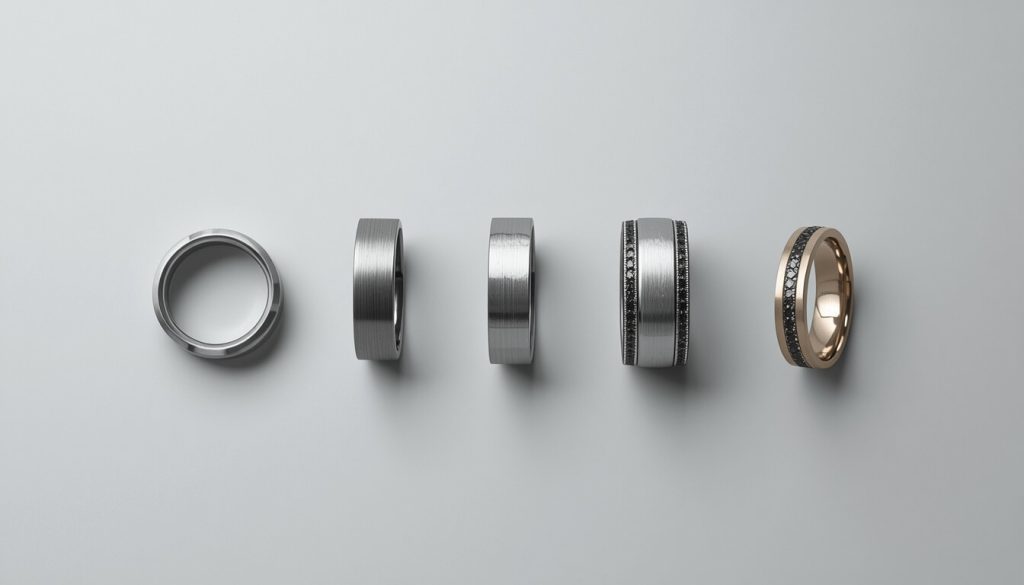
Most men who wear engagement rings prefer plain metal bands over stone-set designs. This isn’t a hard rule, some men do choose a single small stone, often a black diamond, for a bit of distinction, but the overwhelming preference leans toward simplicity. A plain band reads as understated and durable, which matters for daily wear in a way it might not for a ring that comes off more often.
Common Metal Choices for Men’s Rings
Gold remains popular, particularly in couples with cultural ties to Chile, Brazil, or Sweden where gold bands are the traditional default. Yellow gold has the strongest historical association with these traditions, though white gold has become a common modern substitute for men who want a less warm-toned finish. Platinum offers a similar look with more durability and hypoallergenic properties, making it a strong choice for men with sensitive skin or anyone who wants a ring that will hold up to decades of daily wear without much visible change.
Titanium and tungsten have become popular alternatives for men who want something scratch-resistant and lower maintenance, particularly if they work with their hands or stay physically active. Tungsten in particular is prized for being one of the hardest metals commonly used in jewelry, resistant to scratching in a way that softer metals like gold simply aren’t. The tradeoff is that tungsten rings can’t be resized once made, since the material is too hard to reshape, so accurate sizing matters even more with this option than with others. Titanium splits the difference, offering strong scratch resistance while remaining lightweight and, unlike tungsten, still resizable in most cases.
Stainless steel and silver show up occasionally as budget-friendly starting options, particularly for couples who want a ring for the engagement period itself and plan to upgrade to something more permanent at the wedding. This mirrors, in a modern context, exactly what Ed Sheeran did when his fiancée handmade his ring from silver clay rather than sourcing something more expensive or elaborate.
How Men’s Rings Differ From Women’s
The biggest difference isn’t the metal, it’s the design philosophy. Women’s engagement rings in Western tradition tend to center a stone, often a diamond, as the visual focal point. Men’s engagement rings, even in cultures where the tradition is well established, tend to prioritize the band itself. The ring is a symbol of the commitment rather than a showcase piece, which is part of why plain bands dominate.
Width is another quiet but consistent difference. Men’s rings typically run wider than women’s, both because men’s fingers tend to be larger on average and because a wider band reads visually as more proportionate on a larger hand. A ring that looks balanced on a woman’s finger can look undersized on a man’s, which is part of why simply resizing a women’s-style ring for a man rarely produces a great result. Purpose-designed men’s bands account for this from the start.
Finish also tends to diverge. Women’s rings more often use high-polish, reflective finishes to maximize sparkle around a center stone. Men’s rings lean toward brushed, matte, or satin finishes that read as understated and are also more practical, since a matte finish hides the small scratches that accumulate from daily wear far better than a mirror polish does.
| Style | Description | Best For |
|---|---|---|
| Plain metal band | Gold, platinum, titanium, or tungsten | Men who prefer minimal jewelry |
| Brushed or matte finish | Less reflective, more masculine look | Active lifestyles, manual workers |
| Black diamond center | Single stone on a plain band | Men who want some distinction |
| Matching band with partner | Coordinated design with the engagement ring | Couples who value shared symbolism |
| Mixed metal | Two-tone or contrasting metal accents | Men with a stronger style preference |
Which Hand and Finger Does a Men’s Engagement Ring Go On
The Left Hand Convention
In most Western contexts where men do wear engagement rings, the left hand ring finger is the default choice, mirroring where a woman’s engagement ring traditionally sits. This lines up with why the wedding ring goes on the left hand, a convention with roots stretching back to the belief that a vein in that finger connected directly to the heart. Modern anatomy has debunked the vein theory, but the tradition stuck regardless, and most men who adopt an engagement ring in a Western setting default to the same hand and finger without giving it much extra thought.
That said, some men choose a different finger deliberately, particularly if they want a visible way to distinguish “engaged” from “married” without switching hands entirely the way Chilean or Brazilian couples do. A ring worn on the right hand ring finger, or occasionally the middle finger, can serve as a placeholder that clearly reads as pre-wedding, then gets replaced or supplemented once the actual wedding band goes on the traditional left hand ring finger.
The Right Hand in Some Cultures
Chile and Brazil both favor the right hand for the engagement period specifically, for both partners, with a switch to the left hand happening at the wedding itself. This isn’t inconsistency, it’s an intentional design. Wearing the ring on the right hand during engagement visually distinguishes “engaged” from “married” at a glance, something the single-hand Western system doesn’t naturally do.
What Happens After the Wedding
In countries following the right-hand-then-left-hand model, the wedding ceremony includes physically moving the ring from one hand to the other, sometimes as part of the ceremony itself. In Western practice, where men are increasingly opting into engagement rings on the left hand, the engagement ring is more commonly replaced entirely by a wedding band at the ceremony, or occasionally worn alongside it, depending on personal preference.
Practical Considerations for Men Who Wear Rings
Removing the Ring for Work, Sports, and Exercise
Wearing a ring daily is a new habit for a lot of men, and it comes with logistics that women who grew up expecting to wear an engagement ring have often already worked out. Manual labor, gym sessions, and contact sports all create situations where a ring needs to come off, and having a consistent, dedicated spot for it matters more than people expect. The Prazoli Men’s Ring Holder, a wooden ring dish hand-carved from scratch-resistant oak, gives a man a specific place to set his ring during workouts or manual work so it doesn’t end up loose in a gym bag or forgotten on a bathroom counter.
Sizing and Comfort for Daily Wear
Ring sizing matters more for men who haven’t worn jewelry regularly before. Fingers can swell slightly during exercise or in hot weather, and a ring that felt fine at the jeweler can feel tight later in the day. Getting properly sized, and accounting for some natural size fluctuation, prevents the discomfort that leads a lot of first-time ring wearers to just stop wearing it.
Weight is worth thinking about too. Men who have never worn a ring before sometimes find the constant physical presence distracting for the first few weeks, especially if they’re used to having nothing on their hands at all. This tends to fade with time as the ring becomes part of the daily routine, similar to how anyone adjusts to wearing a watch or glasses full time after a period of getting used to it.
Choosing Between a Fitted Band and a Flexible One
Traditional fitted metal bands offer the most durable, long-term option, but they require accurate sizing and don’t flex with temporary swelling. Some men, particularly those newer to daily ring wear or with more physically demanding jobs, opt for a slightly looser fit or a band designed with minor flexibility built in. Neither choice is wrong. It comes down to lifestyle, comfort preference, and how much the ring needs to withstand on a typical day.
Keeping It Clean With Daily Use
A ring worn every day picks up oil, dirt, and grime faster than most people expect, especially plain bands without a polished, reflective finish to hide it. The Connoisseurs Diamond Dazzle Stik, a portable pen-style jewelry cleaner, makes it easy to restore shine to a metal band without needing a full jewelry cleaning kit at home. It’s compact enough to keep in a bag or desk drawer, which matters for anyone new to the habit of wearing a ring at all.
Caring for a Men’s Engagement Ring
Consistency is the real key to ring care, more than any specific product. A ring that gets tossed in a different spot every night eventually gets lost, scratched, or damaged. The Mora Ceramic Ring Dish, a modern minimal white ring holder designed for a nightstand or bathroom vanity, gives both partners a shared, consistent place to rest their rings each night, which becomes especially useful once both people in a couple are wearing engagement rings and need somewhere reliable to keep them.
Traditional vs Modern Approach at a Glance
| Factor | Traditional Western View | Modern Approach |
|---|---|---|
| Who wears an engagement ring | Women only | Either or both partners |
| Purpose of the ring | Symbol given to the woman | Shared symbol of mutual commitment |
| Ring style for men | Wedding band only | Any style the man prefers |
| Which hand | Left hand, ring finger for women | Varies by preference and culture |
| Is it expected | No | Still optional, becoming more common |
Related Reading
Frequently Asked Questions
Do men wear engagement rings?
Yes. It’s still not the norm in most Western countries, but a growing number of men wear engagement rings, either by personal choice or as part of a cultural tradition from their partner’s background. In countries like Chile, Sweden, and Brazil, it has been standard practice for generations.
Is it common for men to wear engagement rings?
Not yet common in the US or UK, but it’s becoming less unusual every year. Jewelers report a steady rise in men requesting engagement rings, and younger couples in particular are more likely to consider a ring for both partners rather than just one.
Which countries have a tradition of men wearing engagement rings?
Chile, Sweden, Brazil, and Norway all have well-established traditions of both partners wearing an engagement ring, often as a plain band, from the moment of engagement.
What does a men’s engagement ring look like?
Most commonly a plain metal band in gold, platinum, titanium, or tungsten, without a center stone. Some men choose a single small stone, often a black diamond, but simple bands are far more common than elaborate designs.
Which hand does a men’s engagement ring go on?
In Western contexts, typically the left hand ring finger. In Chile and Brazil, engagement rings for both partners traditionally go on the right hand, then move to the left hand after the wedding.
Can a man propose with an engagement ring for himself?
Yes. Some men buy or select their own engagement ring in advance, either to wear once the proposal happens or to give to a partner as part of a mutual exchange during the proposal itself.
Do men in same-sex relationships both wear engagement rings?
Often, yes. Since same-sex couples don’t have a “traditional” single-ring default to follow, many choose matching or complementary rings for both partners from the start of the engagement.
What did celebrities Ed Sheeran and Michael Bublé say about wearing engagement rings?
Ed Sheeran said he never understood why men didn’t wear engagement rings and described the commitment as the same either way, wearing a band his fiancée made herself. Michael Bublé wore a plain band after his proposal and told fans it reflected a tradition from his wife’s home country of Argentina.
What happens to a men’s engagement ring after the wedding?
In cultures that follow the right-hand tradition, like Chile and Brazil, the ring moves from the right hand to the left hand during the wedding ceremony. In Western practice, the engagement ring is often replaced by a separate wedding band, or occasionally worn alongside it.
Is there a difference between a men’s engagement ring and a men’s wedding band?
Traditionally, yes, an engagement ring marks the promise and a wedding band marks the marriage. In practice, many men’s engagement rings are simple enough that they get worn continuously through the wedding without much visual distinction from a wedding band.
Are men’s engagement rings more common among younger couples?
Yes. According to Benjamin Khordipour, a GIA-certified gemologist and author of Engagement Ring Guide for Men, men’s engagement rings are still far from mainstream in most Western countries, but the trend is steadily growing, particularly among younger couples.
What metal is most popular for men’s engagement rings?
Gold and platinum remain popular, particularly among couples with ties to countries where the tradition is already established. Titanium and tungsten have grown in popularity as durable, lower-maintenance options for men who are active or work with their hands.
Do men’s engagement rings cost as much as women’s?
Generally no. Since most men’s engagement rings are plain metal bands without a center stone, they typically cost significantly less than a diamond engagement ring for a woman. Price varies mainly by metal choice, with platinum and gold running higher than titanium or tungsten.
Should a man’s engagement ring match his wedding band?
Not necessarily, though many men choose to keep wearing the same ring straight through the wedding rather than swapping it out, especially if it’s already a simple band that could pass for either. Couples following the right-hand tradition tend to treat the engagement ring and wedding ring as the same physical object, just worn on different hands at different stages.
How do you bring up wanting an engagement ring as a man?
Directly and early is usually the simplest approach. Since it’s still not the automatic default in most Western relationships, it typically needs to be said out loud rather than assumed, ideally before the proposal itself so both partners can plan for it together rather than one person feeling caught off guard.
Men wearing engagement rings isn’t a new idea, it’s a very old one that Western culture temporarily set aside. Whether it’s a couple honoring a family tradition from Chile or Sweden, two men choosing matching bands, or someone who just likes the idea of visible mutual commitment, the option is more available and more accepted now than it’s been in decades. The choice comes down to what feels right for the two people making it.
About The Author


Leave a Reply