
Quick Answer
A wedding speech for a best friend works best when it follows a five-part structure: a hook, an introduction of who you are, one or two stories that reveal the bride or groom’s character, praise for the couple, and a clear toast. Speeches should stay under five minutes, since longer ones tend to lose the room. The right balance leans toward warmth with light humor mixed in, rather than going fully for laughs or fully for tears. Skip inside jokes that exclude guests, any mention of ex-partners, and anything that could embarrass the couple in front of family. The maid of honor speech traditionally follows the parents’ speeches, with the best man’s toast usually closing out the night.
Before You Start Writing: What You Need to Know
What Role Are You Playing: Maid of Honor or Best Man

Your role shapes the tone people expect from you. A maid of honor speech tends to lean warmer, often touching on the bond between two close friends and how the speaker has watched the relationship grow. A best man speech usually opens with more humor, then shifts into something sincere by the end. Neither role has a strict script, but guests have expectations based on tradition, and meeting those halfway makes your speech land better.
If you are the best friend giving the speech, you already have an advantage. You know the real stories, the inside details, and the moments that actually mattered. The job now is choosing which of those moments belong in front of a room full of people, including grandparents.
How Long Should the Speech Be
Three to five minutes is the target. That sounds short, but it is roughly 450 to 750 words spoken at a natural pace. Anything longer risks losing the room, especially if your speech comes near the end of a long lineup of toasts.
A good rule of thumb is to keep the entire speech portion of a wedding reception under twenty minutes across all speakers combined, which is why staying close to the three to five minute range for your individual speech matters. If your draft is running past 700 words, look for the parts that over-explain. A good story rarely needs setup longer than two sentences.
When Does Your Speech Happen During the Reception
If parents of the bride and groom give speeches, they usually go first, followed by the maid of honor, with the best man’s toast as the final speech of the evening. This order is not universal, but it is common enough that you can plan around it. Speeches typically happen after the meal, once everyone has a drink in hand and the room has settled into a relaxed mood.
Ask the couple or the wedding planner ahead of time where you fall in the lineup. Knowing whether you are warming up the room or closing it out changes how you might want to open and close your speech.
Should You Write It Down or Memorize It
Write it down, then practice it enough that you do not need to read every word. Memorizing word for word often backfires, since nerves can wipe out even well-rehearsed lines. Reading directly from a full printed page also creates distance between you and the audience.
Using index cards or short prompts rather than a full written script allows for better eye contact and a more natural delivery. Bullet points for each section, with key phrases you want to get right, work better than a full transcript.
The Five-Part Structure That Works for Any Speech
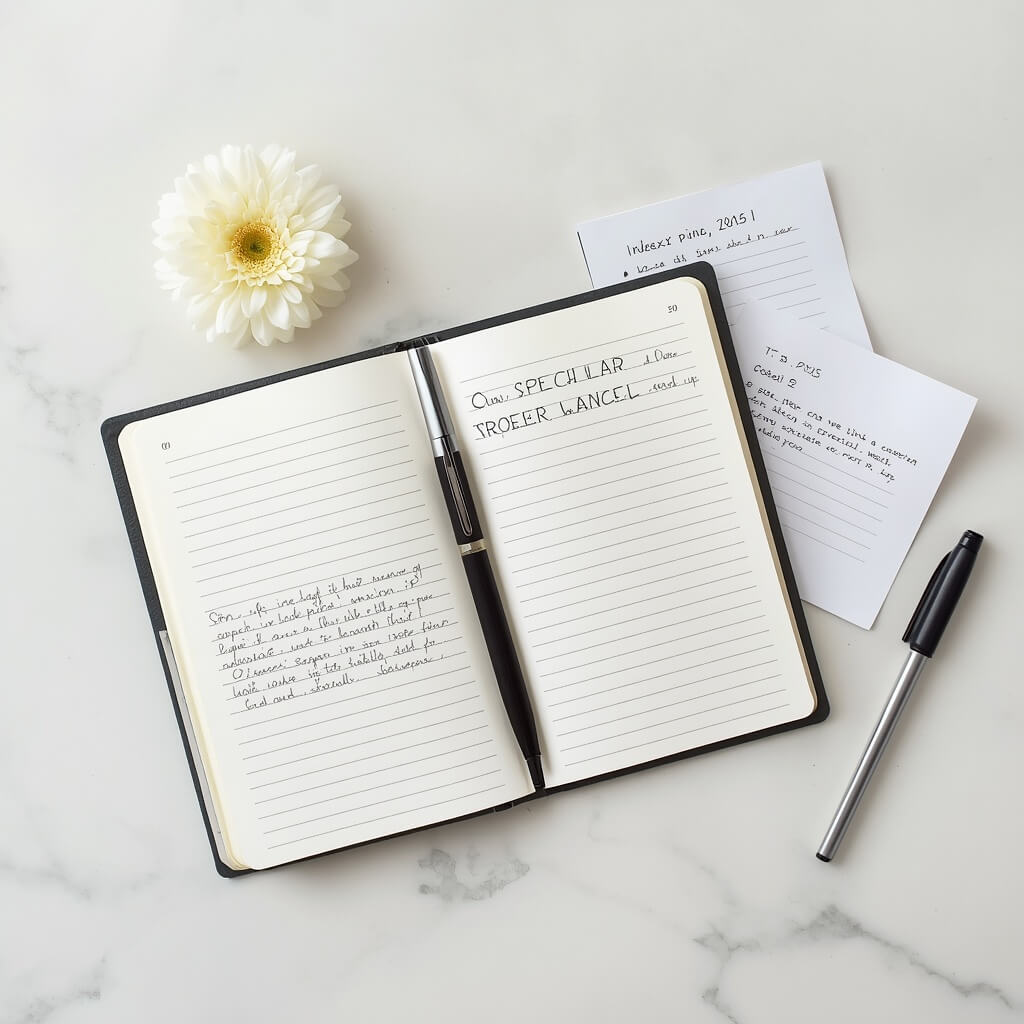
A wedding speech for a best friend works best when it follows a five-part structure: a hook, an introduction, one or two character-revealing stories, praise for the partner, and a clear toast. Each part has a job to do, and skipping one usually leaves a gap the audience notices.
The Hook: Your Opening Line
Your first line sets the tone for everything that follows. A strong hook gets a reaction, whether that is a laugh, a knowing smile, or a moment of quiet attention. Avoid starting with “I’m not good at speeches” or “I didn’t prepare anything,” even if it is true. Those lines lower expectations in a way that does not help you.
Who You Are and Your Connection to the Bride or Groom
Some guests will not know who you are. A quick line establishing your relationship, how long you have known them, and why you are the one standing up gives context for everything that follows. Keep this part short. One or two sentences is enough.
One or Two Stories That Reveal Their Character
Stories that reveal the bride or groom’s character, rather than stories about the speaker themselves, are what make a best friend speech memorable. The best stories show something true about who they are: their generosity, their humor, the way they show up for people. Pick moments that say something about them, not moments that are funny only because you were there.
Praising the Couple and Their Relationship
This is where you shift from your friend as an individual to your friend as part of a couple. Talk about what you have noticed since they got together. Maybe they are calmer, happier, more themselves. Specific observations land better than broad compliments like “they are perfect for each other.”
The Toast: Ending on the Right Note
End with a clear toast, not a trailing off. Raise your glass, say something direct, and give the room a clear signal that it is time to drink and applaud. A vague ending leaves people unsure whether to clap.
Speech Structure and Timing Reference
| Part | Purpose | Suggested Time |
|---|---|---|
| Hook | Grab attention with a line, joke, or observation | 30 seconds |
| Introduction | Explain who you are and your relationship | 30 seconds |
| Story | Share one or two stories that reveal character | 90 seconds |
| Praise | Highlight the couple and why they work | 60 to 90 seconds |
| Toast | Close with a clear wish and raise your glass | 30 to 45 seconds |
| Total | Full speech | 3 to 5 minutes |
Opening Lines That Actually Work

Funny Openers for a Lighthearted Tone
“For those who don’t know me, I’m the friend [Bride] calls when she needs the truth, not comfort. So naturally, she asked me to speak today.”
“I’ve known [Groom] for ten years, which means I’ve seen him through three different haircuts and at least two questionable decisions, one of which we’re celebrating today. Just kidding, this one’s the good one.”
Heartfelt Openers for an Emotional Tone
“I have been preparing for this speech since we were teenagers practicing in her bedroom, pretending one of us was getting married. I just didn’t think it would actually be this nerve-wracking.”
“[Bride], I’ve watched you become exactly the person you always hoped you’d be, and today I get to watch you become someone’s wife too.”
Openers That Work for Any Personality
“They say behind every bride is a best friend who helped her pick the dress and calmed her nerves. I’d like to think I did at least one of those things well.”
“The first time I met [Groom], [Bride] had already told me three things about him. Two of them were true, and I’ll let you guess which two as the night goes on.”
Opening Lines by Tone
| Tone | Example Opening Line | Best For |
|---|---|---|
| Funny | “For those who don’t know me, I’m the friend [Bride] calls when she needs the truth, not comfort.” | Lighthearted receptions, close friend groups |
| Heartfelt | “I have been preparing for this speech since we were teenagers practicing in her bedroom.” | Emotional tone, long friendships |
| Confident | “They say behind every bride is a best friend who helped her pick the dress and calmed her nerves.” | Works for almost any personality |
| Self-Deprecating | “I’ve given a lot of toasts in my life, but none where I was this nervous to mess up.” | Nervous speakers wanting to ease in |
| Story-Led | “The first time I met [Groom], [Bride] had already told me three things about him. Two of them were true.” | Speeches that lead into a story right away |
How to Choose the Right Story

Stories That Reveal Character vs Stories That Embarrass
There is a real difference between a story that is funny because of who your friend is and a story that is funny at their expense. The first kind makes the room like them more. The second makes people uncomfortable, especially with family present. Before including a story, ask yourself: does this show something good about them, even if it is also funny?
Think about the gap between “here is a moment that shows exactly who she is” and “here is a story she would rather no one heard.” The first kind of story earns the room’s affection. The second earns an awkward silence.
How Far Back to Go: Childhood vs Recent Memories
Older stories often carry more weight because they show how long you have known each other, but recent ones can feel more relevant to who your friend is now. A mix works well: one story from years ago that shows where the friendship started, and one from more recently that shows growth or how they have changed.
If the older story needs too much context to make sense out of the room, it is probably better replaced by something recent that lands without five sentences of explanation.
When to Involve the Partner in the Story
If a story naturally includes the partner, especially one showing how the couple brings out the best in each other, it can strengthen your speech. But do not force the partner into a story that was really about you and your friend. Save partner-focused moments for the praise section instead.
How to Handle Long-Distance or Newer Friendships
If you have been long-distance or your friendship is newer than others in the room, you can address this without apologizing for it. A line like “We have spent most of our friendship a few thousand miles apart, but somehow [Bride] still knows when something is wrong before I even tell her” turns distance into a strength rather than a gap.
The length of a friendship is not what makes a speech feel real. Specificity does. One genuine detail about your actual friendship says more than ten sentences about how long you have known each other.
How a Best Friend Speech Differs from Parent or Partner Speeches
A best friend speech carries a different kind of weight than a parent’s speech or the couple’s own toast. Parents speak about watching their child grow up, and the couple’s speeches tend to be more private and emotional. As the best friend, your job is different. You are the bridge between the person everyone has known for years and the person they are about to spend their life with.
This means your speech can hold the texture of everyday friendship that parents would not know about and the couple themselves might be too close to see clearly. The way your friend handles a hard day, the small habits that make them who they are, the version of them that only comes out around people they fully trust.
If you want to see how the maid of honor and best man roles are positioned within the full evening lineup, The Knot’s guide to wedding speech order breaks down where each speech typically falls.
Full Example Speech: Maid of Honor for Best Friend
Hi everyone, I’m [Name], and for those who don’t know me, I’m the friend [Bride] calls when she needs the truth, not comfort. Today, though, all I have for her is good news.
I met [Bride] in our first week of college, when she knocked on my dorm room door to ask if I had a phone charger, and then stayed for three hours because we couldn’t stop talking. That was twelve years ago, and we’ve barely stopped talking since.
I want to tell you about the time [Bride] drove four hours overnight to be at my side during a rough week, no questions asked, just showed up with coffee and bad reality TV. That’s who she is. She shows up. Completely, without making it about her, every single time someone she loves needs her.
When she met [Groom], I noticed something shift in her almost immediately. She started laughing more, the kind of laugh that comes from actually feeling at ease. [Groom], you’ve given her something I’ve watched her want for a long time, which is the feeling of being fully herself with someone and having that be enough.
So if you’ll all raise your glasses: to [Bride] and [Groom]. May your home always be full of the kind of laughter that comes easy, the kind of showing up that asks for nothing in return, and a love that keeps getting better the longer you know each other. Cheers.
Full Example Speech: Best Man for Best Friend
I’ve known [Groom] for ten years, which means I’ve seen him through three different haircuts and at least two questionable decisions, one of which we’re celebrating today. Just kidding, this one’s the good one.
For anyone who doesn’t know me, I’m [Name], [Groom]’s best friend since college, his roommate for four of those years, and the person who can confirm he really did used to practice his “wedding speech reaction face” in the mirror. We’ll get back to that.
A few years ago, [Groom] and I were on a road trip when our car broke down a few hours from anywhere. Instead of panicking, he spent the entire wait talking to the tow truck driver about his family, his job, his dog. By the time we got picked up, the guy gave us his number in case we ever needed anything else. That’s [Groom]. He makes people feel like they matter, even on the worst day of their week.
[Bride], since you came into his life, I’ve watched him become more patient, more present, genuinely calmer in a way I didn’t think was possible for someone who once alphabetized his spice rack out of stress. You bring out the best version of him, and honestly, we’re all a little relieved about the spice rack thing.
So everyone, raise your glasses. To [Groom] and [Bride], to a marriage built on the same kindness he’s shown everyone else his whole life, now finally pointed at someone who gets to keep it. Cheers to you both.
Full Example Speech: Short Version Under Two Minutes
Hi everyone, I’m [Name], [Bride]’s best friend since high school. I’ll keep this short, mostly because I promised her I would, and partly because I get emotional easily.
[Bride] and I have been through a lot together, the good and the genuinely hard, and through all of it, she’s been the most loyal person I know. When [Groom] came into the picture, what struck me most was how steady he made her feel. Not different, just steadier.
[Groom], thank you for being someone who matches her energy and calms it at the same time. That’s rare.
To [Bride] and [Groom]: may your marriage be full of the same loyalty, humor, and steadiness you’ve already shown each other. Cheers to you both.
Finding the Right Words: Quotes, Closings, and Tools
When a Quote Helps and When It Falls Flat
A well-placed quote can give your speech a sense of closure, especially if it connects to something you have already said. But quotes that feel pulled from a search result, with no link to your story, tend to fall flat. If you are searching for a closing line, Toasts: The Perfect Words to Celebrate Every Occasion is a useful reference organized by occasion, helpful for finding a line that fits your tone without sounding borrowed.
Writing Your Own Closing Line
Your own words, even simple ones, often land better than a borrowed quote. Think about what you actually want for your friend’s marriage, then say that directly. “I hope your marriage is full of [specific quality you have seen in them]” is a simple formula that works almost every time.
Personalizing Generic Templates
If you start from a template, the goal is to remove anything that could apply to any couple. Replace general phrases with specific names, places, and details only you would know. The more specific a line is, the less it sounds like a template, even if it started as one. A detail like “the way she always texts back within two minutes no matter what” tells more of a story than “she’s always been there for me.”
Practicing and Delivering Your Speech

How to Practice Without Memorizing Word for Word
Practice out loud, several times, focusing on the structure rather than exact wording. Run through the hook, then the introduction, then each story, then the praise section, then the toast. If you keep landing on similar phrasing naturally, that is a good sign those words are ready.
A set of index cards with a binder ring keeps your notes in order and is far easier to glance at during a speech than a full sheet of paper, especially when your hands are a little shaky. Smaller cards also give you permission to look up more, which is what keeps the speech feeling like a speech and not a reading.
Should You Rehearse in Front of Other People
Yes, if at all possible. Practicing in front of one or two trusted people, even just once, helps you notice which lines land and which ones do not work out loud the way they looked on the page. It also gets you used to the feeling of being watched while speaking, which is different from rehearsing alone in a room.
You do not need a full audience. One friend sitting across from you is enough. Their reactions, even subtle ones, will tell you where your speech slows down, where a joke needs a beat, and where you might rush through something that deserves a pause.
Managing Nerves Before You Speak
Limiting yourself to one drink before giving a speech is the generally recommended cap. More than that and the risk of slurred words or saying something you will wish you had not goes up fast. Deep breaths, a quick mental run through your opening line, and reminding yourself that the room is on your side all help more than they sound like they should.
Nerves are normal, and almost every speaker feels them regardless of how composed they seem once they are standing up. One trick that helps is to find one or two friendly faces in the crowd, people you know are rooting for you, and direct your first few lines toward them. Once you get through the hook and feel the room respond, the rest tends to get easier.
Pacing, Pauses, and Eye Contact
Slow down more than feels natural. Nerves speed people up, and a fast speech is harder to follow and ends before it has any impact. Pause after your hook to let any laughter or reaction land. Look up and around the room, not just at the couple, so everyone in attendance feels included.
What to Do if You Lose Your Place
If you lose your place, pause, take a breath, and glance at your cards. A short pause feels much longer to you than it does to the room. You can also use a light line like “give me a second, I want to get this right,” which usually gets a warm reaction rather than an awkward silence.
What Not to Say in a Best Friend Wedding Speech

Inside Jokes That Exclude the Room
Inside jokes that are not explained to the audience are one of the most common mistakes in best friend speeches, since they leave most guests on the outside looking in. If a joke needs a backstory longer than a sentence, either explain it briefly or cut it entirely.
Ex-Partners and Past Relationships
Even mentioned jokingly, bringing up an ex creates an awkward beat that the whole room feels, including the couple. There is no version of this that lands well. Leave it out completely.
Anything That Could Embarrass the Couple Publicly
Stories involving past relationships, financial struggles, family tension, or anything either partner might not want shared with grandparents and coworkers in the room should be left out, regardless of how funny they are between close friends.
Oversharing About Yourself Instead of Them
This speech is not about your year, your relationship status, or your own milestones. Every story should circle back to what it shows about your friend, not about you. A quick gut check: if you removed the couple’s names from a paragraph, would it still be about you? If yes, rewrite it.
Common Wedding Speech Mistakes
| Mistake | Why It Matters | Better Approach |
|---|---|---|
| Speech runs longer than 5 minutes | Loses guest attention and energy | Time yourself during practice and cut extra material |
| Telling an inside joke without context | Excludes most of the room | Either explain it briefly or cut it entirely |
| Mentioning an ex-partner | Creates an awkward moment for everyone | Focus only on the current relationship |
| Making the speech about yourself | Audience came to celebrate the couple | Every story should reveal something about them |
| Having more than one drink before speaking | Risk of slurred speech or regrettable comments | Limit to one drink maximum before your turn |
| Reading word for word with no eye contact | Feels disconnected from the room | Use note cards as prompts, not a full script |
| No clear ending or toast | Leaves the audience unsure when to respond | End with a direct toast line and raise your glass |
| Forgetting to thank the hosts or families | Feels like an oversight to those hosting | Briefly acknowledge those who made the day possible |
Giving Your Speech as a Keepsake
Writing the Final Version Down for the Couple
Once you have delivered your speech, consider writing out the final version as a gift. A personalized leather journal gives you somewhere to draft beforehand, and afterward becomes a keepsake where the couple can keep the written version. It is one of those gifts that feels more meaningful the longer time passes.
Pairing Your Speech With a Card Message
If you are also writing a card for the couple, your speech and your card message often share similar themes. If you are unsure where to start, our guide on what to write in a wedding card covers messages that pair well with a heartfelt toast.
After the Speech: What Comes Next
Once your speech is done, you can relax and enjoy the rest of the night as a guest. If you are still figuring out what to bring, our roundup of the best wedding gifts for newlyweds covers ideas that pair well with a heartfelt toast and a speech people will remember.
Before the wedding itself, you might also want to check our full guide to what to wear as a maid of honor so you look the part when all eyes are on you at the mic.
What to Do With Your Speech After the Wedding
Most people spend weeks writing a speech and then forget about it the moment it is over. But the speech itself, the final version you actually delivered, can serve as a meaningful document long after the reception.
Consider typing up your final version in the days after the wedding, while the exact words are still clear in your memory. The couple will likely appreciate having it, especially if they were too caught up in the moment to take in every line. If you kept notes on index cards, transcribe those into a clean document and send it to them digitally or tuck it into a follow-up card.
If you are thinking about how to package it as a keepsake alongside a physical gift, our guide on wedding gift etiquette has ideas for presenting gifts and personal notes together in a way that feels considered rather than last-minute.
Related Reading
- Wedding Gift Etiquette: How Much to Spend and What to Give
- How to Address Wedding Invitations
- Wedding Table Decoration Ideas
Frequently Asked Questions
How long should a wedding speech for a best friend be?
A wedding speech for a best friend should generally last three to five minutes, which works out to roughly 450 to 750 words spoken at a natural pace. Going much longer risks losing the audience’s attention, especially if other speeches come before or after yours.
What should I say in a maid of honor speech for my best friend?
A maid of honor speech should include a brief introduction of who you are, one or two stories that show your best friend’s character, an observation about how they have changed or grown since meeting their partner, and a toast to the couple’s future together.
How do I start a wedding speech for my best friend?
Start with a hook that grabs attention, whether that is a funny observation, a warm one-liner, or a confident statement about your role in their life. Avoid opening with an apology for nerves or a disclaimer that you did not prepare.
Should a best friend wedding speech be funny or sentimental?
The best approach blends both, leaning slightly toward warmth with moments of humor woven in naturally. A speech that is entirely jokes can feel like it is avoiding emotion, while one that is entirely serious can feel heavy for a celebration.
What order do wedding speeches go in?
The maid of honor speech traditionally follows the parents’ speeches and is typically given before the best man, who usually closes out the evening with the final toast.
Is it okay to read a wedding speech from notes?
Yes, reading from notes is completely normal and often recommended. Index cards with key phrases or bullet points work better than a full script, since they allow for better eye contact and a more natural delivery than reading word for word.
What should I avoid saying in a wedding speech?
Avoid inside jokes that are not explained to the room, any mention of ex-partners, stories that could embarrass the couple in front of family, and material that focuses more on you than on the couple being celebrated.
How do I end a wedding speech for my best friend?
End with a clear toast that states your wish for the couple directly, then raise your glass as a signal for the room to respond. A vague or trailing ending leaves guests unsure whether to applaud.
What if I get emotional during my speech?
A short pause is normal and often makes the moment feel more genuine to the audience. Take a breath, glance at your notes, and continue when you are ready. Most rooms respond warmly to a speaker who clearly cares about the couple.
Can I use a quote in my wedding speech?
Yes, but a quote works best when it connects directly to something you have already said in your speech, rather than feeling like it was added on separately. A personal closing line you have written yourself often resonates more than a borrowed quote.
How many stories should I include in my speech?
One or two stories is ideal. This gives enough detail to make each story meaningful without making the speech feel like a list of memories. Choose stories that reveal something true about your friend’s character.
What if I am not a confident public speaker?
Write your speech down fully first, then practice it enough times that you know the structure rather than memorizing exact words. Limiting yourself to one drink beforehand, using note cards, and reminding yourself that the room wants you to succeed all help reduce nerves significantly.
Do I need to mention the groom if I’m the maid of honor, or just focus on the bride?
You should mention both, but the balance can lean toward your best friend since that is your primary relationship. A short section acknowledging the partner, what you have noticed about them as a couple, and a direct line to the partner thanking them or welcoming them shows that your speech is about the relationship, not just your friendship.
What if my best friend and I have had ups and downs in our friendship?
You do not need to address this directly in the speech, but it can inform which stories you choose. Focus on stories that reflect where the friendship is now, especially moments of support, growth, or connection. The speech does not need to explain the full history, just reflect the bond as it stands today.
Should I rehearse in front of other people before the wedding?
Yes, if possible. Practicing in front of one or two trusted people, even just once, helps you notice which lines land and which ones do not quite work out loud. It also helps you get used to the feeling of being watched while speaking, which is different from rehearsing alone in a room.
Giving a wedding speech for your best friend is one of those moments you will remember long after the wedding itself. Stick to the structure, keep it under five minutes, and let the stories you choose do most of the work. Your friend will remember how the room felt long after they forget the exact words.
About The Author


Leave a Reply