
Quick answer: An engagement ring is given at the proposal and stands for a promise. A wedding ring (or wedding band) is exchanged during the ceremony and stands for the vow itself, now completed. You don’t technically need both — plenty of couples wear just one ring, just a band, or a matched bridal set — but the classic pairing is an engagement ring plus a wedding band, worn stacked together on the left ring finger for life. During the ceremony, the band goes on first, closest to the heart, and the engagement ring goes back on top afterward.
Why People Mix These Two Rings Up
Both rings live on the same finger. Both get called “the ring” at the dinner table. It’s no surprise people blur them together. But they mark two different moments in a relationship, and knowing which is which actually matters once you’re the one shopping, proposing, or figuring out what order to wear things in.
What an Engagement Ring Actually Symbolizes

An engagement ring shows up first. It’s given at the proposal — sometimes months, sometimes years before the wedding — and it says one thing: I want to marry you. From that point on, it’s worn through the engagement as a visible sign to everyone that a wedding is coming.
Engagement rings tend to be the showier of the two. Most center on a single stone — a diamond, moissanite, or colored gem — set into a prong, bezel, or halo built to catch light. The whole point of the design is to be noticed.
What a Wedding Ring Actually Symbolizes

A wedding ring is exchanged during the ceremony itself, not at the reception afterward. Both partners usually get one, and both say vows while sliding it onto the other’s hand. It represents the marriage that’s now official — not the intention, the actual thing.
Wedding bands are quieter by design. They’re built to survive decades of daily wear, so they sit lower and smoother on the finger. Some are plain metal, others carry a thin line of diamonds or an engraved detail, but even the dressed-up ones stay understated next to an engagement ring’s centerpiece.
The Promise vs. the Vow
Here’s the simplest way to think about it: the engagement ring is the question, and the wedding ring is the answer, made official in front of everyone who matters. One usually happens privately, just the couple. The other happens at the ceremony, with family watching. Wear both together afterward and the message is complete — this is when we promised, and this is when we followed through.
| Element | Engagement Ring | Wedding Ring |
|---|---|---|
| When given | At the proposal | During the ceremony |
| What it symbolizes | The promise to marry | The completed vow |
| Who wears it | Traditionally the person proposed to | Both partners |
| Design style | Statement center stone, raised setting | Simpler band, lower profile |
| Average cost, 2026 | Around $4,600 | $200–$2,000 |
| Placement | Left ring finger | Same finger, sits below the engagement ring |
| Worn | Through the engagement and beyond | For life, starting at the ceremony |
When Each Ring Is Given and Worn
The Engagement Ring Comes First
According to The Knot’s 2026 Real Weddings Study, the person receiving the ring was involved in choosing it nearly 8 in 10 times, and roughly a quarter of couples shopped for it together. The fully blind surprise proposal is becoming the exception rather than the rule — most couples now treat picking the ring as a joint decision, even if the actual moment of asking is still kept under wraps.
The Wedding Ring Comes at the Ceremony, Not the Party
A lot of people assume the “big ring moment” happens at the reception. It doesn’t — the vows and the ring exchange are part of the formal ceremony that comes before any dancing or toasts. If you’re still mapping out your day, our breakdown of what happens at the ceremony versus the reception covers exactly where the ring exchange fits into the timeline.
Why the Order Exists
An engagement is a stretch of preparation — financial, logistical, emotional — and the ring worn during that time signals “committed, not yet married.” The wedding ring only enters once the vows are spoken, marking the shift from engaged to married. That’s part of why losing an engagement ring feels heavier than losing an ordinary piece of jewelry. It’s tied to a specific chapter, not just an object.
How to Wear Both Rings Together
Same Finger, Different Order
Both rings sit on the fourth finger of the left hand in most Western countries. The order matters during the ceremony but not much afterward — once married, most people wear the band closer to the hand, with the engagement ring stacked on top.
Why the Left Ring Finger
The tradition goes back to an old (and inaccurate) belief that a vein in that finger — the vena amoris, or “vein of love” — ran straight to the heart. The anatomy doesn’t hold up, but the symbolism stuck around anyway. Not every culture follows it: some countries wear both rings on the right hand instead, so this reflects the more common US and UK convention.
What Happens During the Ceremony Itself
Here’s a detail that surprises a lot of couples when it comes up in ceremony planning: the wedding band is meant to sit closest to the heart, so it goes on first. In practice, that means the person wearing the engagement ring usually moves it to their right hand right before the ceremony starts. The wedding band then goes onto the now-bare left ring finger during the vows, and the engagement ring gets moved back afterward, stacked on top.
Getting the Fit Right
This is where a lot of buying mistakes happen. If the engagement ring has a high setting — a halo, a cathedral shank, a cluster — a flat wedding band can leave a visible gap or sit awkwardly against the curve. Anyone planning to stack rings should think about that fit before buying either one, not after the fact.
| Scenario | How It’s Worn | Notes |
|---|---|---|
| Traditional order | Band on bottom, engagement ring on top | Band sits closest to the heart |
| During the ceremony | Engagement ring moved to the right hand | Moved back once the band is placed |
| Bridal set | Both rings designed to sit flush | Bought together from one designer |
| Mismatched metals | Worn together on purpose | A deliberate style choice in 2026 |
| Shaped band with a halo ring | Curved or fitted band needed | A flat band leaves a gap next to most halos |
| Engagement ring alone | Worn with no separate band | Increasingly common |
How the Two Rings Look Different
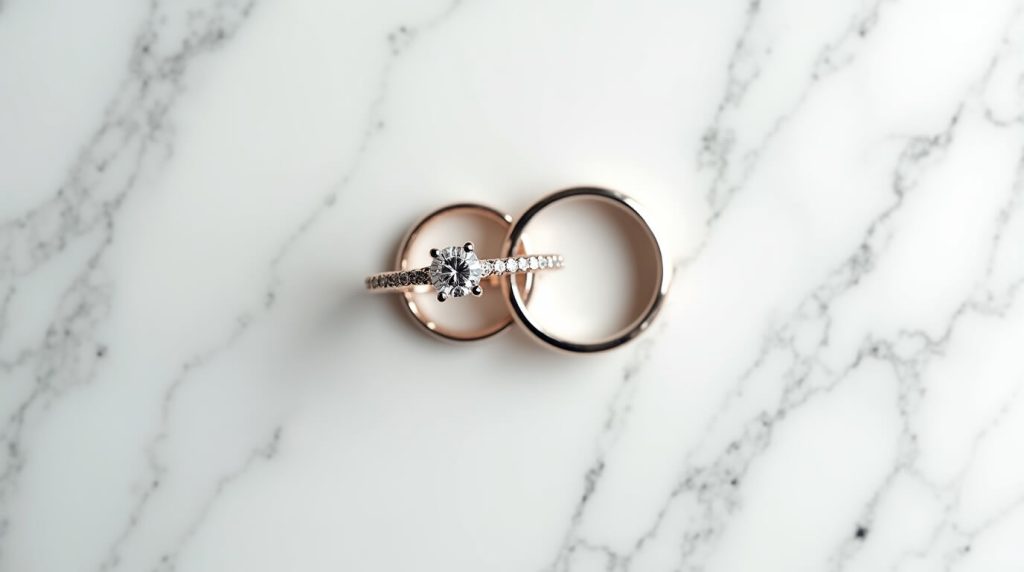
Engagement Ring Design
Engagement rings are built around a center stone and a setting meant to stand out. Prong settings lift the stone so light hits it from every angle. Halo settings surround the center stone with smaller accent diamonds to make it look bigger. Three-stone settings pair a larger center stone with two smaller ones, often read as past, present, and future.
Wedding Band Design
Wedding bands are the workhorses. They go through dishwashing, gym sessions, and manual work every single day, so durability tends to win out over drama. Plain bands, comfort-fit interiors, and lower profiles that won’t snag on gloves or clothing are all common. Diamond-set bands exist, but even those sit closer to the finger than an engagement ring ever does.
Shaped and Sculptural Bands Are Having a Moment
A lot of modern engagement rings don’t sit flush next to a straight band anymore, which is why curved, notched, and contour bands have become one of the bigger trends of 2026 — they’re built specifically to hug the shape of a given engagement ring so the two sit together without a gap.
Matching Sets vs. Buying Separately
A bridal set is designed as one unit from the start, so the two rings fit like puzzle pieces. Buying separately gives more flexibility, especially if your taste shifts between the proposal and the wedding — it just means paying closer attention to metal match and setting height so the two actually sit well side by side.
There’s a timing angle here too. If the wedding is close behind the proposal, a bridal set locks in the fit without a second round of shopping. If the engagement runs a year or two, styles change, and a person’s taste in metal or setting can genuinely shift in that window — waiting to pick the band closer to the big day leaves room for that, even if it takes more legwork to find something that pairs well later.
Choosing Rings for Your Actual Life, Not Just the Trend
Trend charts are fun, but a ring has to survive daily life, not just look good in a proposal photo. Someone who works with their hands — in a kitchen, a workshop, a hospital — needs a lower, more protective setting no matter what’s trending that year. A bezel setting or a flush-set stone holds up far better under that kind of wear than a tall prong setting, even if the prong version photographs better.
Skin tone and existing jewelry matter more than most first-time buyers expect. Warmer skin tones tend to read well against yellow and rose gold, while cooler tones often look sharper in white gold or platinum — though personal preference always overrides any rule here. If someone already wears a lot of gold day-to-day, a white metal engagement ring can end up feeling disconnected from everything else on their hands.
Comfort-fit bands — with a slightly rounded interior instead of a flat one — are worth the small upcharge for anyone planning to wear a band every day for decades. It cuts down on pinching and makes the ring easier to slide on and off, which matters far more after year one of marriage than it does on the wedding day itself.
If you want to check your size at home before visiting a jeweler, a ring sizing gauge set on Amazon covers all standard US sizes and is worth the few dollars it costs.
2026 Engagement Ring Trends
Yellow Gold Is the Fastest-Growing Metal
Yellow gold has more than doubled in popularity over the past five years and now sits at about 39% of engagement rings, while white metals — white gold and platinum combined — still lead at roughly 48%. Of that white metal share, white gold accounts for about 35% and platinum for around 13%, per The Knot’s 2026 study. Warmer tones are winning largely because they match the gold jewelry so many people already wear.
Oval and Emerald Cuts Are Closing In on Round
Round diamonds still lead at about 26%, but oval has nearly caught up at 25%. Emerald cuts keep gaining ground too, prized for their clean step-cut lines and a look that reads differently from a traditional brilliant cut.
Lab-Grown Diamonds Are Now the Default
Lab-grown diamonds are physically, chemically, and optically identical to mined ones, and they’re certified by the same major labs, including GIA and IGI. The real story is price — lab-grown stones typically run 50–70% cheaper than a mined diamond of the same carat, cut, and clarity. Lab-grown centers now make up 61% of all engagement ring purchases, a jump of roughly 239% since 2020.
Colored Gemstones Are Having a Real Moment
Sapphires are leading a shift away from the traditional clear diamond center, with rubies and emeralds picking up share close behind. A lot of it comes down to couples wanting something that feels distinct rather than a repeat of the solitaire everyone else is wearing.
Men’s Engagement Rings Are Surging
Men’s engagement ring sales climbed sharply this year, part of a broader shift toward both partners wearing a ring before the wedding instead of just one person. It’s still a smaller slice of the overall market, but the growth rate is one of the more notable movements in bridal jewelry right now.
Vintage and Sculptural Settings Are Back
Milgrain detailing, filigree shoulders, and Art Deco geometry are all having a comeback, usually paired with yellow gold rather than the white metal that dominated a decade ago. Sculptural settings — where the metal itself curves and flows around the stone — are gaining traction from couples who want something that reads as intentional rather than off the shelf.
| Trend | Ring Type | What It Looks Like |
|---|---|---|
| Yellow gold | Both rings | Warm, vintage tone replacing white gold |
| Oval cut | Engagement ring | Elongated shape that faces up larger than round |
| Emerald cut | Engagement ring | Clean step-cut, sleek and modern |
| Lab-grown diamond | Engagement ring | Identical to mined, 50–70% cheaper |
| Colored gemstone | Engagement ring | Sapphire, ruby, or emerald center |
| Shaped/curved band | Wedding band | Fits flush against the engagement ring |
| Chunky, wide band | Wedding band | Bolder profile replacing thin bands |
| Sculptural setting | Engagement ring | Fluid, shaped metal with intentional design |
| Stackable bands | Wedding band | Multiple thin bands added over time |
| Men’s engagement ring | Engagement ring | Both partners wearing a ring pre-wedding |
2026 Wedding Band Trends
Diamond-set and half-pavé bands give a bit of sparkle without the height of a full engagement ring setting — the plain back half sits flat against the palm, so comfort doesn’t take a hit.
Shaped bands are becoming close to standard for anyone pairing a band with a halo or cluster engagement ring, since straight bands increasingly struggle to sit flush against more sculptural settings.
Chunky, wider bands are replacing thin, delicate ones, especially in yellow gold — part of the same shift driving bolder gold jewelry outside of bridal too. A wider band also tends to hold up better under years of wear.
Stackable bands let some couples skip a single wedding band entirely in favor of two or three thinner ones, sometimes adding a new band at each anniversary instead of buying everything up front. It’s a flexible option for people who like the idea of the ring evolving alongside the marriage.
What Each Ring Actually Costs
The average spend on an engagement ring in the US was $4,600 in 2025, down from $5,200 the year before and $6,000 back in 2021 — a real three-year decline. It’s not that couples care less; lab-grown diamonds let people get more stone for less money, and more couples are prioritizing meaning over sheer carat size.
Wedding bands run a much wider range, typically $200–$2,000 depending on metal, width, and whether the band is diamond-set. A plain 14K gold band sits at the low end; a wider platinum band or one lined with diamonds climbs toward the top.
The gap between lab-grown and natural diamonds is large enough to change what people can actually afford — a lab-grown stone typically costs 50–70% less than a natural one of the same carat, cut, and clarity, which is a big reason average ring spend has kept dropping even as ring sizes trend larger.
Does the two-month salary rule still apply? Not really. The old two- or three-month salary guideline for engagement ring spending is considered outdated by most jewelers today. It started as a marketing idea, not a financial principle, and most current advice points toward budgeting around your actual finances rather than an arbitrary formula tied to income.
Do You Need Both Rings?
Plenty of couples skip one entirely. Some wear only the engagement ring for life and never add a band. Others go the other way and choose one simple ring at the ceremony with no separate engagement ring beforehand. There’s no rule requiring both — only tradition, and traditions are increasingly optional in how people plan a wedding.
Using the engagement ring as the wedding ring is a genuinely common choice. Rather than buying a second ring for the ceremony, a couple simply uses the engagement ring in the vow exchange too — a good fit for people who prefer one ring at all times, or who’d rather put that budget toward a honeymoon or a house down payment instead.
Matching wedding bands for both partners — same metal, similar width, sometimes an identical style — is another common way to visually connect the two rings, even when only one partner has an engagement ring.
Getting the Sizing Right
Sizing mistakes are one of the most common, and most avoidable, problems in ring buying. Fingers swell in heat and shrink in cold, so measuring on the wrong day throws off the number. If you’re buying a surprise engagement ring, quietly borrowing a ring the person already wears on that finger and tracing or measuring it is the most reliable method. A ring sizer set from Amazon makes it easy to check at home before visiting a jeweler, and it comes in handy again once you’re sizing the second ring to sit comfortably next to the first.
Caring for Both Rings
Both rings can generally be worn daily, but a few moments call for taking them off — heavy lifting, certain sports, working with chemicals or cleaning products, and swimming in chlorinated water, which can dull some metals over time. A jewelry cleaning kit safe for diamonds and gold paired with a soft brush is the simplest way to keep both rings sparkling between professional visits — a quick clean every couple of weeks stops everyday buildup from dulling the stone.
Whenever the rings come off, whether at the gym, the sink, or bedtime, they need a consistent spot rather than a random countertop or pocket. A ring dish gives each ring its own safe space — which matters more than people expect once there are two rings to keep track of instead of one.
Beyond home care, both rings benefit from a professional check every six to twelve months. A jeweler can catch loose prongs, thinning metal, or a shifted stone early, while it’s still cheap to fix.
Related Reading
- Wedding Gift Etiquette
- Groomsmen Gift Ideas Your Guys Will Brag About
- Wedding Ceremony vs Reception: The Real Difference
Frequently Asked Questions
What is the difference between an engagement ring and a wedding ring? An engagement ring is given at the proposal and symbolizes the promise to marry. A wedding ring is exchanged at the ceremony and symbolizes the completed vow. Engagement rings usually feature a statement center stone; wedding rings are simpler and built for daily wear.
Do you need both an engagement ring and a wedding ring? No. Wearing both is a common tradition, but plenty of couples choose only one ring, use the engagement ring as the wedding ring, or skip the engagement ring and wear only a band. It comes down to preference and budget.
Which finger does the engagement ring go on? In most Western traditions, the fourth finger of the left hand — the ring finger. The wedding ring goes on the same finger, worn closer to the hand once both are worn together.
Which ring goes on first, the engagement ring or the wedding band? The wedding band goes on first, since it’s meant to sit closest to the heart. During the ceremony, the engagement ring is usually moved to the right hand temporarily so the band can be placed on the bare left ring finger, then moved back on top afterward.
Can you use your engagement ring as your wedding ring? Yes — plenty of couples wear the engagement ring alone during the ceremony instead of buying a separate band. It’s a practical choice for people who prefer one ring, or who’d rather spend that budget elsewhere.
How much should you spend on an engagement ring in 2026? The US average was $4,600 in 2025, down from $5,200 the year before. There’s no fixed rule — most jewelers now recommend budgeting around your actual finances rather than an income-based formula.
What is a bridal set, and is it worth buying one? A bridal set is an engagement ring and wedding band designed together so they sit flush when stacked. It’s worth it if you want a guaranteed match in metal, style, and fit — buying separately gives more flexibility if your taste changes over time.
What are the most popular engagement ring styles in 2026? Round and oval diamonds are nearly tied for the top shape, with emerald cuts rising fast behind them. Yellow gold is the fastest-growing metal, though white metals still lead overall. Lab-grown diamonds and colored gemstones — especially sapphires — are also gaining significant ground.
Are lab-grown diamonds a good choice for an engagement ring? Yes. They’re physically, chemically, and optically identical to mined diamonds and certified by the same major labs, including GIA and IGI, while typically costing 50–70% less for the same carat, cut, and clarity.
What metal is best for a wedding band in 2026? Yellow gold is trending for its warmth and pairing with everyday jewelry, but platinum and white gold remain popular for durability. The right choice depends on lifestyle, skin tone, and whether the band needs to match an existing engagement ring.
How do you make an engagement ring and wedding band fit together? Choose a shaped or curved wedding band if the engagement ring has a high or elaborate setting like a halo or cluster. A flat band often leaves a visible gap next to those styles, while a contour band is built to hug the engagement ring’s shape.
Can men wear an engagement ring? Yes, and it’s a fast-growing trend, reflecting a broader shift toward both partners marking the engagement with a ring rather than just one person.
Common Ring-Buying Mistakes
| Mistake | Better Approach |
|---|---|
| Buying the engagement ring without thinking about the wedding band | Choose both together, or at least plan for how they’ll pair later |
| Getting the wrong ring size | Measure properly before buying, using a sizing guide |
| Assuming higher carat means better value | Cut and clarity affect appearance more than carat weight |
| Ignoring lab-grown diamonds | They’re identical in quality at 50–70% lower cost |
| Choosing a flat band for a high-set engagement ring | Use a shaped or curved band that sits flush |
| Buying based on trend alone | Choose something that will still feel personal in ten years |
| Skipping professional cleaning | Get both rings checked every 6–12 months |
| Mixing metals without intention | It can look great, but choose deliberately, not by accident |
Where This Tradition Actually Comes From

The idea of an engagement ring goes back much further than most people assume. The oldest known example is tied to Ancient Rome, where a plain iron band was sometimes given as a public symbol of a betrothal contract, more legal statement than romantic gesture. Diamonds didn’t enter the picture until 1477, when Archduke Maximilian of Austria gave Mary of Burgundy a diamond ring to mark their engagement — often cited as the first recorded diamond engagement ring in European history. For centuries after that, diamonds stayed a luxury reserved for nobility.
The shift toward diamonds as a mainstream expectation didn’t happen until the 20th century, driven heavily by a marketing campaign in the late 1930s built around the idea that “a diamond is forever.” That campaign is a big part of why diamonds became the default center stone, and why an entire industry norm — including the old two-month salary guideline — grew out of advertising rather than any older custom.
Wedding bands have a separate, arguably older, history. Circular rings without a beginning or end have symbolized eternity across multiple ancient cultures, including Egypt, where rings woven from reeds were reportedly exchanged as early symbols of union. The unbroken circle is still the core symbolic idea behind a wedding band today, even as materials and styles have changed completely.
How Ring Customs Differ Around the World
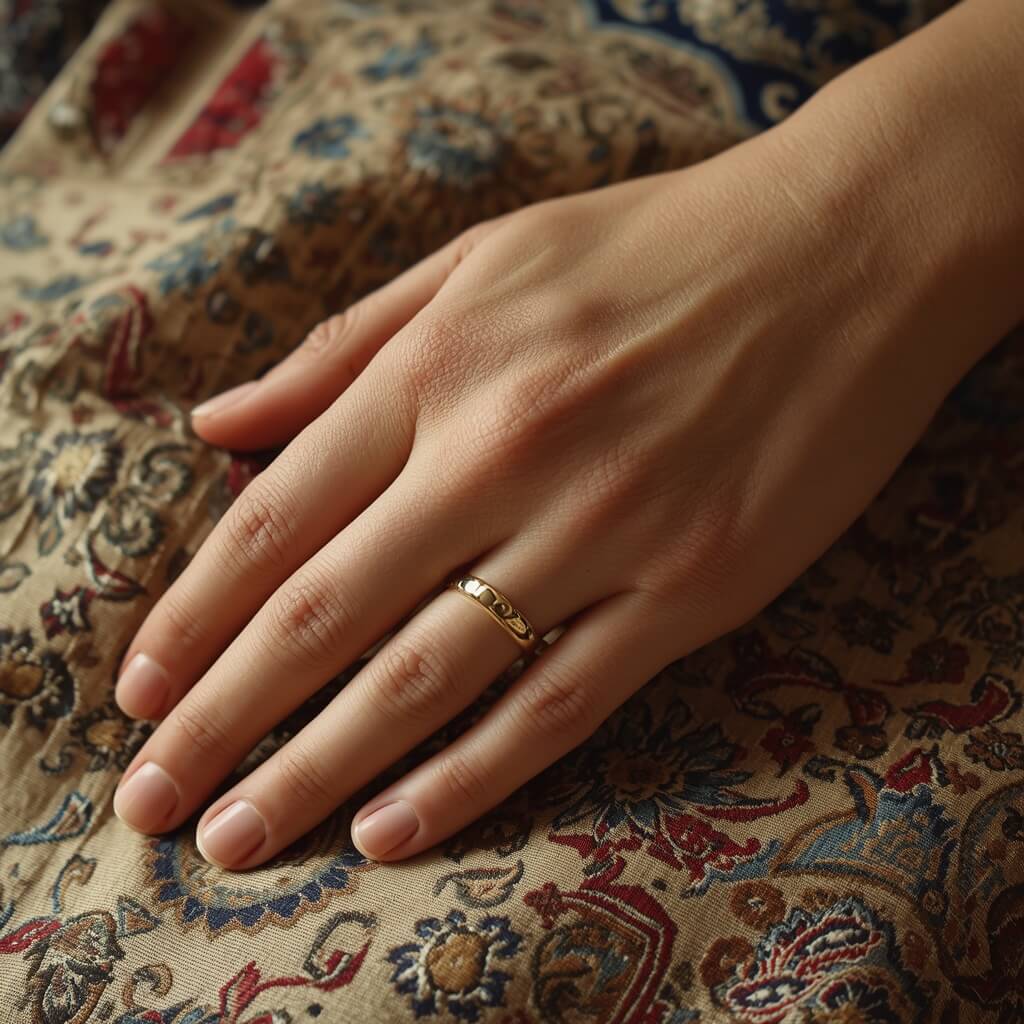
Not every culture follows the “engagement ring plus band on the left hand” model described above, and it’s worth knowing the variations exist even if this guide focuses on the more common US and UK convention.
In several European countries, including Germany, Russia, and parts of Scandinavia, both the engagement ring and the wedding band are traditionally worn on the right hand instead of the left. In some of those same countries, couples wear a single plain band during the engagement and simply move it to the other hand after the wedding, rather than adding a second ring.
In parts of South Asia, engagement ceremonies often involve rings for both partners exchanged well before the wedding itself, sometimes as part of a separate formal event distinct from both the proposal and the wedding day. Bridal jewelry traditions in these cultures frequently extend far beyond a single ring, incorporating other symbolic pieces worn throughout the wedding period.
In Orthodox Jewish weddings, the ring given during the ceremony is traditionally a plain, unbroken band with no stones or engravings, since the unbroken metal is meant to represent an unbroken marriage. An engagement ring, separate from that ceremonial band, may still be given and worn beforehand.
None of these variations make one tradition more “correct” than another. They’re worth knowing mainly because couples blending families or cultural backgrounds sometimes have to actively decide which convention to follow, or whether to build a version that borrows from both.
Insuring an Engagement Ring or Wedding Band
Given how much a ring can cost, insurance is worth a real look rather than an afterthought — the same way wedding insurance covers the day itself, a ring needs its own separate policy. Most homeowners’ or renters’ insurance policies only cover a limited amount of jewelry loss by default, often just a few thousand dollars total, which can fall well short of what a single engagement ring is worth.
A standalone jewelry insurance policy, or a scheduled rider added to an existing homeowners’ or renters’ policy, typically covers loss, theft, and accidental damage, including a stone falling out of its setting. Premiums are usually a small percentage of the ring’s appraised value per year, and most insurers require a recent appraisal or the original purchase receipt before coverage starts.
It’s worth getting a professional appraisal soon after buying either ring, both for insurance purposes and to have a documented record of the stone’s specifications in case a claim is ever needed. Keeping a copy of that appraisal, along with photos of the ring, somewhere other than a jewelry box is a small step that saves a lot of stress if a ring is ever lost or stolen.
Anniversary Bands and Eternity Rings
Some couples add a third ring later in the marriage, most commonly at a milestone anniversary. An eternity band, set with stones running partway or all the way around the ring, is one of the more common choices, sometimes marking five, ten, or twenty-five years together. Others choose a plain band in a different metal to sit alongside the original set, or simply add another thin stacking band in the same style as the wedding ring.
There’s no fixed rule for when or whether to do this. It’s less a tradition and more a personal ritual some couples build for themselves, a way of adding to the ring stack the same way the relationship itself keeps adding chapters.
A Quick Checklist Before You Buy Either Ring
A few questions are worth answering before money changes hands, whether it’s the engagement ring or the band that follows it.
For the engagement ring:
- Has the ring size actually been confirmed, or is it a guess based on a similar ring?
- Does the setting fit the wearer’s daily routine — hands-on work, gym, kids — or is it a style that needs to come off often?
- Is the budget based on actual finances, or on an outdated income formula?
- Has a lab-grown option been compared against a natural stone at the same specs, even just to see the price gap?
- Is there a plan for how a wedding band will eventually sit next to this setting?
For the wedding band:
- Does it need a curved or contour profile to sit flush against the engagement ring?
- Is the metal a match, or an intentional mix?
- Is the width and comfort-fit interior right for someone who’ll wear it every day for decades?
- Has the ring been appraised and photographed for insurance purposes?
- Is there a plan in place for cleaning and a professional check-up schedule?
None of these questions have a single right answer. They’re just the ones that tend to surface later, after the purchase, when it’s harder to fix.
The Bottom Line
The engagement ring marks the promise. The wedding ring marks the vow that follows it. Whether you end up wearing one ring, two, or a full bridal stack, the right setup is whichever one actually fits your relationship, your budget, and how you want your hands to look every single day for the rest of your life.
There’s no committee grading how closely a couple follows tradition. Some people want every piece of the classic setup — the proposal, the separate band, the ceremony order, the eventual eternity ring at year ten. Others want none of it and are happiest with a single simple band picked out together on a Tuesday afternoon. Both approaches are just as valid, and neither one says anything about how serious the relationship is. The rings are a detail, not the point.
A note on links: every internal link above has been verified against live pages on stylesora.com, and the Amazon links use your site’s affiliate tag (stylesora-20) and point to search results rather than single product pages, since individual listings get discontinued or re-priced over time while a search query stays reliable indefinitely.

About The Author


Leave a Reply